Photo essay by Kalyani Majumdar | Published in Domus India | Nov, 2013
Ceaseless monsoon rain and scorching hot and humid weather cannot dampen the spirit of the kumors/kumars (potters) of Kumartuli as they continue shaping clay to create idols for more than two centuries.

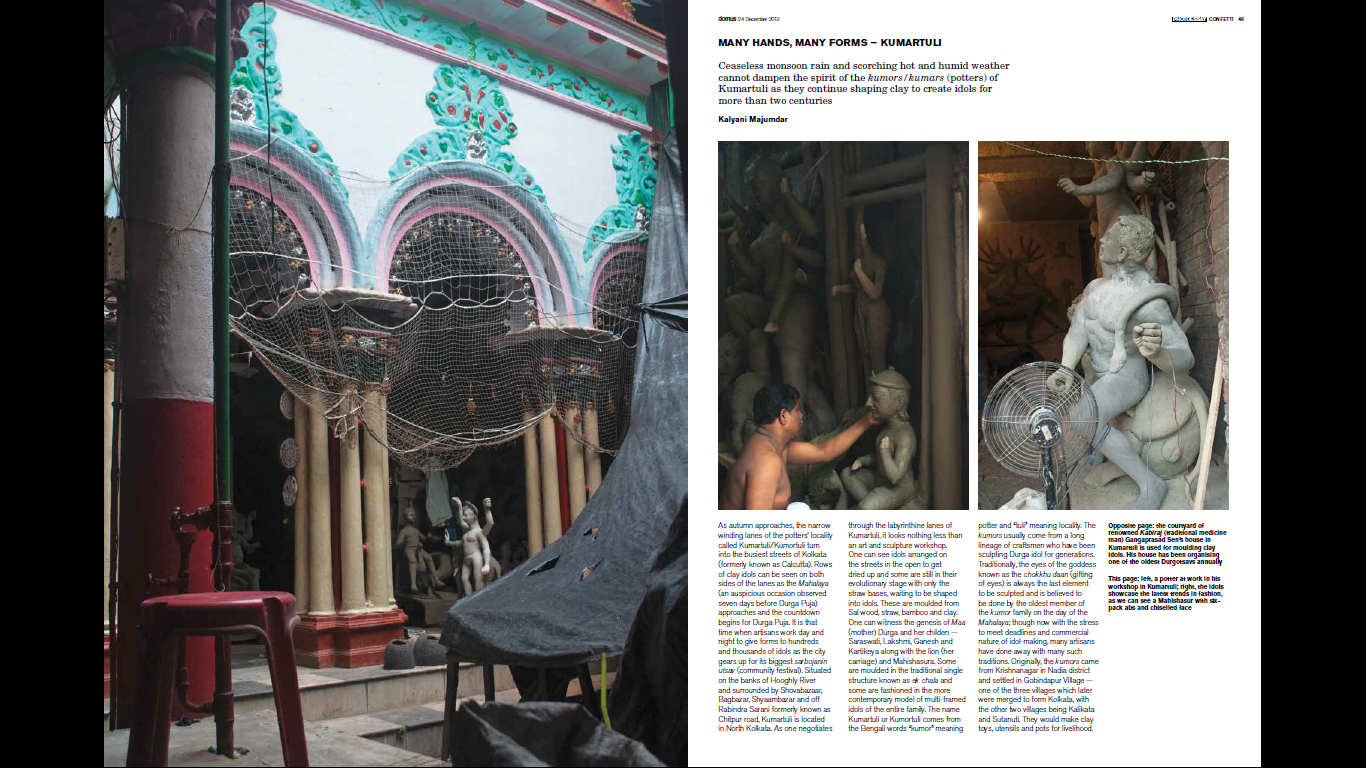
renowned Kabiraj (traditional medicine
man) Gangaprasad Sen’s house in
Kumartuli is used for moulding clay
idols. His house has been organising
one of the oldest Durgotsavs annually
As autumn approaches, the narrow winding lanes of the potters’ locality called Kumartuli/Kumortuli turn into the busiest streets of Kolkata (formerly known as Calcutta). Rows of clay idols can be seen on both sides of the lanes as the Mahalaya (an auspicious occasion observed seven days before Durga Puja) approaches and the countdown begins for Durga Puja. It is that time when artisans work day and night to give forms to hundreds and thousands of idols as the city gears up for its biggest sarbojaninm utsav (community festival). Situated on the banks of Hooghly River and surrounded by Shovabazaar, Bagbazar, Shyaambazar and off Rabindra Sarani formerly known as Chitpur road, Kumartuli is located in North Kolkata. As one negotiates through the labyrinthine lanes of Kumartuli, it looks nothing less than an art and sculpture workshop.
One can see idols arranged on the streets in the open to get dried up and some are still in their evolutionary stage with only the straw bases, waiting to be shaped into idols. These are moulded from Sal wood, straw, bamboo and clay. One can witness the genesis of Maa (mother) Durga and her childen —Saraswati, Lakshmi, Ganesh and Kartikeya along with the lion (her carriage) and Mahishasura. Some are moulded in the traditional single structure known as ek chala and some are fashioned in the more contemporary model of multi-framed idols of the entire family. The name Kumartuli or Kumortuli comes from the Bengali words “kumor” meaning potter and “tuli” meaning locality. The kumors usually come from a long lineage of craftsmen who have been sculpting Durga idol for generations.

Traditionally, the eyes of the goddess known as the chokkhu daan (gifting of eyes) is always the last element to be sculpted and is believed to be done by the oldest member of the kumor family on the day of the Mahalaya; though now with the stress to meet deadlines and commercial nature of idol-making, many artisans have done away with many such traditions. Originally, the kumors came from Krishnanagar in Nadia district and settled in Gobindapur Village — one of the three villages which later were merged to form Kolkata, with the other two villages being Kalikata and Sutanuti. They would make clay toys, utensils and pots for livelihood decided to build Fort William at Gobindapur village, the inhabitants of that area migrated to Sutanati and it is believed that under the instruction of the Company, John Holwell was given orders to designate areas according to the nature of profession of the inhabitants; Kumartuli was one such area that was designated as a residential area for all the potters and craftsmen. In those days these kumors were invited by the old and nouveau rich Indian households —mostly the Zamindars who were also the first few patrons and organised Durga puja in their houses — to make clay images of Durga and other idols. These houses had thakurdalans/thakurbaris (separate building used for annual festivals).
The thakurdalans were high-ceilinged flat-roofed buildings. Apart from the autumn festival, the artisans were called round the year to sculpt ornamental elements such as the fairies, foliages, other patterns and inlay works on brackets and columns of the houses as many modelled after the Western influence, thus giving rise to a fusion of Indo-Bengal form of ornamental art for residential built forms. With time, as Durgotsav shifted out of the thakurdalans and became a community festival, the common people became the new patrons of Kumartuli. Also, every year one can easily predict the current trends in vogue by looking at the idols; this time it was Mahishasurs’ six-pack abs and chiselled faces that were in popular demand — straight out of a Greek mythology.

workshop in Kumartuli

showcase the latest trends in fashion,
as we can see a Mahishasur with sixpack
abs and chiselled face
From its humble beginning to post- Independence, Kumartuli has risen to become the exclusive exporter of idols of the goddess to the Bengalis settled in different parts of the world. Clearly, Kumartuli is more than just an urban space in Kolkata that produces clay idols for Durga Puja. It has been an active participant for more than two centuries in maintaining a continuity of cultural tradition and craftsmanship, and has witnessed the trajectory of the changing socioeconomic and political climate of the city — the transition from pre to Post- Independent India and from Calcutta to Kolkata.

All photographs and text copyright with Kalyani Majumdar