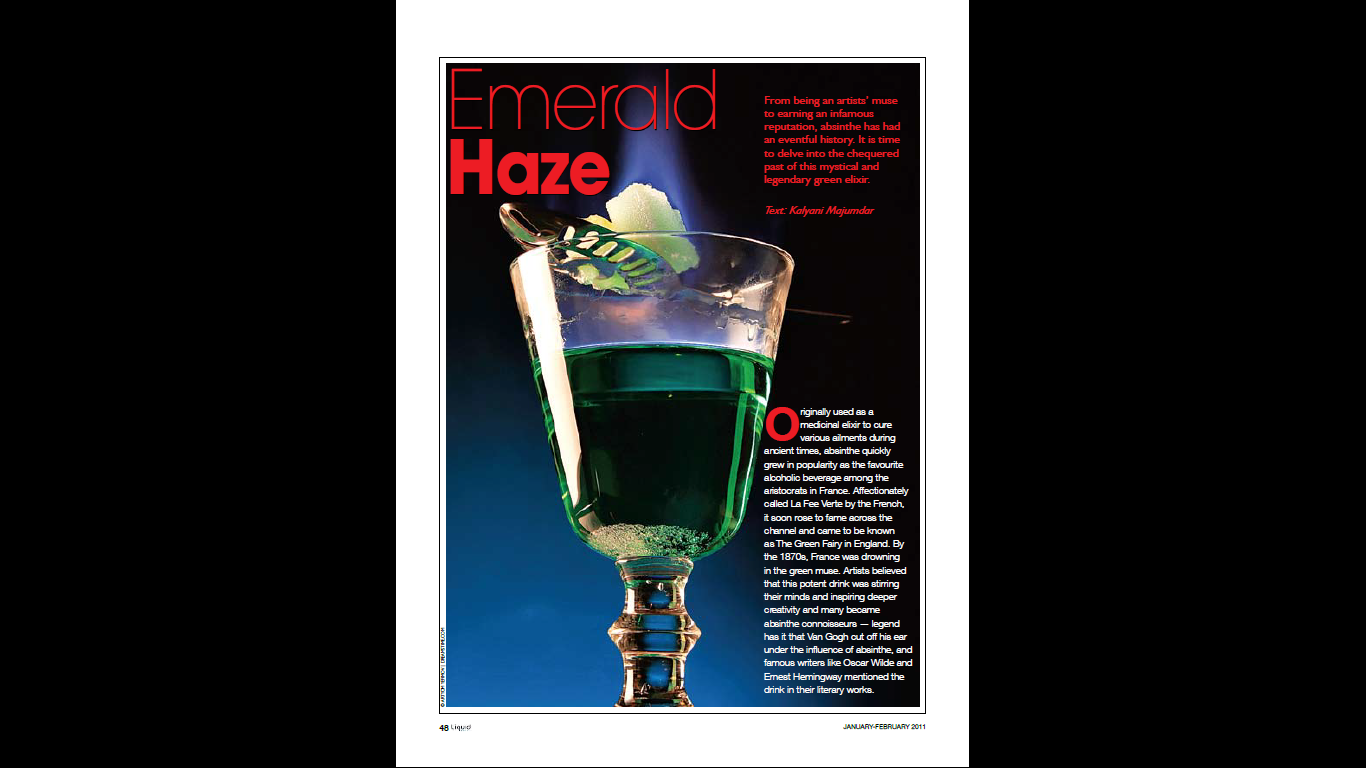
From being an artists’ muse to earning an infamous reputation, absinthe has had an eventful history. It is time to delve into the chequered past of this mystical and legendary green elixir.
Text by Kalyani Majumdar | Published in Liquid magazine | 2011

Originally used as a medicinal elixir to cure various ailments during ancient times, absinthe quickly grew in popularity as the favourite alcoholic beverage among the aristocrats in France. Affectionately called La Fee Verte by the French, it soon rose to fame across the channel and came to be known as The Green Fairy in England. By the 1870s, France was drowning in the green muse. Artists believed that this potent drink was stirring their minds and inspiring deeper creativity and many became absinthe connoisseurs — legend has it that Van Gogh cut off his ear under the influence of absinthe, and famous writers like Oscar Wilde and Ernest Hemingway mentioned the drink in their literary works.

With an alcoholic proof ranging from 45% to 75% and the presence of wormwood in the spirit, which is derived from the essence thujone, absinthe soon gained notoriety among drinkers. The ‘Fairy’ was associated with transformation, a freer state of mind and artistic expressions. In 1893, Edgar Degas painted L’Absinthe, portraying a French actress drinking absinthe in a Parisian café. The artwork was too nouvelle for England’s straightlaced Victorian taste and was, as a consequence, removed from the Christie’s auction. The tide began to turn against absinthe, and it was suddenly being associated with society’s evils.
Interestingly, it is believed that the 1870s blight in France led to a wine shortage and resulted in the popularity of absinthe, and by the end of the 19th century, France was gulping down more than two million litres of the spirit. This popularity, however, ended in the 20th century when the Belgians, the Swiss and then the French banned the alcohol. Absinthe was a great leveller in society, as it was popular across all classes, but the notorious legends attached to it, coupled with the global temperance movement — a social movement urging the reduced use of alcoholic beverages — instigated the ban.
Adding fuel to the fire was the bad press that was generated when a Monsieur Lanfray from Switzerland killed his entire family while under the influence of absinthe. However, the fact that he had also consumed several litres of wine and brandy was overlooked. This was the last blow to the already bruised reputation of the green fairy. After enduring an almost 100-year ban, this elusive green elixir is back on bar tables all over the world. Christophe Clement, a celebrated freelance bartender in France, comments, “It is not an easy drink to mix, and only a few chosen ones have the passion and the guts to make good and innovative cocktails with absinthe.” When asked about the popularity of absinthe among regular drinkers, he said, “I think people are not scared to try absinthe anymore as it is very safe, and every bar should have a bottle of absinthe on its shelves because it is one of the legendary alcoholic beverages.”

Making an absinthe drink is considered an art. Absinthe is elegantly served with a sugar cube sitting atop a slotted silver spoon. Water is then slowly poured onto the sugar cube, which slides through the spoon and mixes into the absinthe, creating a misty jade drink – a magical ritual indeed! Traversing from the bohemian bars of Paris, absinthe has made its way to India and is gaining popularity here. The familiar flavours of aniseeds — often chewed as a palate cleanser between meals — also find adaptability with the taste profiles in the country. “Absinthe has just been introduced in India, hence there are few takers. But, the good news is that, we have tried two recipes, Long Island Iced Tea with absinthe and Absinthe Bull, and both have received great response,” said Leorith Ashtamkar, a freelance bartender in India.
The Green Fairy Absinthe Company (TGFAC) imports absinthe in India from the Pontarlier district of France – the holy grail of absinthe. Initially, TGFAC was importing Green Fairy absinthe by Liqueurs de France (LDF), but now it has been replaced by Enigma, also a product by LDF. Both are distilled absinthes, prepared in the traditional way with the herbs that give absinthe its unique flavour. This year, TGFAC has also introduced another product in the Indian market called Nemesinthe. It is a developed quality oil-mix priced at R3,300. It is much lighter on the wallet compared to the classic distilled high quality Enigma, which is priced at Rs 5,200. Farrokh Maneckshaw of TGFAC says, “We think that this will be a popular and affordable drink for the club-goers, and looking at the response in Goa, I can clearly say that absinthe is already a very popular drink among young Indians.” So, next time when you go out drinking, order a glass of absinthe and experience the legend in every sip of this enchanting green spirit. Sante!


