Category: Published Works

  • Elvis Presley birth anniversary: Rocking tribute to the King

    Published in Free Press Journal; Date: 07.01.2018

    As a teenager, Elvis Presley used to hang around at the iconic Beale Street, the hub of the music scene in Memphis. Little did he know then that in few years he would become not only Rock ‘n’ Roll’s biggest star, but also a cultural force of the 50s. Kalyani Majumdar pays tribute to the King.
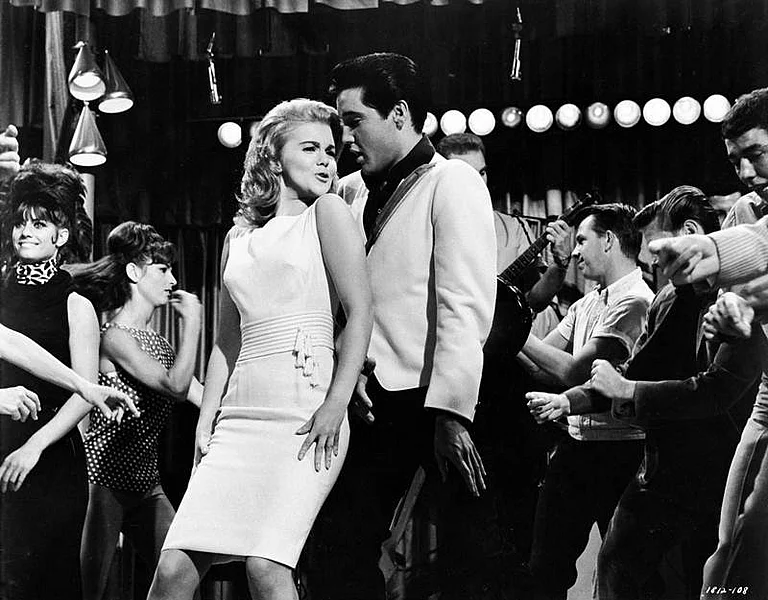
    Even today Elvis Presley’s soulful voice evoke the same magic that made him a star when the audience heard him on air for the first time. His music, dance moves and persona was something of a shock for the conservative 50’s American society, and it is safe to say that he did pave the way for the rock ‘n’ roll stars of the 60s. “Before Elvis there was nothing,” said John Lennon. That is just how big the Elvis phenomenon was.

    A humble beginning

    Elvis Presley was born on January 8, 1935 in Tupelo, Mississippi to Gladys and Vernon Presley. He had a twin brother who was still born. His parents did several day jobs to get by. On his eleventh birthday he wanted a bicycle and apparently his second choice was a rifle. The bicycle was too expensive and the gun obviously was a bad idea, so his mother got him a guitar instead. In 1948, the family moved to Memphis, and it was here that young Presley got his music influences from. During his teenage years he spent his free time at the black part of Memphis. Beale Street was known for its Blues and Jazz clubs. He would regularly go there to listen to B.B King and other popular black artists of the time. He finished his schooling from Humes High in 1953. He took up a job as a truck driver, but he never quit singing.

    Meteoric rise of Elvis Presley to stardom
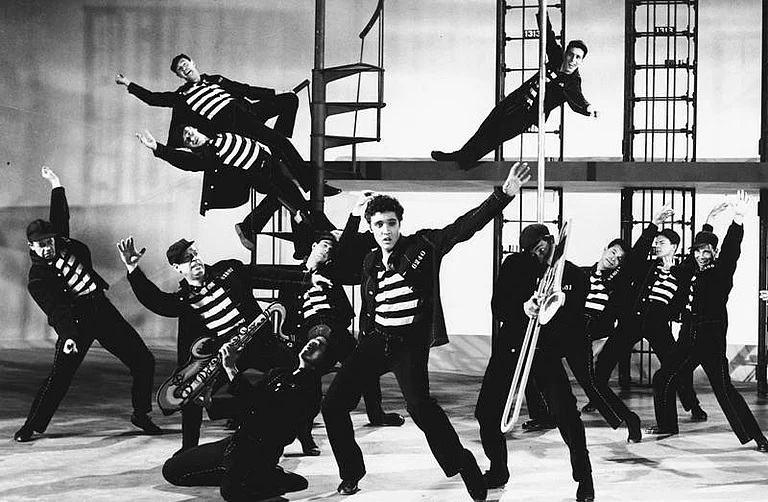
    Elvis Presley performing Jailhouse Rock

    In 1954, DJ Dewey Philips played Presley’s version of That’s All Right on his radio show for the first time. It was recorded at the legendary Sun Studio situated at downtown Memphis. After the song was aired the phones won’t stop ringing. The listeners were ecstatic and numerous requests poured in to play the song again. This was only the beginning of Presley’s popularity. In 1956, Presley became a national star. His songs, Heartbreak Hotel, Don’t Be Cruel, Hound Dog, Love Me Tender were all chart toppers. He was unstoppable.  He made his TV appearance with the Dorsey Brothers’ Stage Show and then on The Ed Sullivan Show. After conquering the radio and television, it was his turn to light up the big screen. Love Me Tender released in 1956 did not do that well. However, Jailhouse Rock in 1957 made an impact on the big screen. It had a strong storyline, fantastic songs along with Presley’s signature dance moves. One could even say that the title track of this movie was perhaps the first music video ever made.

    Elvis, the cultural movement

    It was the 1950s when Elvis Presley arrived in the music scene. The American society was conservative then. The demarcation between Black and White people was very stark. Cultural biases were very evident. However, Presley managed to blur that colour line between what was considered Black music and White music. No one before Presley had ever blended African-American R & B with country blues and gospel music, let alone a white Southerner. Unknowingly, he had broken the racial barrier through his music. His dance moves were considered provocative and he exuded sex appeal. He was not conventional and his music did not conform to the norms of that time. He was shaking and stirring the American society. His distinct edgy hairstyle and clothing were becoming a fashion statement for the teenagers. His fame was a clear sign that the youth wanted a change and he was epitome of that change.
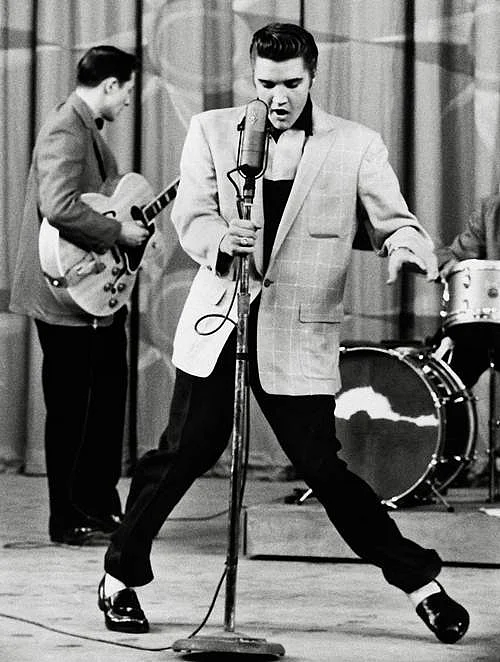
    His dance moves were considered provocative and he exuded sex appeal.

    The King had arrived

    People would either like or dislike him, but no one could ignore Elvis Presley. Initially, the popular family television programme, The Ed Sullivan Show had announced that he would not feature Elvis Presley on his show because his music and dance was considered vulgar and was posing a threat to the American society, especially the youth. But seeing the viewership ratings for other shows featuring Presley, Ed Sullivan could not ignore him anymore. However, Presley was shown performing waist up and even then the viewership was phenomenal for that particular episode. Never before had the world seen such hysteria at a music concert. His good looks coupled with his voice made women go frenzy at the sight of him. Teenagers were tattooing his name. America didn’t know what to make of it. Elvis Presley was a phenomenon and was creating the same magic internationally too. Presley was nominated 14 times for Grammy and had won the Grammy three times and was also the recipient of the Grammy Lifetime Achievement Award. He is believed to have sold more than one billion records worldwide, and his American sales alone had earned him gold and platinum awards.
    The U.S Army and Personal Life

    He was at the pinnacle of his music career when in 1958 he had to join the U.S Army. He served his country till 1960. It was also at that time that he met his future wife Priscilla Beaulieu. Post his stint in the army, Presley continued to give hits such as Are You Lonesome Tonight in 1960 and Can’t Help Falling In Love in 1961 to name a few. He married Priscilla in 1967, however the marriage didn’t last long and they divorced in 1972.

    If I can dream

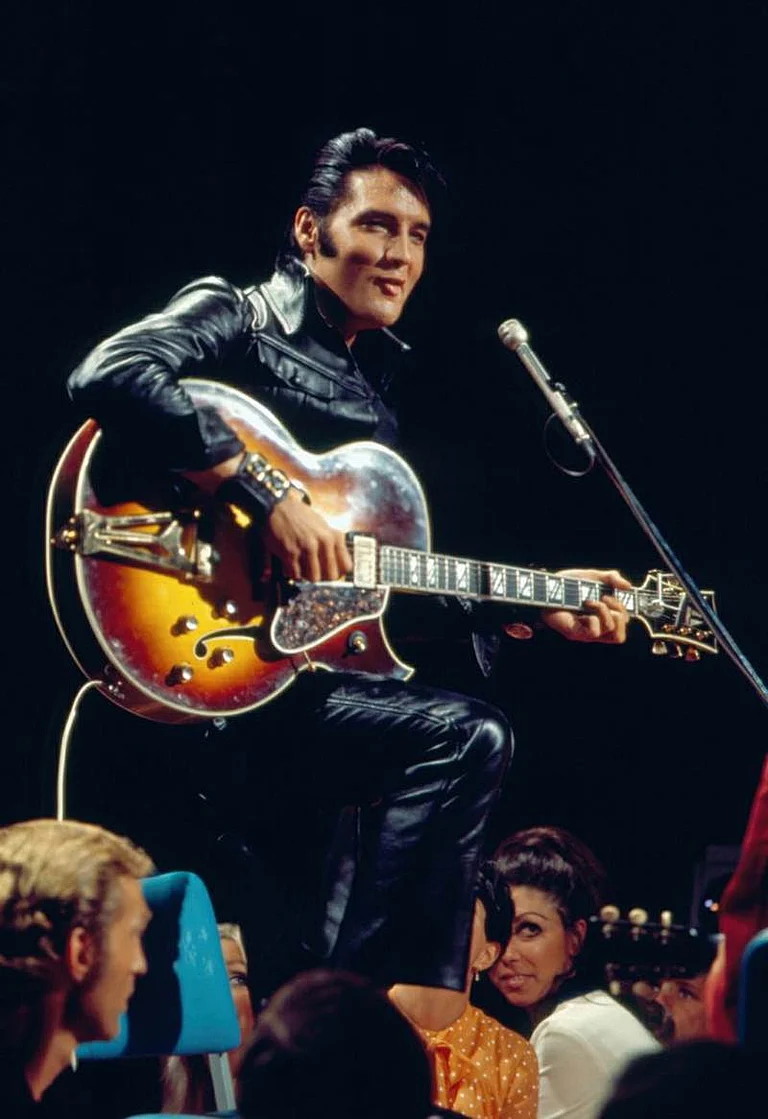
    In 1968, Presley came out with his comeback special with a soul searching and socially conscious song, If I Can Dream. Till this day, it is one of the most powerful and emotional performances by him. It was recorded two months after Martin Luther King Junior’s assassination and it made the lyrics and the song even more relevant for the time.

    Graceland

    In 1957, Presley bought the stately mansion, Graceland. It is now Elvis Presley museum and is one of the most visited houses in the United States. Millions of fans from all over the world visit his house which is now a pilgrimage of sorts. Elvis Presley was known for his kindness, humility and generosity. He would often give money to strangers and was always dedicated to his fans.

    On August 16, 1977 he was found dead by his then girlfriend, Ginger Alden in his bathroom in Graceland, reportedly of a heart attack. He was only 42.

    Play it again, Elvis

    While we may or may not see the ghost of Elvis walking in Memphis, he surely comes alive the moment his deep and heartfelt voice floats from the speakers and we can’t help falling in love with him all over again.

  • Celebrating Oscar Wilde, the iconic writer

    Published in Free Press Journal; Date: 15.10.2017

    Known for his wit and flamboyant style, Oscar Wilde needs no introduction in the literary world. He was certainly a non-conformist, trapped in the narrow-mindedness of the late Victorian English Society. KALYANI MAJUMDAR celebrates the iconic writer.

    Oscar Wilde once wrote, “The world is yours for a season.” Startlingly, the quote came to reflect the trajectory of his own life. He was basking in the glory of his literary works when his life quite dramatically took an unfortunate turn that finally led to his eventual downfall. And, what a great tragedy it was for the world to have lost a brilliant playwright, novelist, essayist and poet. Was he far too bold for the 19th century? Perhaps, he was.

    The early life

    Born in Dublin, Ireland on October 16, 1854, Oscar Wilde was a bright boy with avid interest in Greek and Roman studies. His father Sir William Wilde was a renowned doctor and his mother Jane Wilde was a poet, who wrote under her pen name Speranza. Her liberal ideas had a strong influence on Wilde’s early life. While studying at Portora Royal School, he was awarded a scholarship to attend Trinity College in Dublin. Afterwards, he went on to complete his graduation from Oxford University. At Oxford, he wrote a prize winning poetry titled, Raveena, in 1878.

    A fashion icon

    When Wilde went to New York on a lecture tour, he drew a lot of attention due to his stylish attire and flowing wavy hair that was unlike the fashion that was prevalent then. Not surprisingly, he strongly supported the Dress Reform Movement of the 19th century.

    Feminist, family and children’s stories

    In 1884, he married Constance Lloyd, a wealthy Englishwoman and had two sons Cyril and Vyvyan. He took up a job as the Editor of a magazine on women’s fashion, called The Woman’s World. Wilde expanded the range of content in the magazine by focusing on not just what women should wear but also of what they think and feel. It gave a platform for women to voice their opinion. Simultaneously, Wilde published The Happy Prince and Other Tales, a collection of stories for children in 1888. The popularity of the stories garnered him significant attention and praise.

    Aestheticism and Dorian Grey

    A scene from the movie Picture of Dorian Gray, 1945

    From his Oxford days, Wilde was deeply influenced by Aestheticism. The movement emphasised on the aesthetic value of a creative work that should be independent of vices and virtues. Oscar Wilde was devoted to this idea and his works reflected that fully. In 1891, he published his first and only novel, The Picture of Dorian Grey. It was a story of an attractive young man, Dorian Grey, who traded his soul with his portrait, so that he would remain young while his painting would age. Alas, the novel did not go down well with the Victorian English society, as they felt it had a sheer absence of morality and the lead protagonist lacked virtue. However, Wilde stayed committed to his devotion to aestheticism. While defending his work, he said that right and wrong are just material for the artist to work with. Of course, the book is now revered as one of the finest classics from 19th century and has been adapted into numerous movies, plays and television series.

    The brilliant satirical playwright

    Wilde’s natural wit won the hearts of the masses with his plays. In 1892, he penned his first play, Lady Windermere’s Fan. It received critical acclaim. It was followed by A Woman of No Importance in 1893, again a huge success. Then in 1895 he wrote two plays, An Ideal Husband and The Importance of Being Earnest. The latter went on to become his most popular play. Wilde was the toast of the town. His name was resonating on every socialite’s living room.

    The infamous case

    During the time when Wilde was riding high on his literary success, he got involved with a young man, Lord Alfred Douglas. In his private life Wilde was homosexual and it was an open secret. But in Victorian England being homosexual was a crime. When Douglas’ father, Marquess of Queensberry, got a whiff of the affair, he left a calling card for Oscar Wilde addressing him as a posing sodomite. It was evident that Queensberry wanted to ruin Wilde’s reputation and popularity. When Wilde sued Queensberry for libel, a lengthy trial began and evidences were presented by Queensberry of Wilde’s homosexuality. Although, the credibility of the evidences was rather questionable in nature, Wilde was arrested on charges of ‘gross indecency’. He was convicted for two years of hard labour in prison. Overnight his playbills were removed from every theatre.  Wilde became a pariah. His name was not to be uttered in public.

    The last days

    In 1897 when he was released from prison he was impoverished and alone. He left for Paris. He wrote very little in the last years of his life. In 1898 he wrote The Ballad of Reading Gaol describing his experience at the prison. Wilde died in a cheap hotel in Paris in1900 due to cerebral meningitis at the age of 46. He rests at the Père Lachaise Cemetery in Paris and it is one of the most visited graves.

    Questions left unanswered

    In the strange turn of events in his life, there are many ambiguities in the charges that were made against him. Apparently, some documents from the trial went missing. Throughout the trial, few of Wilde’s close friends felt that he was trying to protect Douglas and did not defend himself adequately for some of the outrageous accusations that were brought against him. Clearly, Wilde paid a steep price for his affection for Douglas.

    Literary legend

    Although, Oscar Wilde’s last days were spent as an outcast, he remains immortalised through his brilliant works that he has left behind. His quotes are timeless, and even after more than a century has passed, his writing does not fail to find an eager audience.

  • 2020 World of War: Review

    Published in Free Press Journal; Date: 12.11.2017; Reviewed by Kalyani Majumdar

    Are we heading towards the third world war? If yes, then will it be in the year 2020? Paul Cornish and Kingsley Donaldson in their book, 2020 World Of War, intricately poses all the different scenarios in the current world order that might eventually lead to the world going to war.

    The book offers a comprehensive account of the changing nature of war in today’s world. As we all understand that linear warfare is a thing of the past. It has become far more complex, from cyber security to rapid up gradation and development in weapon technology. The impact of automation technologies on battlefield, such as the unmanned drones are changing the nature of conflicts. Economics and geopolitics have their intricate roles in initiating a war-like situation almost in any part of the world. It helps that both, Cornish and Donaldson come from army backgrounds.

    Paul Cornish was educated at the University of St Andrews and the London School of Economics. He then served in the British Army (Royal Tank Regiment) and the Foreign and Commonwealth Office. Kingsley Donaldson is a retired Army officer. He has served on operations in a number of European and Middle Eastern countries in various roles that span from countering weapons of mass destruction through to negotiating with armed groups in Iraq.

    2020 World Of War, makes for a compelling read as the authors bring their personal experiences and inside knowledge to every plot that they talk about. Does the book give an impression of a grim future? Yes, it does to some extent, as Cornish and Donaldson says, “This book is knowingly and deliberately an exercise in worst-case analysis and as such it is, arguably, precisely how security and policy-makers and analysts should be spending much of their time in a chaotic and often confusing world.”

    Will there be a cyber-attack on the pentagon that might crash the greatest military power in the world? Will there be a standoff between India and Pakistan over Afghanistan? What will happen in Putin’s Russia? And what would be the repercussion of Trump’s policy of isolating US gradually from the rest of the world? Not to forget the pressing issues pertaining to mass migration in Europe due to ISIS. These and many more questions would rise in the reader’s mind while reading 2020 World Of War.

    The book says, “Across Europe, established political systems are experiencing a crisis in public confidence, resulting in the rise of anti-establishment figures, parties and movements, as evinced in extreme right-wing movements gaining popularity, in the Scottish referendum and in the UK ‘Brexit’ referendum in June 2016, and the US Presidential election later the same year.” The book provides a good understanding on why the world is struggling to contain conflicts and offers expert analysis and solutions to combat these situations.

    The book is thought-provoking and insightful. However, some of the scenarios provided in the book seems a bit far-fetched, although time will only tell if everything that 2020 World Of War says is plausible or not. We can only hope for the best, but plan for the worst.  It is a must read for those who are eager to understand how our world would look like in the near future.

    Book: 2020 World of War

    Authors: Paul Cornish and Kingsley Donaldson

    Publisher: Hodder & Stoughton/ Hachette

    Pages: 320; Price: Rs 699

  • Strangers No More: New Narratives from India’s Northeast by Sanjoy Hazarika- Review

    Published in Free Press Journal; Date: 25.02.2018; Reviewed by Kalyani Majumdar

    With three states in the Northeast of India — Meghalaya, Nagaland and Tripura — busy with the assembly elections this February, all of a sudden there is a surge in the amount of coverage the Northeastern states are getting by news channels that are otherwise largely ignored. Unfortunately, the ignorance regarding the Northeast that comprises of eight states, by the people of the rest of India is equally pitiful.

    Thus, the book Strangers No More: New Narratives from India’s Northeast by Sanjoy Hazarika, is a must-read for those that would like to understand the ground realities of the Northeastern states, from socio-economic and political perspectives. It has been twenty years that Hazarika wrote his first book on Northeast, Strangers of the Mist. It was perhaps the first comprehensive book on India’s Northeast and even till this day, his book is referred by researchers, journalists and students pertaining to information on Northeast India. And, now with Strangers No More, Hazarika continues his journey in the Northeast with stories and interviews that provide an in-depth overview of where the Northeast stands, today.

    Hazarika uses his exemplary narrative style to tell the stories that otherwise might go untold.  The author not only highlights the issues that are being currently faced by the people of the Northeastern states, but also, provides suggestions and effective solutions to these issues. Hence, this book can be treated as a handbook by political leaders, non-governmental organisations, activists and specialists that are working at grassroots level, to get a holistic view of the Northeastern states of India, and in turn, help them to focus on the betterment of the people in these states.

    The author has suggestions in the book pertaining to gargantuan sized projects that are planned for Northeastern states, that could also apply to other states in India, “It’s better to improve what we have instead of launching ambitious projects that would lead to endless corruption, delays, frustration, growing anger and confrontation and massive destruction of irreplaceable species. We have no right to do that.”

    While discussing Arunachal Pradesh, the author says, “Arunachal’s political and social stability as well as those of ‘national interest’ mesh and merge at every point in this distant border state.” This aspect makes Arunachal Pradesh an extremely tricky area to tread on, in terms of policies and governance.

    Every page of the book is a minefield of information and stories that upholds everything that one needs to understand about Northeastern states. While for most Indians, Sikkim is a beautiful tourist spot, which holds true, but the other glaring truth is that most are oblivious of its history and how it became part of India. As Indians, perhaps we should ask ourselves, how much do we really know about this Indian state and how much of a concern it generates in the public domain.

    Hazarika brings forth facts that would force the reader to ponder upon issues that are mostly brushed under the carpet. While mentioning about Meghalaya, the author writes, “A closer examination shows that power-broking, moneymaking, environment exploitation and traditional systems and processes are all caught up and bound together in this mesh. Otherwise, how else can one explain the fact that large parts of Shillong, which gets an annual average rainfall of about 2,167 centimetres spread over the summer depend on frantic calls to water tanker companies?”

    “The past always intrudes into the present here and elsewhere in the Northeast.”

    Book title: Strangers No More: New Narratives from India’s Northeast

    Author: Sanjoy Hazarika

    Publisher: Aleph Book Company

    Pages: 296; Price: Rs 799

  • Revisiting Brutalism

    Text by Kalyani Majumdar

    Published in Domus; Date: May 2014

    SESC Pompeia in Sao Paulo, Brazil designed by Lina Bo Bardi

     The term Brutalism evokes a myriad of responses from the architecture and design community — some are extremely critical and some see it as a utopian moment in architecture, but mostly it evokes extreme emotions and debates. And thus it did not come as a surprise that when an event curated by Mohile Parikh Center in collaboration with Studio X, Mumbai had Prof. Yehuda Safran revisiting Brutalism through a presentation, followed by a conversation with architect Mustansir Dalvi, had full attendance at the spacious Studio X. Originating from a French term béton brut, when translated stands for “raw concrete” defines it as literally as possible. Brutalist buildings were known for their sculptural qualities and the rawness that was evident from the display of true materiality — raw concrete. It is believed that this form of architecture was developed between 1950s to the mid 1970s. Some say that Brutalism sprung out of a need to create a classless society and against gentrification in a city. Post-war Britain saw Brutalist buildings coming up everywhere and it was evident that this movement was seen as an evocative solution to create a classless society and to create mini-societies that would comprise schools, hospital, shops/ community centre, banks and other basic amenities for the people living around. Also, there was a grand cost-cutting due to in-situ casting. Among Prof Safran’s presentation of Brutalist buildings was the infamous Robin Hood Gardens in Poplar, London designed by Alison and Peter Smithson in the late 1960s and realised in 1972.

    The idea behind this structure was indeed pragmatic with Smithsons’ social intentions that integrated through the concept of “streets in the sky” and one must admit was a wonderful idea for any city where people crave to get a glimpse of the sky. Every third level of the buildings was designed with a wide concrete balcony jutting off towards the centre of the site, overlooking the garden. After much deliberation Tower Hamlets Council passed the demolition plans for Robin Hood Gardens and just last year it was razed to make way for new structure. During the talk, Prof Safran mentioned that Brutalism by many is associated with the term satanic. One might think probably because it was a movement that did trigger radical thoughts to design cities which did not go down well with many from the design communities. Another Brutalist building from Prof Safran’s presentation was the SESC Pompeia in Sao Paulo, Brazil. After the end of a 20-year military regime SESC Pompeia in Sao Paulo, Brazil designed by Lina Bo Bardi was an important addition to the Sao Paulo skyline and was a fresh start for the country as its two concrete towers connected to each other with pre-stressed concrete walkways. Even though the conversation lasted for two hours, but it did make us ponder on the current take on Brutalism. Is demolishing of these buildings the only way forward? To sum up all the facts Brutalism was a movement of a particular time and it had a great influence and played a part in modern form of architecture. Isn’t it possible to repurpose the architectural form that after all stemmed out of a novel idea to lessen disparity amongst the city dwellers and prevent urban gentrification?


    Event detail:

    Mohile Parikh Center
    www.mohileparikhcenter.org
    Studio X, Mumbai
    www.arch.columbia.edu
    SESC

  • World Radio Day

    As we celebrate the World Radio Day on 13th of February, KALYANI MAJUMDAR sums up the trajectory of one of the significant inventions of humankind that shaped our world and saw us through some of the epochal moments in history.

    Published in Free Press Journal

    The sound crackled a bit. You turned the knob to clear the radio static as the song Radio Ga Ga by Queen came alive on air, and you sang along the lines… ‘Radio…someone still loves you.” There was a time, when if you wanted to listen to a song you loved, you had to go all the way to a music store to buy music, or you had to wait for your radio show to play that song and even then you were left at the mercy of the announcer to play that song. Sounds unbelievable now, right? Today, if you like a song, just stream it online and buy it in a second. However, radio was not just for entertainment purpose, it was also a source to get news and information.

    Invention: The twists and turns

    Guglielmo Marconi

    The idea of developing radio came from the invention of the telegraph and the telephone. Based on Scottish scientist, James Clerk Maxwell’s theory on the existence of radio waves, in 1886, German scientist Heinrich Rudolph Hertz, demonstrated the projection of electric current of rapid variation into space, in the form of radio waves.But the real question was, could it transmit music and speech invisibly?Although, the credit for inventing radio goes to an Italian Guglielmo Marconi, the Mercury Coherer that was used by Marconi was the exact copy of the one invented by Jagadish Chandra Bose in Calcutta, India. In fact, in 1895 Bose gave a public demonstration of electromagnetic waves at the Calcutta Town Hall.

    He solved Hertz’s problem and the waves could penetrate through walls or water. His demonstration had left everyone spellbound, especially when he passed the wave through the body of Lt Governor of Bengal. However, Bose was looking at it from an academic point of view whereas, Marconi was looking at its commercial viability. Also, Bose believed in free sharing of knowledge and didn’t go for a patent initially. The story doesn’t end there. Nikolas Tesla was another contender for the invention of radio. He was working on it since 1884. He even took Marconi to the court. However, one must understand that often a number of scientists work simultaneously to find different solutions to one problem and sometimes their research is built on works of other scientists. Hence, such overlaps does happen in the world of scientific inventions.

    Radio during the World Wars

    During the First World War, radio technology was still in its early stages of development. The equipment was still bulky, thus difficult to be carried around in the war field. Interestingly, the US army had adapted the design that was known as the horse-pack set, wherein, the entire radio transmitter and receiver could fit into a saddle.During the Second World War, radio transmitters were used by aircrafts, submarines, tanks, and on battlefields. There were codes used for communication. Winning wars depended on breaking codes. Radio played a crucial role.

    Radio and India’s freedom struggle

    Azad Hind Radio was a propaganda radio service that was started under the leadership of Netaji Subhash Chandra Bose in Germany to encourage Indians to fight for freedom. Bose addressed the people of India from Berlin. You can listen to the recordings online. During the Quit India Movement in 1942, when the British had banned free circulation of news within India, an underground radio station was operated by the Indian nationalists. Freedom fighter, Dr Usha Mehta organised it with the help of ham radio operators. People of India would hear her voice announcing: “This is the Congress Radio calling on (a wavelength of) 42.34 meters from somewhere in India.”

    When Radio was the star

    Before television really became popular, it was the radio that was the main source of listening to news and music. Therefore, radio stood witness to some of the greatest events in history and was broadcasting those events real time. It was the radio that announced the Indian independence when Jawaharlal Nehru gave his momentous speech: “Tryst with destiny”. It was the radio that broadcasted HG Wells’ famous novel, War of the Worlds as a radio drama presented by an entertainer Orson Welles. He performed it as if the alien invasion was happening real time. That radio show caused widespread panic among the audience. Overnight, Welles became a star. You can listen to the radio show online.

    ‘You are listening to All India Radio’

    In India, radio had its humble beginnings. In 1923, the Radio Club of Bombay made the first broadcast in the country and in few months it was followed by Calcutta Radio Club. In 1930, the Indian Broadcasting Service was commenced under the Department of Industries and Labour and in 1936 it became All India Radio (AIR). From only six stations in 1947, today AIR’s home service comprises around 420 stations and is a broadcasting giant that broadcasts in 23 languages and 146 dialects. It also operates FM stations and is the main source of information and entertainment for the masses. Prime Minister Narendra Modi chose the radio as the medium to address the nation through his programme called Mann Ki Baat.

    Did internet kill the radio?

    Radio networks worldwide have made a comeback. Recently, a radio and digital project called Radio Garden by Netherlands Institute for Sound and Vision came up with an idea to bring the world closer through radio broadcasts. You can download the application and enjoy a global experience. While radio might have competition from all the new technologies, but radio comes with its heritage, nostalgia and identity that is unique. While listening to radio, there is always a certain amount of anticipation of what would be the next song and that element of surprise is missing when you play songs online, isn’t it?

  • Bangalore: Exploring the multi-layered history of the city

    Published in Free Press Journal; Date: 14.02.2018

    If the soul of a city is uncovered by walking the streets, then definitely it holds true for Bangalore as it reveals itself beyond its IT hub and impersonal glass buildings. Kalyani Majumdar explores the multi-layered history of the city.

    As you look past the traffic and catch sight of rows of pink and yellow flowers against the clear blue sky, for a second you forget the traffic, and savour the moment. Welcome to Bangalore/Bengaluru.

    Rise of a modern city

    Bangalore came into significance in 1537 AD, when Kempe Gowda I, a feudatory of Vijaynagar Empire laid the foundation of the city by building a mud Fort, wherein people of different vocation had their settlements. After him, it changed many hands from the Marathas to the Mughals, followed by Hyder Ali and then his son Tipu Sultan and finally, the British Empire. They have all left their imprints on Bangalore. However, Bangalore flourished as a city once the British took over. It started with the shifting of British Headquarters from Mysore to Bangalore in 1837. Gradually, the city witnessed a steady development of wider roads, boulevards, railway lines, improved post and telegraph facilities, and buildings.

    A royal experience

    A grand view of the Bangalore Palace; Photo credit: Kalyani Majumdar

    As you approach the Bangalore Palace, it is hard to miss the close resemblance of the exterior with the Windsor Palace in England. It is a magnificent Tudor-style structure facing a beautiful garden and has royalty written all over its façade. The plot was bought by King Chamaraja Wadiyar’s guardians in 1873. The palace was built in 1887. Once inside it is hard to miss the bright yellow-coloured ballroom with its decorated columns, ceiling and arches. After taking in the splendour of the ball room walk up a wooden staircase to the Durbar Hall. The huge room with its embellished interiors, huge chandeliers and a beautiful collection of art is indeed a rich experience. The corridors have exhibits from Maharajas hunting escapades. One of the courtyards has a beautiful coloured-tile bench gifted by an erstwhile Spanish royal. It is highly recommended that you walk the lane lined up with trees on your way to the exit.

    From South Parade to M.G Road

    It is not just now that M.G Road in Bangalore is famous for being the centre of social life. Even during the British era, it had a similar character and was known as South Parade. The building that now has the office of Deccan Herald was once where the popular Funnel’s Restaurant stood. Next to it, is the iconic Higginbotham book store. It has been there since 1905. Recently, it revamped its interiors and now it has reopened with a colourful interior and the façade looks bright as well. The book store has a fantastic collection. There is certainly a sentimental factor attached to this bookshop that has catered to generations of booklovers and still continues to do so. It is lovely to see how the old and the new has blended effectively on this particular stretch. Across the road, alongside the metro station there is a lovely boulevard. The walkway is almost half a kilometer and is lined up with white and pink bougainvillea. It is so refreshing even though it is right next to a busy road.

    The roads from the past 

    Book Society on St. Marks Road; Photo credit: Kalyani Majumdar

    At the intersection where M.G Road meets St. Marks Road, you can see a gothic building with etching in bold letters that say, ‘Book Society’. It was built in 1912. Part of the building is now the Hard Rock Café and apparently, sometime back it also had a HMV record store. As you continue further on St Mark Road the prestigious Bowring Institute is on view. From there you can easily negotiate through wide streets to reach the Museum Road, lest you are not wearing comfortable shoes. In 1865, part of the Cantonment Jail building on this road, now Good Shepherd Convent, served as the Government Museum, before it was shifted to its present location on a beautiful neoclassical structure in Kasturba Road, in 1878. Nevertheless, the road retained its name, thus keeping alive a part of history. Also, on the same road right next to the Post Office stands a 150-year-old tiled-roof building that serve as the office of the senior superintendent of post office.

    Cubbon Park 

    A statue of Queen Victoria stands at one corner of the Cubbon Park; Photo credit: Kalyani Majumdar

    If you approach Cubbon Park from Kasturba Road then you will come across a statue of Queen Victoria standing at the corner of the Park, facing the busy street, perhaps wondering how much the city has changed since 1906. The Cubbon Park was established in 1870 by John Meade and the landscaping was done by Richard Sankey. It is a lovely place to park yourself under a tree with a book.

    Imprints from the past 

    The Glass House at Lalbagh Botanical Garden; Photo credit: Kalyani Majumdar

    At the entrance of the Lalbagh Botanical Garden there is a peninsular gneissic rock, dated to about 3,000 million years, making it one of the oldest rock formations on the planet. And atop the rock is the Kempe Gowda tower. Hyder Ali laid its foundation in 1760. It was a pleasure garden till William New, a gardener from Kew in London came to Lalbagh in 1858 and turned the place into a scientific research centre and maintained a regular inventory of the trees. He lived in a small cottage inside Lalbagh which is now the Lalbagh library. In 1874, John Cameron took over as superintendent of Lalbagh. He too did many experimental cultivations within the garden. He proposed the idea of a Glass House. It was built in 1889 inspired by the famous Crystal Palace of London. It houses many flower shows and is a must-see.

    Outside the Lalbagh gate, there are stalls selling fresh fruit juice in the morning. One might wonder, if this was perhaps the spot where Cameron enthusiastically distributed seeds of new vegetables that he grew, to the passing farmers. We do owe him Chayote, a popular vegetable in Karnataka. Stories such as these crop up when one steps out on the streets of this city to listen to the echoes from the past and weave them into an urban narrative.

  • Remembering the great Indian bard

    On the 157th birth anniversary of Rabindranath Tagore we take a moment to remember the polymath as he continues to ignite our creative consciousness and inspires us to see the world from a fresh perspective. KALYANI MAJUMDAR pays homage to the Nobel Laureate.

    Published in Free Press Journal; Date: 06.05.2018

    On the 157th birth anniversary of Rabindranath Tagore we take a moment to remember the polymath as he continues to ignite our creative consciousness and inspires us to see the world from a fresh perspective. Kalyani Majumdar pays homage to the Nobel Laureate

    “Where the mind is without fear and the head is held high

    Where knowledge is free,

    Where the world has not broken into fragments…”

    These profound words were written by Rabindranath Tagore in 1910, and even today these words remain relevant. Tagore is the only known personality who has penned the national anthem for two countries. The Jana Gana Mana was chosen for India and Aamar Shonar Bangla was selected for Bangladesh.

    Tagore believed that humanity was the highest spiritual practice and he believed in the idea of ‘One World’. Thus, it is no wonder that his works have an immense capacity to transcend nationality, religion, geographical regions and has the natural ability to touch every soul. Tagore was one of the prominent faces of the Indian Renaissance. Not only did he changed the landscape of Bengali literature, but also redefined modern Indian art, and presented Indian literature, philosophy and culture to an international audience.

    Movie clip from Charulata. The movie is based on Tagore’s novel Noshto neer (broken nest).

    The early years

    Rabindranath Tagore was born in a highly educated and influential Bengali-Hindu family to Debendranath Tagore and Sarada Devi in Jorasanko Thakur Bari in Calcutta (now Kolkata) in British India in 1861 on the 25th day of Baisakh, which according to the Gregorian calendar usually falls either on the 7th or on the 9th of May. His family owned lands and estates mostly in East Bengal, which later became Bangladesh.

    He was never interested in the formal education system that was prevalent at that time and dropped out from school. His interest in art and literature developed from a very young age as his family was progressive and was leading the way in culture, art and literature in Bengal. But it was Rabindranath Tagore, who was destined to shine through as the brightest star among all the Tagores.  His father was an extensive traveler and young Tagore travelled with him for months at stretch to different parts of India. These travels left a lasting impression in the young mind of Tagore that found expression later on through his writings.

    Tagore with Einstein

    A polymath

    Rabindranath Tagore did not limit himself to one form of creative expression. Apart from writing poetry, short stories and novels, he was a great essayist, dramatist, song writer, composer and painter. When gramophone was introduced in India, he recorded his songs. He was an exceptionally curious man who wanted to learn as much as was humanly possible in one life. Some of his very popular short stories include Kabuliwalla, Khudita pashan, and Bhikarini.

    Apart from his short stories, his novels Ghare Baire (At Home and Outside) and Nastanirh (Broken Nest) were made into fantastic films by none other than Satyajit Ray, the latter was called Charulata. Both had strong female protagonists. It is said that no one understood women as beautifully as Tagore did. In 1913, he became the first non-European to win a Nobel Prize for Geetanjali—a collection of poems that was originally written in Bengali and were translated to English by Tagore. He never stopped exploring new avenues of self-expression. Tagore was in his sixties when he started painting. He was not formally trained in fine art, but that did not stop him from pursuing painting and he used his sensibilities and visual vocabulary to develop a distinct style of his own.

    A global phenomenon

    Tagore was inspired by both Eastern and Western philosophies. As an avid traveler, he had a keen understanding of different cultures and till his last days even with his failing health, he continued with his travels. He had visited around thirty countries in his lifetime, including Japan, Mexico, United States, and England to name a few. He wanted to spread his idea of ‘One World’ and gave lectures in universities in different countries. He was on a constant quest to facilitate a dialogue between the East and the West based on concepts of humanity, freedom and creative expression. He met some of the world’s greatest minds including Albert Einstein and shared ideas with them.

    An educationist

    Tagore’s pursuit to impart knowledge without the barriers of nation, geography, race or religion continued as he went on to set up a school at Santiniketan with the aim to focus on humanity and its creative expressions based on a Guru-Shishya method of schooling system. His father had bought a large stretch of land around 136 km from Kolkata and had established an ashram with a temple. Tagore shifted there in 1901 and set up an educational institution that was experimental. The classes were held under trees, close to nature. Later on, he turned it into the Visva Bharati University.

    The personal tragedies

    In Tagore’s life he had to confront several deaths of his near and loved ones. He lost his mother when he was very young and he found comfort when he identified his mother’s love in nature. But then the untimely death of his sister-in-law, Kadambari Devi, left him devastated. She was his muse and an anchor for the budding writer that he was, then. The loss was reflected in many of his stories, songs and poetry.  Between 1902 and 1918 he lost his wife, father, son and two daughters. Despite facing these personal tragedies in his life, Tagore never lost the optimism that life had to offer. Instead of drowning into the sea of sorrows he channeled his energy towards creative pursuits.

    It was on 7th August 1941, that Tagore breathed his last. He died in Jorasanko Thakur Bari, the place where he was born and had his first tryst with writing. Tagore wrote a poem Aaji hote shoto borsho pore (100 years from now), wherein, he was curious to know who would be his readers after 100 years. Perhaps, when he wrote that poem, he didn’t know that even after 76 years since Tagore’s demise, he continues to live through his writing, music and ideas in the collective consciousness of people from around the world.

  • Of bodies, armour and cages

    Art installation by Shakuntala Kulkarni; Photo courtesy: Chemould Prescott Road

    What does physical protection mean and what are the solutions? These are some of the questions that Shakuntala Kulkarni explores in her recent project.

    Text: Kalyani Majumdar

    Published in Domus India; Date: October 2012

    If only we could walk around the city with a house-like structure around us then we would have protected ourselves from the assault that our physical form is subjected to every day. The constant invasion of personal space is unavoidable in the over-populated Indian cities and Shakuntala Kulkarni has been working on this idea and her recent exhibition at Chemould Prescott Road gallery titled, Of bodies, armour and cages showcased cane armours and costumes that could possibly be used as mediums for protection when walking around in the cities. She has brought historical armours in the modern context but has given them the format of elaborate period costumes and dresses from different times and cultures. Shakuntala is fascinated by the idea of armours made of cane as even though it is masculine, rigid and stiff yet the cane armour has a sense of fluidity and is linear, fragile and has a feminine quality about it.

    Interestingly, her project has conflicting theories as while the armour is protecting the physical self, at the same time it is also restricting the body from exploring and being flexible. The feeling of claustrophobia is clearly reflected in these cane structures. Shakuntala has worked with metals, wires, rubber and leather in her previous projects but somehow none of those mediums worked for her this time. She has always been fond of cane but she never thought of exploring it for her projects. She added, “When Dinesh Pardeshi, a cane worker from the city burnt the cane to give a particular shape to it, the yellow colour of the cane changed to a brownish-black, which I really liked. Initially it was just the visual liking, but then I really fell in love with this material because of the possibilities. And I went by how the cane spoke to me.”

    The cane armours look very delicate and yet they are very strong. Shakuntala worked on the mechanics of the costume. In this project, her work explores outside the realms of photographs and two-dimensional medium to another form of visual space. As part of her art performance she wore the cane costume and walked around the city and she could experience the feeling of being caged and it was difficult to move and the discomfort caused by the armour set limits to her movement, which again represented the limitations that the society imposes on women. When she narrates her experience of wearing the costume, she said that sometimes her hand or her fingers would come in the way while wearing the costume, and it translated to a feeling of binding oneself. The entire costume also involved accessories — bangles, rings — made of cane in order to protect the parts of her body that were exposed. Another interesting fact that Shakuntala observed was that when the cane armour was dismantled and lying on the floorit formed different shapes  crabs, flowers and lamp shades  and the same when assembled to form the costume imbibed a different aura. The project involved her walking around the city and standing amidst the unplanned urbanisation and re-development of the city and here her armour acts as a metaphor for the issues that are plaguing the city. The armour symbolises a medium for protection of the physical space at one level, and also represents the resistance of the physical form towards the ad hoc changes in the urban fabric at another, but this entire process of protection has trapped the form itself in a cage-like structure.

  • The ‘spirit’ of America

    The ‘spirit’ of America

    From its humble beginnings to becoming a magnificent spirit, we embark on a quest to understand and celebrate the true ‘spirit’ of bourbon.

    Text: Kalyani Majumdar

    Published in Liquid (a bi-monthly magazine) pdf file of the pages ; Date: Nov-Dec 2013

    Maker’s Mark, Kentucky straight Bourbon; Picture credit: Maker’s Mark

    Mark Twain’s famous quote, “If I cannot drink bourbon and smoke cigars in heaven then I shall not go”, speaks volume about the all American spirit—bourbon. So, why is bourbon considered the native spirit of America? The answer lies in the American history itself, as bourbon is closely entangled with the story of United States of America, and has been an active catalyst in the political and economic struggle that created the nation. And, it is a fact that very few whisky drinkers outside the United States of America know the process of how Bourbon is made, and its difference from other whiskies of the world—in terms of its taste, colour and ingredients. It all began with the early settlers who travelled from England, Ireland, Scotland, Germany, France and Spain in the hope of making it big in the promising land. Along with them came their many skills, and distilling was one of them. The primary grain that farmers in the new land were growing was corn, and it was transported from the west of the Allegheny Mountains to the east for trading purposes. The horses could carry only a limited amount of grain on the mountainous and difficult terrain, so, converting the grain into whiskey was more profitable for these local farmers. But, in 1791, Congress levied excise taxes on all distilled spirits. And, the taxes levied by the central government escalated a feeling of injustice amongst the farmers of the west and led to a revolution that is known as the Whiskey Rebellion of 1794. Protests continued and many small-time distillers from the British colonies moved towards Kentucky, as the land was fertile to grow corn, and it was not until 1803 that the tax was repealed by Thomas Jefferson—the third president of USA. And, in 1964 the U.S. Congress recognised bourbon as America’s Native Spirit.

    The spirit Bourbon when poured in a glass has the colour of the sunset, and has distinctly oaky, woody notes coupled with a sweet and smooth taste, with flavours of vanilla and caramel, and is savoured perfectly on the rocks or with water. Unlike other whiskies, bourbon is aged in barrels that are for one-time use only, and the oak is charred, giving the liquor richness, spice and its brownness. As a result of its strong oak flavour, bourbon makes a great cocktail because it is not muted by any number of mixes. When making bourbon, the only thing that can be added is water and that too to bring down the proof, whereas other whisky makers can add colours and flavours. Interestingly, there are strict guidelines laid by the Federal Government, as to what could be called ‘bourbon’. For instance, the label cannot say ‘Kentucky Bourbon’ if it is not distilled in Kentucky, and it cannot be called ‘bourbon’ if it is not distilled in the United States. Also, it must contain at least 51 per cent corn in the fermented grain mash, and it must be aged for a minimum of two years, in new American white oak barrels that have been charred on the inside. It is believed that around 80 per cent of the flavour of bourbon whiskey comes from the oak barrels used to store them in, and temperature plays an important

    role in the final product. The premium bourbon whiskey labels are usually distilled in small batches and the main ingredients in making bourbon traditionally are corn, rye and barley. But, there are bourbons that replace rye with wheat. While talking about the true American spirit, it would be a travesty if we don’t mention the Maker’s Mark Distillery that has been recognised as ‘the world’s oldest operating bourbon whisky distillery’ by Guinness World Records. And, Maker’s Mark is the only bourbon that spells ‘whisky’ without an ‘e’ on their bottles, clearly, displaying the Scottish lineage of the family. Robert Samuels was a farmer by trade, and made Kentucky whisky only for personal use and close friends. He had arrived in Kentucky in the year 1780 and insisted on spelling whisky the Scottish way. Till 1840, the Samuels family was not commercial producers of bourbon. It was only when his grandson T. W. Samuels constructed a distillery at Samuels Depot, Kentucky that they started to produce bourbon commercially. But, the Maker’s Mark (warehouse image) that we know of today was created by Bill Samuels Sr., as he wanted to produce a bourbon without the bitterness, and so he did. In 1954, he made the first 19 barrels of whisk(e)y, using limestone water from the distillery’s spring-fed lake and a mash consisting of corn, barley and soft, red, gentle winter wheat. And, bourbon was rediscovered. Fifty years later, his son Bill Samuels, Jr. introduced Maker’s 46, a handcrafted, full-bodied bourbon without any bitterness, and it begins when fully matured Maker’s Mark is emptied from the barrel so that 10 seared French oak staves can be affixed to the sides. Then, Maker’s Mark, which is made with red winter wheat for a smooth taste, is put back in the barrel and aged for several more months, allowing the natural caramel, vanilla and spice flavours released by the staves to enhance the end product. Maker’s Mark bottles are easily known for their wax seal and each bottle is individually sealed to this day. Most bourbon whiskies are named after familial legends and every bottle narrates a story of the iconic bourbon that it is. Jim Beam has its own share of legends, and this bourbon was started by Jacob Beam in 1795. The Boehm family from Germany landed in America in 1740, and would later change their name to Beam and the rest as we know is history. The Beam family created one of the world’s finest and best-selling bourbons, and also a brand that has come to be a prominent presence all over the world including India. Jim Beam

    also creates small-batch bourbons for example, Knob Creek®, Basil Hayden’s®, Booker’s® and Baker’s® that are each handcrafted from their own special, time-honoured recipes in limited quantities, and is aged somewhere between six to eight years. In 2011, Fred Noe’s personal addition to the Beam collection, the Jim Beam® Devil’s Cut®, is made from the rich whiskey trapped inside the barrel wood after they’re emptied. This barrel-treated extract is blended with 6 YO Jim Beam® bourbon and bottled at 90 proof. The result is a robust, premium bourbon with deep colour, aroma and character. As aforementioned, bourbon because of its distinct taste can be a great mixer for cocktails, the brand that comes to mind is Wild Turkey. Although the Ripy Brothers’ distillery was already
    making bourbon whiskey for a long time, it was only in 1940 that Wild Turkey Bourbon got its name from a distillery executive during an annual Wild Turkey hunting trip. Try cocktails such as the 56 Julep that contains Wild Turkey® 101 Bourbon, or the Black Demure made with Wild Turkey® 81 Bourbon for a sweet palate, or enjoy a spicy cocktail with 1873 Manhattan—a wonderful concoction of Wild Turkey® 101 Bourbon with Carpano Antica Vermouth and Orange Curaçao. Buffalo Trace Bourbon Whiskey is another one to look out for, and one should consider themselves lucky if they can get their hands on a 15 YO Pappy Van Winkle, another Kentucky classic. So, next time you go for a drink, try this brilliant amber-coloured whiskey, and roll it in your mouth and enjoy the myriad flavours in every sip. Cheers!