Category: Socio-economic

  • Discussing Indian Cities

    Discussing Indian Cities

    Text and Photo by Kalyani Majumdar | Published in Domus India | 2013

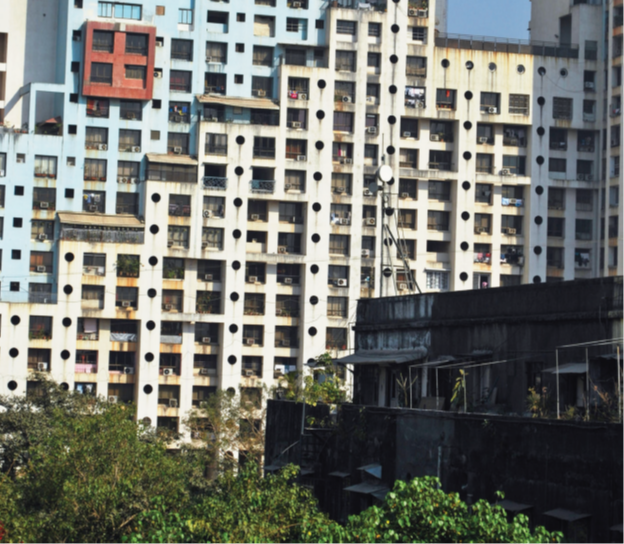
    The rapid growth of cities has led to increasing demand for more residential, office, commercial and retail spaces and the core area of older town and mega cities are saturated, it is estimated that more than half to 95 per cent of the new buildings will come up in resource stressed suburbs and new townships, not to forget that the lack of sound infrastructure and planning coupled with ad-hoc construction in Indian cities have taken its toll. A workshop organised by Centre for Science and Environment (CSE) on Urbanscapes: How sustainable are our buildings and cities, stressed on issues of affordable housing and the notion of what is a sustainable building. According to the 2013 Union Ministry of Housing and Urban Poverty Alleviation (MoHUPA) the number of obsolescent dwelling units (excluding those that are less than 40 years old and those aged 80 years or more) was estimated to be 2.27 million in March 2012.

    Mega cities such as Mumbai, Delhi, Hyderabad, Kolkata, Bengaluru and Chennai have seen maximum urbanisation and that is effecting water, land and other natural resources. Creation of new towns in green areas have further accelerated the perils of striking a balance between demand and supply. With changing lifestyles, cities are and will use up more and more of precious water and energy and will generate massive amounts of waste. So what is the way forward? How do we provide a city that has sustainable housing which works on a two-pronged manner in serving the needs and comfort of the city dwellers on one hand, and not creating pressure on the environment? What are green buildings and are they really a solution? These are some of the questions that surfaced at the workshop. CSE executive director (Research and Advocacy) Anumita Roychowdhury, took the example of traditional Chettinad homes which have sufficient cross-ventilation with big verandahs and courtyards as common feature in most traditional homes in Chennai, as the climate there is hot and humid and hence, it does not require air-tight glass buildings. However, quite a few tight glass buildings in Chennai are being constructed.

    City planners and architect need to look back at traditional wisdom and techniques to find design solutions for modern Indian cities. She also added, “What is worrisome is that Indian cities use more of precious water and energy and generate massive amounts of waste. The construction boon can be a bane as unfettered growth can have a damaging impact. In India, buildings are responsible for 40 per cent of the energy use, 30 per cent of the raw material use, 20 per cent of water use and 20 per cent of land use. At the same time, they generate 40 per cent of carbon emissions, 30 per cent of solid waste generation and 20 per cent of water effluents. With almost 70 per cent of the building stock in India yet to come up, the country is looking ahead to a critical situation.” Sunita Narain, the director general of CSE, cited a very valid problem in terms of the certification of a building being green when she pointed out that there is no clarity on the parameters for a building to be a “green building” also, how do we retrofit modern innovations to an already existing building? These were some of the thoughts to ponder upon.

    Kalyani Majumdar

    www.cseindia.org

  • 2020 World of War: Review

    Published in Free Press Journal; Date: 12.11.2017; Reviewed by Kalyani Majumdar

    Are we heading towards the third world war? If yes, then will it be in the year 2020? Paul Cornish and Kingsley Donaldson in their book, 2020 World Of War, intricately poses all the different scenarios in the current world order that might eventually lead to the world going to war.

    The book offers a comprehensive account of the changing nature of war in today’s world. As we all understand that linear warfare is a thing of the past. It has become far more complex, from cyber security to rapid up gradation and development in weapon technology. The impact of automation technologies on battlefield, such as the unmanned drones are changing the nature of conflicts. Economics and geopolitics have their intricate roles in initiating a war-like situation almost in any part of the world. It helps that both, Cornish and Donaldson come from army backgrounds.

    Paul Cornish was educated at the University of St Andrews and the London School of Economics. He then served in the British Army (Royal Tank Regiment) and the Foreign and Commonwealth Office. Kingsley Donaldson is a retired Army officer. He has served on operations in a number of European and Middle Eastern countries in various roles that span from countering weapons of mass destruction through to negotiating with armed groups in Iraq.

    2020 World Of War, makes for a compelling read as the authors bring their personal experiences and inside knowledge to every plot that they talk about. Does the book give an impression of a grim future? Yes, it does to some extent, as Cornish and Donaldson says, “This book is knowingly and deliberately an exercise in worst-case analysis and as such it is, arguably, precisely how security and policy-makers and analysts should be spending much of their time in a chaotic and often confusing world.”

    Will there be a cyber-attack on the pentagon that might crash the greatest military power in the world? Will there be a standoff between India and Pakistan over Afghanistan? What will happen in Putin’s Russia? And what would be the repercussion of Trump’s policy of isolating US gradually from the rest of the world? Not to forget the pressing issues pertaining to mass migration in Europe due to ISIS. These and many more questions would rise in the reader’s mind while reading 2020 World Of War.

    The book says, “Across Europe, established political systems are experiencing a crisis in public confidence, resulting in the rise of anti-establishment figures, parties and movements, as evinced in extreme right-wing movements gaining popularity, in the Scottish referendum and in the UK ‘Brexit’ referendum in June 2016, and the US Presidential election later the same year.” The book provides a good understanding on why the world is struggling to contain conflicts and offers expert analysis and solutions to combat these situations.

    The book is thought-provoking and insightful. However, some of the scenarios provided in the book seems a bit far-fetched, although time will only tell if everything that 2020 World Of War says is plausible or not. We can only hope for the best, but plan for the worst.  It is a must read for those who are eager to understand how our world would look like in the near future.

    Book: 2020 World of War

    Authors: Paul Cornish and Kingsley Donaldson

    Publisher: Hodder & Stoughton/ Hachette

    Pages: 320; Price: Rs 699

  • Strangers No More: New Narratives from India’s Northeast by Sanjoy Hazarika- Review

    Published in Free Press Journal; Date: 25.02.2018; Reviewed by Kalyani Majumdar

    With three states in the Northeast of India — Meghalaya, Nagaland and Tripura — busy with the assembly elections this February, all of a sudden there is a surge in the amount of coverage the Northeastern states are getting by news channels that are otherwise largely ignored. Unfortunately, the ignorance regarding the Northeast that comprises of eight states, by the people of the rest of India is equally pitiful.

    Thus, the book Strangers No More: New Narratives from India’s Northeast by Sanjoy Hazarika, is a must-read for those that would like to understand the ground realities of the Northeastern states, from socio-economic and political perspectives. It has been twenty years that Hazarika wrote his first book on Northeast, Strangers of the Mist. It was perhaps the first comprehensive book on India’s Northeast and even till this day, his book is referred by researchers, journalists and students pertaining to information on Northeast India. And, now with Strangers No More, Hazarika continues his journey in the Northeast with stories and interviews that provide an in-depth overview of where the Northeast stands, today.

    Hazarika uses his exemplary narrative style to tell the stories that otherwise might go untold.  The author not only highlights the issues that are being currently faced by the people of the Northeastern states, but also, provides suggestions and effective solutions to these issues. Hence, this book can be treated as a handbook by political leaders, non-governmental organisations, activists and specialists that are working at grassroots level, to get a holistic view of the Northeastern states of India, and in turn, help them to focus on the betterment of the people in these states.

    The author has suggestions in the book pertaining to gargantuan sized projects that are planned for Northeastern states, that could also apply to other states in India, “It’s better to improve what we have instead of launching ambitious projects that would lead to endless corruption, delays, frustration, growing anger and confrontation and massive destruction of irreplaceable species. We have no right to do that.”

    While discussing Arunachal Pradesh, the author says, “Arunachal’s political and social stability as well as those of ‘national interest’ mesh and merge at every point in this distant border state.” This aspect makes Arunachal Pradesh an extremely tricky area to tread on, in terms of policies and governance.

    Every page of the book is a minefield of information and stories that upholds everything that one needs to understand about Northeastern states. While for most Indians, Sikkim is a beautiful tourist spot, which holds true, but the other glaring truth is that most are oblivious of its history and how it became part of India. As Indians, perhaps we should ask ourselves, how much do we really know about this Indian state and how much of a concern it generates in the public domain.

    Hazarika brings forth facts that would force the reader to ponder upon issues that are mostly brushed under the carpet. While mentioning about Meghalaya, the author writes, “A closer examination shows that power-broking, moneymaking, environment exploitation and traditional systems and processes are all caught up and bound together in this mesh. Otherwise, how else can one explain the fact that large parts of Shillong, which gets an annual average rainfall of about 2,167 centimetres spread over the summer depend on frantic calls to water tanker companies?”

    “The past always intrudes into the present here and elsewhere in the Northeast.”

    Book title: Strangers No More: New Narratives from India’s Northeast

    Author: Sanjoy Hazarika

    Publisher: Aleph Book Company

    Pages: 296; Price: Rs 799