THE COMMEDIA DELL’ ARTE CHARACTERS HAVE NEW CLOTHES, COURTESY 16 TOP DESIGNERS. KALYANI MAJUMDAR HAS THE STORY.
Published in India Today, Spice Solo | 2009
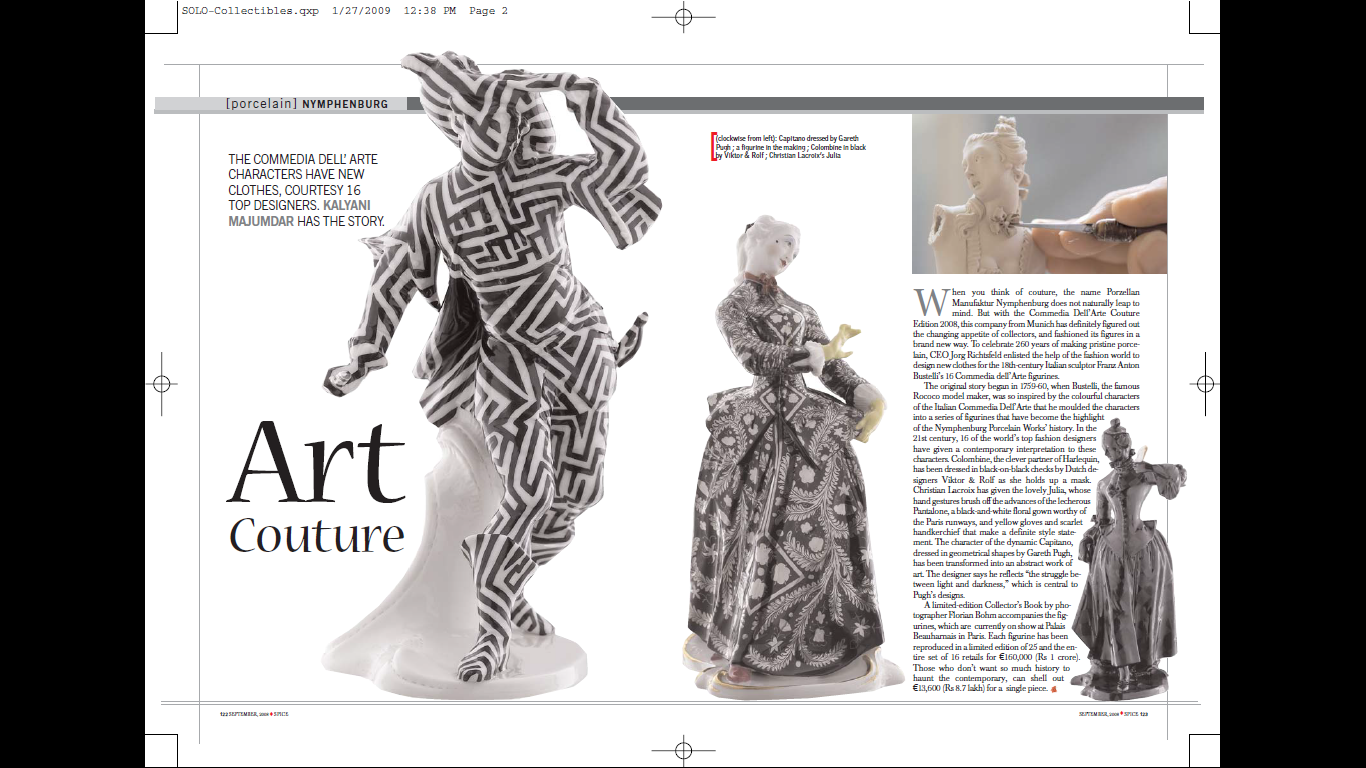
When you think of couture, the name Porzellan ManufakturNymphenburg does not naturally leap to mind. But with the Commedia Dell’Arte Couture Edition 2008, this company from Munich has definitely figured out the changing appetite of collectors, and fashioned its figures in a brand new way. To celebrate 260 years of making pristine porcelain, CEO Jorg Richtsfeld enlisted the help of the fashion world to design new clothes for the 18th-century Italian sculptor Franz Anton Bustelli’s 16 Commedia dell’Arte figurines.
The original story began in 1759-60, when Bustelli, the famous Rococo model maker, was so inspired by the colourful characters of the Italian Commedia Dell’Arte that he moulded the characters into a series of figurines that have become the highlight of the Nymphenburg Porcelain Works’ history. In the 21st century, 16 of the world’s top fashion designers have given a contemporary interpretation to these characters. Colombine, the clever partner of Harlequin, has been dressed in black-on-black checks by Dutch designers Viktor & Rolf as she holds up a mask.
Christian Lacroix has given the lovely Julia, whose hand gestures brush off the advances of the lecherous Pantalone, a black-and-white floral gown worthy of the Paris runways, and yellow gloves and scarlet handkerchief that make a definite style statement.
The character of the dynamic Capitano, dressed in geometrical shapes by Gareth Pugh, has been transformed into an abstract work of art. The designer says he reflects “the struggle between light and darkness,” which is central to Pugh’s designs.
A limited-edition Collector’s Book by photographer Florian Bohm accompanies the figurines, which are currently on show at Palais Beauharnais in Paris. Each figurine has been reproduced in a limited edition of 25 and the entire set of 16 retails for €160,000 (Rs 1 crore). Those who don’t want so much history to haunt the contemporary, can shell out €13,600 (Rs 8.7 lakh) for a single piece.
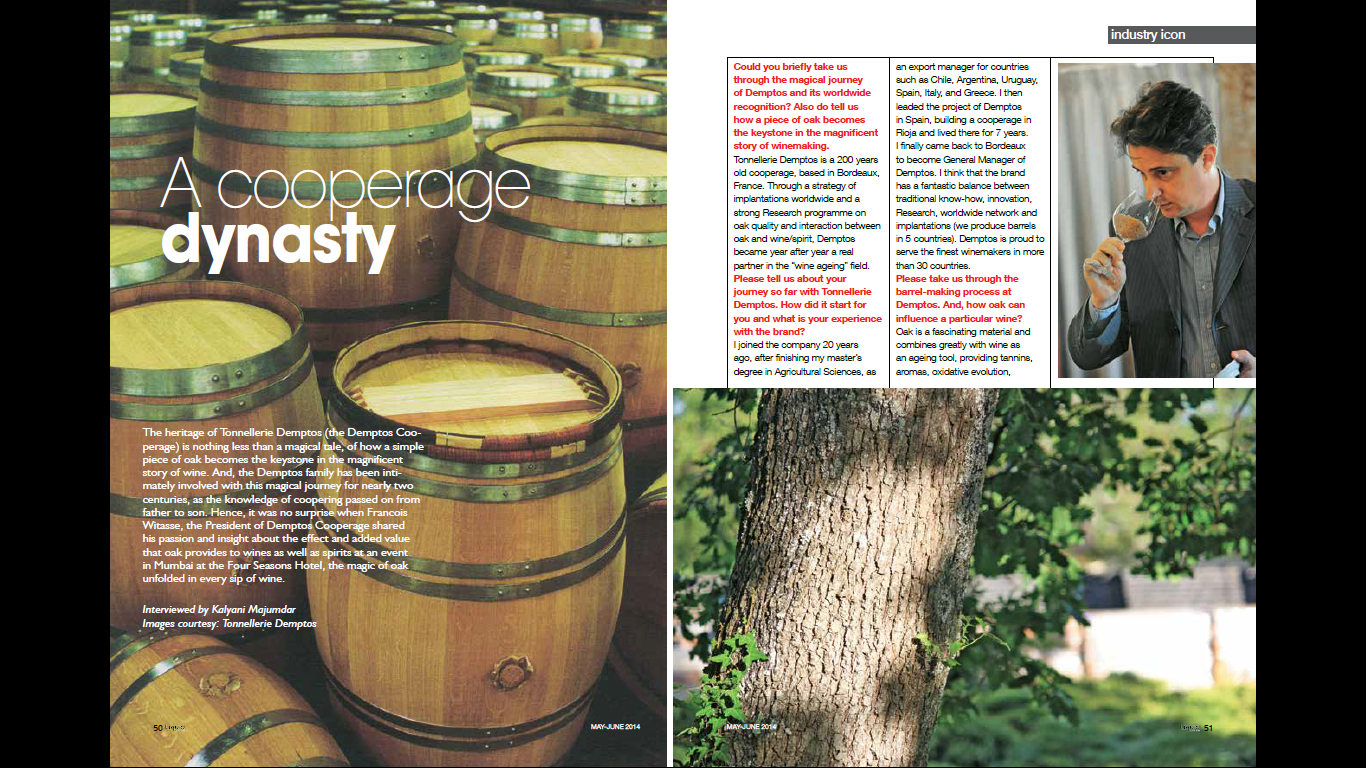
The heritage of Tonnellerie Demptos (the Demptos Cooperage) is nothing less than a magical tale, of how a simple piece of oak becomes the keystone in the magnificent story of wine. And, the Demptos family has been intimately involved with this magical journey for nearly two centuries, as the knowledge of coopering passed on from father to son. Hence, it was no surprise when Francois Witasse, the President of Demptos Cooperage shared his passion and insight about the effect and added value that oak provides to wines as well as spirits at an event in Mumbai at the Four Seasons Hotel, the magic of oak unfolded in every sip of wine.
Francois Witasse Interviewed by Kalyani Majumdar | Images courtesy: Tonnellerie Demptos| Published in Liquid magazine
Kalyani Majumdar: Could you briefly take us through the magical journey of Demptos and its worldwide recognition? Also do tell us how a piece of oak becomes the keystone in the magnificent story of winemaking.
Francois Witasse: Tonnellerie Demptos is a 200 years old cooperage, based in Bordeaux, France. Through a strategy of implantations worldwide and a strong Research programme on oak quality and interaction between oak and wine/spirit, Demptos became year after year a real partner in the “wine ageing” field.
KM: Please tell us about your journey so far with Tonnellerie Demptos. How did it start for you and what is your experience with the brand?
I joined the company 20 years ago, after finishing my master’s degree in Agricultural Sciences, as an export manager for countries such as Chile, Argentina, Uruguay, Spain, Italy, and Greece. I then leaded the project of Demptos in Spain, building a cooperage in Rioja and lived there for 7 years. I finally came back to Bordeaux to become General Manager of Demptos. I think that the brand has a fantastic balance between traditional know-how, innovation, Research, worldwide network and implantations (we produce barrels in 5 countries). Demptos is proud to serve the finest winemakers in more than 30 countries.
KM: Please take us through the barrel-making process at Demptos. And, how oak can influence a particular wine?
FW: Oak is a fascinating material and combines greatly with wine as an ageing tool, providing tannins, aromas, oxidative evolution, clarifying the wine, delivering them roundness, mouthful and balance, stabilizing their structure and infusing them with a better resistance to time! Our job is to control and fine tune our selections to match every enologist’s ageing ‘goals’. From the log to the stave, from the stave to the barrel, our barrel making process is dedicated to the user.
KM: How do the experts at Demptos judge that it is the right moment to start making the oak planks for barrels?
FW: We actually buy raw material from auctions. The ONF, French Administration of Forest Management, organises the oak market. We then split the logs in our stave mills and let the oak planks (staves) season for a minimum of two/three years.
KM: How does wood grain affect the character and expression of the wine stored?
FW: Oak growth speed (grain) has direct consequences on oak porosity and chemical composition. French forest management is based on high density forest principle and mostly provides tight grain. We harvest 180 to 230 year-old trees. While some wine would take more benefits from a very tight grain, porous and flavourful, some wines structure will require a stronger content of elagitannins. An ‘open grain’ will then work better.
KM: Do explain how Demptos fine tunes their barrels to the personality of each wine?
FW: Due to the different effects of ageing and the multiple combinations, we obviously see our work as a partnership with our clients. Understanding the winemaker’s ageing strategy is the only way to reach, year after year, the best marriage of oak and wine. Also, ways to offer the best return on invest, using the most accurate tool in every situation. It is amazing how many ageing strategies exist in the world.
KM: Is French oak the first choice all over the world for the way in which it conserves and improves wine? And, if it is the first choice then why and if not, then which one would you consider as the most suitable oak or the first choice for any winemaker?
FW: French oak represents today a little more than 50% of the wine barrels. It is very hard to define what is right or wrong and what is better or not. In Demptos we believe that the success is to help winemakers to reach their goals. When looking for high content of lactones (sweetness), American oak would then be the first choice.
KM: Is there any particular season that is preferred for harvesting oak trees for barrel-making? What are the precautions you take while seasoning the oak staves before turning them into barrels?
FW: Oak trees should be harvested at sap-going-down season, mainly winter time. The logs will be then processed into staves within a one year period. The process of seasoning starts only after that, when the piles are stored with about 20 per cent of air to help natural ventilation and moisture diffusion. The Aurelio Basilium pullulans and Trichoderma—are the two microorganisms that are responsible for the chemico-physico transformation of oak. They have been identified by Dr. Nicolas Vivas, Director of Demptos Research Center. They do their job by transforming some phenolic contents of oak into more compatible ones with a wine ageing profile. The green and rough tannins turn into smoother ones.
KM: Please point out the observations you made while visiting the Indian vineyards that you think needs improvement or are already at par with the worldwide standards.
FW: I would certainly be very humble in providing recommendations. In my point of view, the level of protection of some Indian wines should be a point of attention. When it comes to exportation, resistance to oxygen will be a key. In some countries the wines are drunk after several years in the bottle. If the wine structure is not compatible with this time, the wine will oxidate or/and alter. I realised that Indian bottles are opened ‘young’ and the bottles are opened soon after their release in the domestic market. Anyway, SO2—Sulphite is an antioxidant that protects wine—is not the only way to protect wine. I detected that this level of protection on Indian wines is not high, but fits the consumption mode. A good balance between colour material and tannins also brings stability. Oak is a fantastic tool to work on the density and expression also. I met some enologists who feared the use of lees in red wines. In some cases, it is a free natural ‘treatment’ that could be used a little more…
KM: What is your take on the wine market in India, anything you have noticed about the Indian palate? Also, in tune with the last question, do you think oaky wine would work better for the Indian palate with its hot and spicy food?
FW: I have been very interested about how the wine industry fits well with Indian taste and gastronomy. I would say that Indian wines have their own identity, definitely at world class standards. However they do adapt to Indian taste-buds, offering roundness and a little bit of sweetness. I realize that astringency is considered as a strong default and that a little oxidation is not necessarily rejected… My belief is American oak, rich in lactones, would complement nicely Indian wines and would underline the “sweet sensation” that is appreciated. However, French oak tannins would work well on the structure and stability. The level of “mix” should be adapted to every wine and winemaker’s style. I don’t think that the general level of grape extraction right now is adapted to age in 100% new oak, but definitely there is room for more “ageing” process and work.
KM: In terms of wine and barrel markets, which according to you is the most exciting country and why?
FW: USA is the biggest market for oak barrels, but any new challenge is exciting! The success is not only the number. If we can help a winemaker to reveal his terroir and participate in the added value of his wine, we are happy. The star is never the barrel, always the wine !
KM: What according to you is a big barrel making no-no?
FW: In my opinion, reducing barrel ageing to its flavouring impact is a big mistake. A barrel producer who would build a barrel in that direction will not succeed. Selection, patience, control, harmony and users’ feedback and understanding are the only way.
KM: What are the trends in the Indian wine and spirits market that you would cite as key, in so much as defining your current and future strategy? Which are the Indian wine brands that are ageing their wine in oak barrels?
FW: Few wineries already age some wines in barrels but most of them already get benefits of oak through other modalities (like oak infusion for example). The education of the audience is the real key. Wine quality is worldly linked to its density, its expression, its resistance to time… All these aspects are improved by the ageing process. Demptos strategy is and will always be the same and that is to be a partner to the industry, creating added value, sharing experiences, offering adaptability and competitiveness… That is how we became the “ageing” world leader.
KM: How good or large is the Indian market for oak barrels?
FW: India is a little market still… A very small proportion of wine is aged in oak barrels. But remember that only 2% of wine does worldwide! It is important for us to be here early.
KM: What are the key challenges that you think your product will be facing in the current scenario of the Indian market?
FW: Year after year, the different trials and experiences will fine tune barrel selection and use in the Indian industry. I am sure this is going to happen. I don’t know how much time it will take… But we have been making barrels for 200 years now, and we will be there in another 200!
KM: In India since the market is price-driven, what do you think is the future of wine ageing in oak barrels as it is after all an expensive affair? Could you also give a rough estimate of the price difference of a wine that has been aged in oak barrels and a wine that is flavoured by oak through, staves and cubes?
FW: Oak in wine treatment might cost from Rs 2 to Rs 15 a bottle; ageing wine in barrel will cost from Rs 60 to Rs 150 per bottle. Expected values are also very different. If the audience values the quality, they will ask for more ageing. But we also will be happy to support the benefits of oak in any wine segment…
KM: Is there anything you would like to suggest to a winemaker in terms of what kind of barrel must s/he select and what vital points should be kept in mind before selecting the barrels?
FW: There is no general rule. I would suggest any way to do an initial diagnostic of the phenolic balance of the grapes and then define a real strategy to age wine. Result of ageing not only depends on the barrel selection, but also on the maturation of the grape, extraction during maceration and lees management… Considering a barrel as a ‘magic box’ will always lead to problems. Percentage of new oak, doing the malolactic in barrels or not, racking management and time of the process should also be seriously considered and adapted to the objectives of the winemakers. We as coopers are here to serve, not to impose our point of view!
Published in Free Press Journal; Date: 12.11.2017; Reviewed by Kalyani Majumdar
Are we heading towards the third world war? If yes, then will it be in the year 2020? Paul Cornish and Kingsley Donaldson in their book, 2020 World Of War, intricately poses all the different scenarios in the current world order that might eventually lead to the world going to war.
The book offers a comprehensive account of the changing nature of war in today’s world. As we all understand that linear warfare is a thing of the past. It has become far more complex, from cyber security to rapid up gradation and development in weapon technology. The impact of automation technologies on battlefield, such as the unmanned drones are changing the nature of conflicts. Economics and geopolitics have their intricate roles in initiating a war-like situation almost in any part of the world. It helps that both, Cornish and Donaldson come from army backgrounds.
Paul Cornish was educated at the University of St Andrews and the London School of Economics. He then served in the British Army (Royal Tank Regiment) and the Foreign and Commonwealth Office. Kingsley Donaldson is a retired Army officer. He has served on operations in a number of European and Middle Eastern countries in various roles that span from countering weapons of mass destruction through to negotiating with armed groups in Iraq.
2020 World Of War, makes for a compelling read as the authors bring their personal experiences and inside knowledge to every plot that they talk about. Does the book give an impression of a grim future? Yes, it does to some extent, as Cornish and Donaldson says, “This book is knowingly and deliberately an exercise in worst-case analysis and as such it is, arguably, precisely how security and policy-makers and analysts should be spending much of their time in a chaotic and often confusing world.”
Will there be a cyber-attack on the pentagon that might crash the greatest military power in the world? Will there be a standoff between India and Pakistan over Afghanistan? What will happen in Putin’s Russia? And what would be the repercussion of Trump’s policy of isolating US gradually from the rest of the world? Not to forget the pressing issues pertaining to mass migration in Europe due to ISIS. These and many more questions would rise in the reader’s mind while reading 2020 World Of War.
The book says, “Across Europe, established political systems are experiencing a crisis in public confidence, resulting in the rise of anti-establishment figures, parties and movements, as evinced in extreme right-wing movements gaining popularity, in the Scottish referendum and in the UK ‘Brexit’ referendum in June 2016, and the US Presidential election later the same year.” The book provides a good understanding on why the world is struggling to contain conflicts and offers expert analysis and solutions to combat these situations.
The book is thought-provoking and insightful. However, some of the scenarios provided in the book seems a bit far-fetched, although time will only tell if everything that 2020 World Of War says is plausible or not. We can only hope for the best, but plan for the worst. It is a must read for those who are eager to understand how our world would look like in the near future.
SESC Pompeia in Sao Paulo, Brazil designed by Lina Bo Bardi
The term Brutalism evokes a myriad of responses from the architecture and design community — some are extremely critical and some see it as a utopian moment in architecture, but mostly it evokes extreme emotions and debates. And thus it did not come as a surprise that when an event curated by Mohile Parikh Center in collaboration with Studio X, Mumbai had Prof. Yehuda Safran revisiting Brutalism through a presentation, followed by a conversation with architect Mustansir Dalvi, had full attendance at the spacious Studio X. Originating from a French term béton brut, when translated stands for “raw concrete” defines it as literally as possible. Brutalist buildings were known for their sculptural qualities and the rawness that was evident from the display of true materiality — raw concrete. It is believed that this form of architecture was developed between 1950s to the mid 1970s. Some say that Brutalism sprung out of a need to create a classless society and against gentrification in a city. Post-war Britain saw Brutalist buildings coming up everywhere and it was evident that this movement was seen as an evocative solution to create a classless society and to create mini-societies that would comprise schools, hospital, shops/ community centre, banks and other basic amenities for the people living around. Also, there was a grand cost-cutting due to in-situ casting. Among Prof Safran’s presentation of Brutalist buildings was the infamous Robin Hood Gardens in Poplar, London designed by Alison and Peter Smithson in the late 1960s and realised in 1972.
The idea behind this structure was indeed pragmatic with Smithsons’ social intentions that integrated through the concept of “streets in the sky” and one must admit was a wonderful idea for any city where people crave to get a glimpse of the sky. Every third level of the buildings was designed with a wide concrete balcony jutting off towards the centre of the site, overlooking the garden. After much deliberation Tower Hamlets Council passed the demolition plans for Robin Hood Gardens and just last year it was razed to make way for new structure. During the talk, Prof Safran mentioned that Brutalism by many is associated with the term satanic. One might think probably because it was a movement that did trigger radical thoughts to design cities which did not go down well with many from the design communities. Another Brutalist building from Prof Safran’s presentation was the SESC Pompeia in Sao Paulo, Brazil. After the end of a 20-year military regime SESC Pompeia in Sao Paulo, Brazil designed by Lina Bo Bardi was an important addition to the Sao Paulo skyline and was a fresh start for the country as its two concrete towers connected to each other with pre-stressed concrete walkways. Even though the conversation lasted for two hours, but it did make us ponder on the current take on Brutalism. Is demolishing of these buildings the only way forward? To sum up all the facts Brutalism was a movement of a particular time and it had a great influence and played a part in modern form of architecture. Isn’t it possible to repurpose the architectural form that after all stemmed out of a novel idea to lessen disparity amongst the city dwellers and prevent urban gentrification?
Event detail:
Mohile Parikh Center www.mohileparikhcenter.org Studio X, Mumbai www.arch.columbia.edu SESC
Even though Oise in Northern France, not far from Paris is usually missing from most travel itinerary, it is a revelation as KALYANI MAJUMDAR found out after visiting this picturesque place with its landscape, people and history.
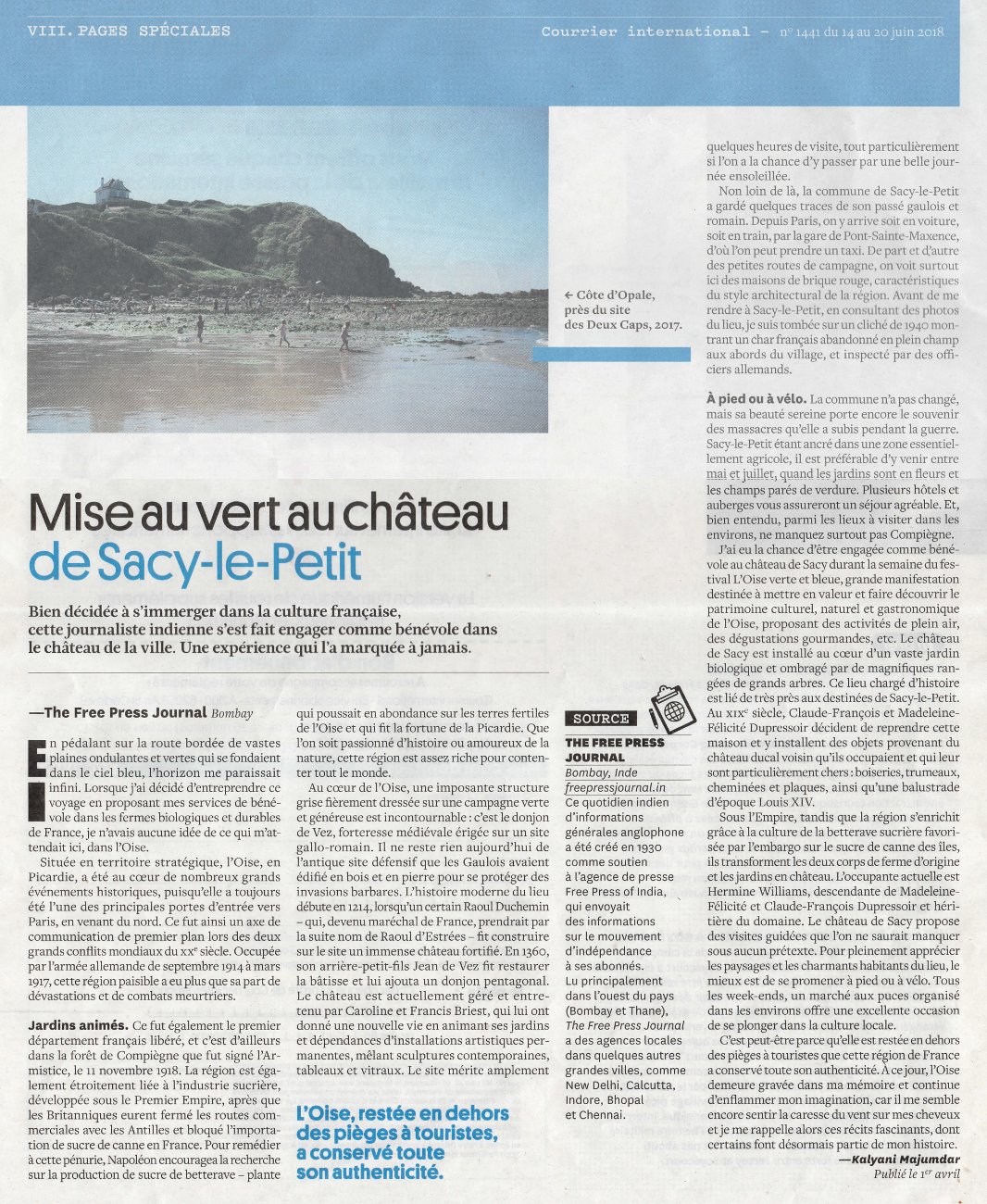
The serene beauty of Sacy-le-Petit in Oise; Image credit: Kalyani Majumdar
As I bicycled my way through the expansive undulating green flatland on both sides of the road that met the blue sky, it seemed like an endless horizon. When I decided to undertake immersive travelling through volunteering on sustainable and organic farms across France, I had no idea what was in store for me here in Oise.
Digging into the history
The geographic location of Oise in Picardy region is strategic to many important events in history as it has always been the passage to Paris and thus played an important role in communication during the two World Wars. Occupied from September 1914 to March 1917, ravaged by the battles of 1918, this peaceful region has had its share of bloodshed and war.
It was also the first French department to be liberated, and even the signing of the Armistice took place in Compiègne Forest in Oise on 11 November 1918. Moreover, this region is also associated with the sugar embargo of the 19th century. During the Napoleonic war in the 1800s, the British had blocked the French trade routes with the Caribbean Islands which led to massive shortage of sugar in France. As a solution, Napoleon I introduced sugar beet to counter the sugar embargo. The fertile lands of Oise grew it in abundance and the region grew rich. Whether you are a history enthusiast or a nature lover, there is something here for everyone.
Unmissable dungeon
Donjon de Vez; Image credit: Kalyani Majumdar
Located in the middle of Oise, Donjon de Vez is hard to miss with its imposing grey structure that is surrounded by lush green landscape. It is a medieval dungeon dating back to Gallo-Roman period. Initially, it was a structure mainly made of wood and stone that was built to protect the Gauls against the invasions by the Barbarians, of which nothing is left today. In 1214, Raoul Ducheim, who later Latinised his name and came to be known as d’ Estrees, re-planned, fortified and restored the structure.
He added the three-storied living quarters, some of which still remains. In 1360, his great-grandson Jehan de Vez added the pentagonal-shaped tower. The terrace consists of machicolations and perhaps it was the primary defense system. At its present state, it is maintained by Caroline and Francis Briest. Because of their efforts they have given a new lease of life to the structure. It showcases permanent art installations—sculptures, paintings and stained glass artworks. Especially on a nice sunny day one could easily spend few hours at the Vez.
Sacy-le-Petit
The expansive flatland in Sacy-le-Petit; Image credit: Kalyani Majumdar
Sacy-le-Petit is a commune in Oise and dates back to pre-historic and Roman period. One can either drive down from Paris or board a train from Paris to Pont-Sainte-Maxence. There are taxis available at the station. The winding roads are dotted with houses made of red bricks mostly. The villages of Picardy region has a distinct culture and architectural style that can be seen in this commune as well. Before visiting this place while looking through images I had come across a photograph from 1940, of an abandoned French tank sitting on a farmland in Sacy-le-Petit, being inspected by the Germans.
It is the same commune, yet its serene beauty belies the gruesome bloodshed that this region has seen. From May to July would be the best time to visit this region when the flowers are in full bloom in the gardens, and farm lands are green. Sacy-le-Petit is majorly an agricultural area. There are inns and hotels available here for a comfortable stay. The popular places to visit nearby includes Compiègne.
Chateau de Sacy
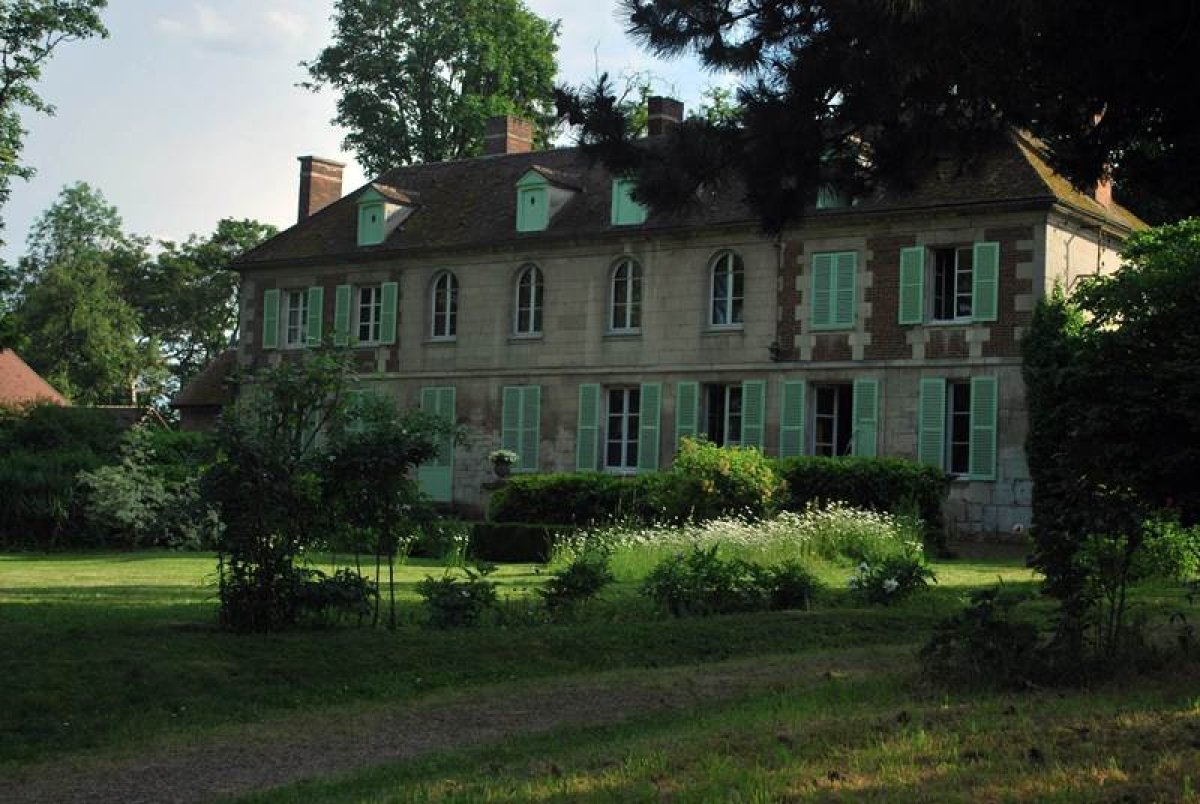
Chateau de Sacy; Image credit: Kalyani Majumdar
I was fortunate to volunteer at the Chateau de Sacy in Sacy-le-Petit during the same week as the festival of L’Oise Verte et Bleu, L’événement Grandeur. It is a festival to celebrate and discover the culture of Oise that includes outdoor activities, local culinary feasts and so on. Chateau de Sacy is situated in the middle of a large organic garden and is surrounded by a lovely collection of tall trees. The chateau is steeped in history and is closely linked to the history of Sacy-le-Petit. In the 19th century, Claude-François and Madeleine-Félicité Dupressoir had decided to take over this house and brought along things that were dear to them from their old castle, items such as, woodwork, trumeau, fireplaces and plates, the balustrade Louis XIV.
Later on, as the region became rich by growing sugar beet during the sugar embargo they turned the two farms and a garden into a chateau. The current occupant is Hermine Williams, who inherited the house and is a descendant of Madeleine-Félicité and Claude-François Dupressoir. There are organised tours of the Chateau de Sacy that should not be missed. Cycling and walking are the best way to see the sights and mingle with the friendly locals. Every weekend there is a flea market nearby, and is a great opportunity to immerse into the local culture.
Perhaps the fact that this region of France has remained free from tourist traps, that it is still in its pristine form. For me, even now, Oise is embedded in my memory. It still continues to stir my imagination as I can still feel the wind in my hair and remember the intriguing stories that I have heard, some of which are now part of my story.