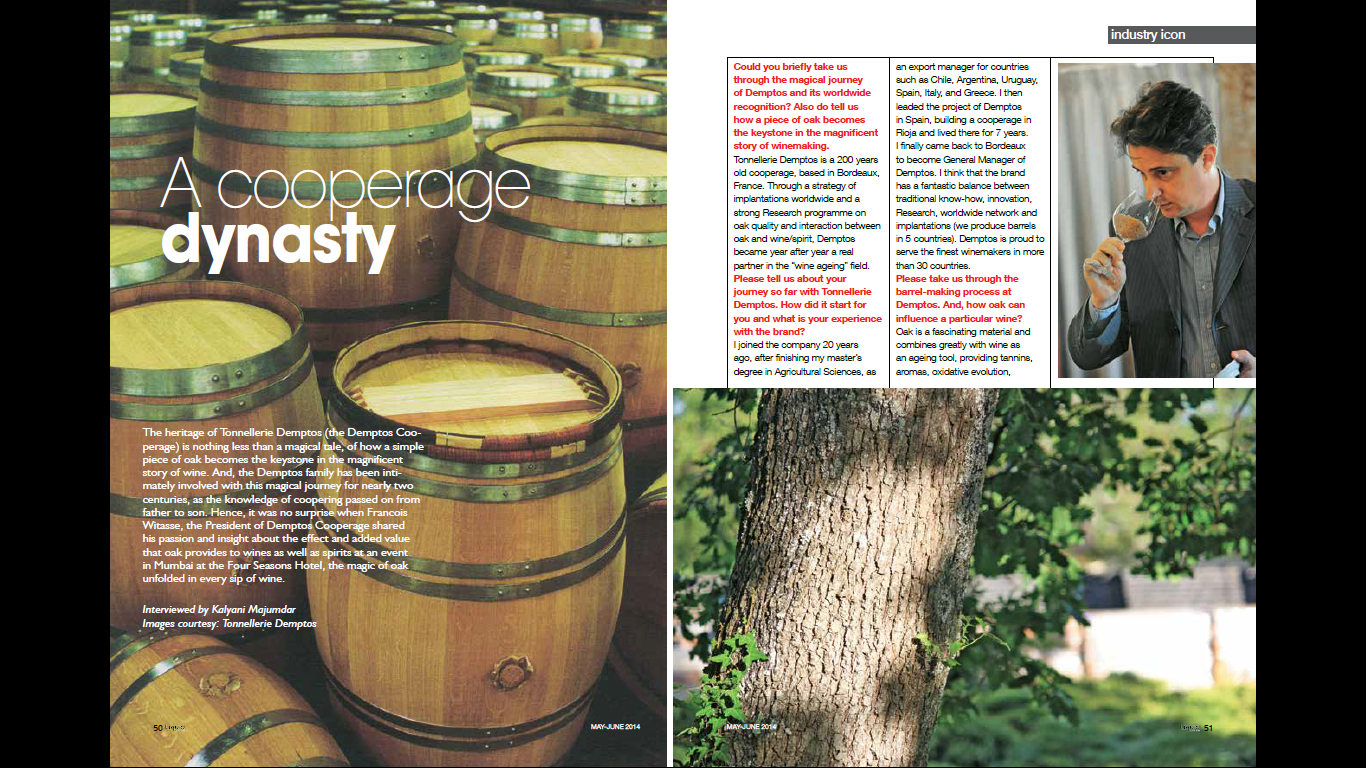

The heritage of Tonnellerie Demptos (the Demptos Cooperage) is nothing less than a magical tale, of how a simple piece of oak becomes the keystone in the magnificent story of wine. And, the Demptos family has been intimately involved with this magical journey for nearly two centuries, as the knowledge of coopering passed on from father to son. Hence, it was no surprise when Francois Witasse, the President of Demptos Cooperage shared his passion and insight about the effect and added value that oak provides to wines as well as spirits at an event in Mumbai at the Four Seasons Hotel, the magic of oak unfolded in every sip of wine.
Francois Witasse Interviewed by Kalyani Majumdar | Images courtesy: Tonnellerie Demptos | Published in Liquid magazine

Kalyani Majumdar: Could you briefly take us through the magical journey of Demptos and its worldwide recognition? Also do tell us how a piece of oak becomes the keystone in the magnificent story of winemaking.
Francois Witasse: Tonnellerie Demptos is a 200 years old cooperage, based in Bordeaux, France. Through a strategy of implantations worldwide and a strong Research programme on oak quality and interaction between oak and wine/spirit, Demptos became year after year a real partner in the “wine ageing” field.

KM: Please tell us about your journey so far with Tonnellerie Demptos. How did it start for you and what is your experience with the brand?

I joined the company 20 years ago, after finishing my master’s degree in Agricultural Sciences, as an export manager for countries such as Chile, Argentina, Uruguay, Spain, Italy, and Greece. I then leaded the project of Demptos in Spain, building a cooperage in Rioja and lived there for 7 years. I finally came back to Bordeaux to become General Manager of Demptos. I think that the brand has a fantastic balance between traditional know-how, innovation, Research, worldwide network and implantations (we produce barrels in 5 countries). Demptos is proud to serve the finest winemakers in more than 30 countries.
KM: Please take us through the barrel-making process at Demptos. And, how oak can influence a particular wine?
FW: Oak is a fascinating material and combines greatly with wine as an ageing tool, providing tannins, aromas, oxidative evolution, clarifying the wine, delivering them roundness, mouthful and balance, stabilizing their structure and infusing them with a better resistance to time! Our job is to control and fine tune our selections to match every enologist’s ageing ‘goals’. From the log to the stave, from the stave to the barrel, our barrel making process is dedicated to the user.

KM: How do the experts at Demptos judge that it is the right moment to start making the oak planks for barrels?
FW: We actually buy raw material from auctions. The ONF, French Administration of Forest Management, organises the oak market. We then split the logs in our stave mills and let the oak planks (staves) season for a minimum of two/three years.
KM: How does wood grain affect the character and expression of the wine stored?
FW: Oak growth speed (grain) has direct consequences on oak porosity and chemical composition. French forest management is based on high density forest principle and mostly provides tight grain. We harvest 180 to 230 year-old trees. While some wine would take more benefits from a very tight grain, porous and flavourful, some wines structure will require a stronger content of elagitannins. An ‘open grain’ will then work better.
KM: Do explain how Demptos fine tunes their barrels to the personality of each wine?
FW: Due to the different effects of ageing and the multiple combinations, we obviously see our work as a partnership with our clients. Understanding the winemaker’s ageing strategy is the only way to reach, year after year, the best marriage of oak and wine. Also, ways to offer the best return on invest, using the most accurate tool in every situation. It is amazing how many ageing strategies exist in the world.

KM: Is French oak the first choice all over the world for the way in which it conserves and improves wine? And, if it is the first choice then why and if not, then which one would you consider as the most suitable oak or the first choice for any winemaker?
FW: French oak represents today a little more than 50% of the wine barrels. It is very hard to define what is right or wrong and what is better or not. In Demptos we believe that the success is to help winemakers to reach their goals. When looking for high content of lactones (sweetness), American oak would then be the first choice.
KM: Is there any particular season that is preferred for harvesting oak trees for barrel-making? What are the precautions you take while seasoning the oak staves before turning them into barrels?
FW: Oak trees should be harvested at sap-going-down season, mainly winter time. The logs will be then processed into staves within a one year period. The process of seasoning starts only after that, when the piles are stored with about 20 per cent of air to help natural ventilation and moisture diffusion. The Aurelio Basilium pullulans and Trichoderma—are the two microorganisms that are responsible for the chemico-physico transformation of oak. They have been identified by Dr. Nicolas Vivas, Director of Demptos Research Center. They do their job by transforming some phenolic contents of oak into more compatible ones with a wine ageing profile. The green and rough tannins turn into smoother ones.
KM: Please point out the observations you made while visiting the Indian vineyards that you think needs improvement or are already at par with the worldwide standards.
FW: I would certainly be very humble in providing recommendations. In my point of view, the level of protection of some Indian wines should be a point of attention. When it comes to exportation, resistance to oxygen will be a key. In some countries the wines are drunk after several years in the bottle. If the wine structure is not compatible with this time, the wine will oxidate or/and alter. I realised that Indian bottles are opened ‘young’ and the bottles are opened soon after their release in the domestic market. Anyway, SO2—Sulphite is an antioxidant that protects wine—is not the only way to protect wine. I detected that this level of protection on Indian wines is not high, but fits the consumption mode. A good balance between colour material and tannins also brings stability. Oak is a fantastic tool to work on the density and expression also. I met some enologists who feared the use of lees in red wines. In some cases, it is a free natural ‘treatment’ that could be used a little more…

KM: What is your take on the wine market in India, anything you have noticed about the Indian palate? Also, in tune with the last question, do you think oaky wine would work better for the Indian palate with its hot and spicy food?
FW: I have been very interested about how the wine industry fits well with Indian taste and gastronomy. I would say that Indian wines have their own identity, definitely at world class standards. However they do adapt to Indian taste-buds, offering roundness and a little bit of sweetness. I realize that astringency is considered as a strong default and that a little oxidation is not necessarily rejected… My belief is American oak, rich in lactones, would complement nicely Indian wines and would underline the “sweet sensation” that is appreciated. However, French oak tannins would work well on the structure and stability. The level of “mix” should be adapted to every wine and winemaker’s style. I don’t think that the general level of grape extraction right now is adapted to age in 100% new oak, but definitely there is room for more “ageing” process and work.
KM: In terms of wine and barrel markets, which according to you is the most exciting country and why?
FW: USA is the biggest market for oak barrels, but any new challenge is exciting! The success is not only the number. If we can help a winemaker to reveal his terroir and participate in the added value of his wine, we are happy. The star is never the barrel, always the wine !
KM: What according to you is a big barrel making no-no?
FW: In my opinion, reducing barrel ageing to its flavouring impact is a big mistake. A barrel producer who would build a barrel in that direction will not succeed. Selection, patience, control, harmony and users’ feedback and understanding are the only way.
KM: What are the trends in the Indian wine and spirits market that you would cite as key, in so much as defining your current and future strategy? Which are the Indian wine brands that are ageing their wine in oak barrels?
FW: Few wineries already age some wines in barrels but most of them already get benefits of oak through other modalities (like oak infusion for example). The education of the audience is the real key. Wine quality is worldly linked to its density, its expression, its resistance to time… All these aspects are improved by the ageing process. Demptos strategy is and will always be the same and that is to be a partner to the industry, creating added value, sharing experiences, offering adaptability and competitiveness… That is how we became the “ageing” world leader.
KM: How good or large is the Indian market for oak barrels?
FW: India is a little market still… A very small proportion of wine is aged in oak barrels. But remember that only 2% of wine does worldwide! It is important for us to be here early.
KM: What are the key challenges that you think your product will be facing in the current scenario of the Indian market?
FW: Year after year, the different trials and experiences will fine tune barrel selection and use in the Indian industry. I am sure this is going to happen. I don’t know how much time it will take… But we have been making barrels for 200 years now, and we will be there in another 200!
KM: In India since the market is price-driven, what do you think is the future of wine ageing in oak barrels as it is after all an expensive affair? Could you also give a rough estimate of the price difference of a wine that has been aged in oak barrels and a wine that is flavoured by oak through, staves and cubes?
FW: Oak in wine treatment might cost from Rs 2 to Rs 15 a bottle; ageing wine in barrel will cost from Rs 60 to Rs 150 per bottle. Expected values are also very different. If the audience values the quality, they will ask for more ageing. But we also will be happy to support the benefits of oak in any wine segment…
KM: Is there anything you would like to suggest to a winemaker in terms of what kind of barrel must s/he select and what vital points should be kept in mind before selecting the barrels?
FW: There is no general rule. I would suggest any way to do an initial diagnostic of the phenolic balance of the grapes and then define a real strategy to age wine. Result of ageing not only depends on the barrel selection, but also on the maturation of the grape, extraction during maceration and lees management… Considering a barrel as a ‘magic box’ will always lead to problems. Percentage of new oak, doing the malolactic in barrels or not, racking management and time of the process should also be seriously considered and adapted to the objectives of the winemakers. We as coopers are here to serve, not to impose our point of view!
Leave a Reply