Whether you are a foodie, an architecture enthusiast, a book worm, a history buff, or a poet at heart, Kolkata has something for everyone, says Kalyani Majumdar who lists six must-do activities to do in the city
Through the meandering streets and by lanes flanked with a mix of colonial, vernacular and modern built structures you land on a busy street where along with cars, bikes and buses you see a tram moving at its own pace. That is Kolkata for you! With all the hustle and bustle of a city it still manages to have a whiff of leisurely pace to it.
The Trams from yore Did you know that the trams in Kolkata are the oldest electrically operated trams in Asia?At first when it was introduced by the British in 1873 it was horse drawn. In 1902 they became electric. This is the only tram network in India which is still operating. The slow pace of a tram ride gives you an opportunity to enjoy the sight and sound of the city properly and has the added feel good factor that your mode of transport is environment friendly. The old trams still have wooden interiors. If you want to feel nostalgic of the good old days then choose a tram ride that take you northwards of the city as that is the old part of Kolkata.
Trams still run on Kolkata streets | Image credit: Kalyani Majumdar
College Street and Coffee House The name College Street goes back to 1817 when Sir David Hare started the Hindu College. Now of course, it also has Kolkata’s most prestigious and renowned academic institutions such as the University Of Calcutta, Calcutta Medical College, Presidency College, Sanskrit College and Hare School. This stretch is a paradise for book lovers. It is a one stop place for all your book search.
Once you are done with your book browsing, stop at the legendary Coffee House. Even if the coffee they serve is too sweet for your palate, and the fact that the place does not have fancy amenities, it can beat any modern coffee shop for its old world charm. A spiral staircase takes you to the coffee house. Waiters wearing headdress greets you, as a young Rabindranath Tagore looks on over everyone from his life size portrait. The place has been graced by notable personalities such as Rabindranath Tagore, Subhas Chandra Bose, Satyajit Ray, Manna Dey, Amartya Sen, Shashi Kapoor and Aparna Sen to name a few.
Exploring the streets, museums and ghats
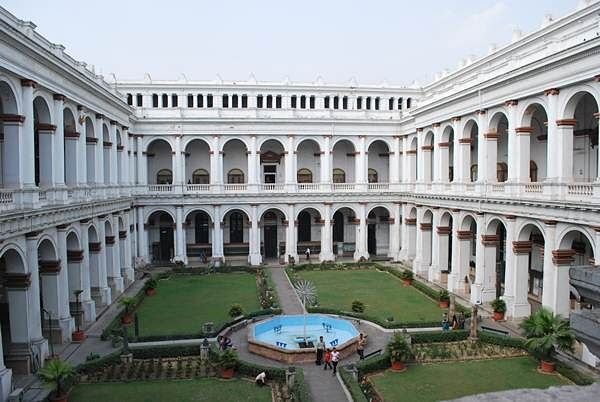
The oldest museum in India The Indian Museum, Kolkata | Image credit: Kalyani MajumdarJorasankho is the house where Rabindranath Tagore lived, now it is a museum | Image credit: Kalyani Majumdar
Walking is the best way to not miss the vibrant energy of the city. Amix of architectural styles can be observed such as the Victorian, Neo classical, Indo-Saracenic and also few art-deco buildings.Do not miss the majestic Esplanade mansion, built in 1910. Also, visit the Indian Museum. It is the oldest in India founded in 1814. In 1878 it was transferred to the present building. It houses an Egyptian mummy.
Make a trip to the Marble Palace in North Kolkata. Walking around this property takes you back to the 19th century. It is a popular location for movie shoots. Also, nearby is the JorasankhoThakurbari. It was built in 1785and was the ancestral home of Rabindranath Tagore. It houses a lovely museum which is worth visiting.
The Ganga ghat and the boat rides beacon | Image credit: Kalyani Majumdar
After a good measure of history and culture take a leisurely walk either at the Princep Ghat or the Outram Ghat in the evening. It is highly recommended that you take a boat ride under the starlit sky and appreciate the Vidyasagar Setu, a cable-stayed bridge from the river.
A dose of spirituality Plan an early morning visit to the beautiful Dakkhineshwar temple. It was built in 1855 by Rani Rashmoniand has a traditional Bengali nine-spired architectural style. The spacious temple complexis dedicated to Goddess Kali and is associated with the spiritual leader Shri Ramakrishna Paramhansa.From here take a boat ride across Hooghly River to visit Belur Math. It was founded in 1938 by Swami Vivekananda. The serene and quiet atmosphere at Belur is a perfect place to unwind while providing a splendid view of the river.
The potters of Kumartuli (to read more about Kumartuli visit my article here) A trip to Kolkata is incomplete without visiting Kumartuli. The name Kumartuli or Kumortuli comes from the Bengali word kumor meaning potter and tuli meaning locality. As you negotiate through the labyrinthine lanes of this area it is like visiting an art and crafts workshop. Rows of idols of Durga and the entire pantheon can be seen standing on either sides of the narrow lanes as you see sculptors in action. The idols for Durga Puja are prepared here and also exported to different parts of the world. It is an amazing place for budding photographers and is a delightful experience to interact with the potters.
Although the name of the city changed from Calcutta to Kolkata in 2001, the city has managed to keep the unique mix of both worlds alive in a graceful manner, and that is perhaps what adds to the extraordinary charm that Kolkata imbues.
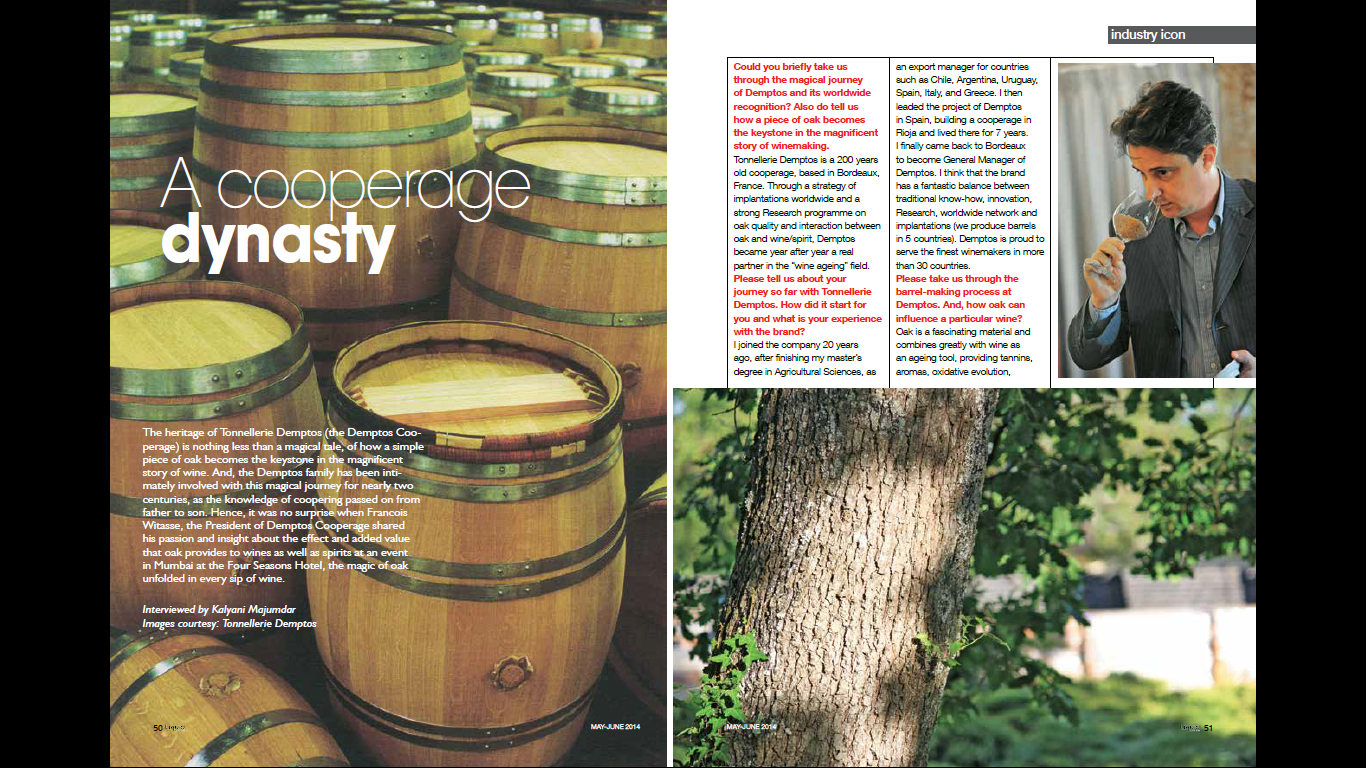
The heritage of Tonnellerie Demptos (the Demptos Cooperage) is nothing less than a magical tale, of how a simple piece of oak becomes the keystone in the magnificent story of wine. And, the Demptos family has been intimately involved with this magical journey for nearly two centuries, as the knowledge of coopering passed on from father to son. Hence, it was no surprise when Francois Witasse, the President of Demptos Cooperage shared his passion and insight about the effect and added value that oak provides to wines as well as spirits at an event in Mumbai at the Four Seasons Hotel, the magic of oak unfolded in every sip of wine.
Francois Witasse Interviewed by Kalyani Majumdar | Images courtesy: Tonnellerie Demptos| Published in Liquid magazine
Kalyani Majumdar: Could you briefly take us through the magical journey of Demptos and its worldwide recognition? Also do tell us how a piece of oak becomes the keystone in the magnificent story of winemaking.
Francois Witasse: Tonnellerie Demptos is a 200 years old cooperage, based in Bordeaux, France. Through a strategy of implantations worldwide and a strong Research programme on oak quality and interaction between oak and wine/spirit, Demptos became year after year a real partner in the “wine ageing” field.
KM: Please tell us about your journey so far with Tonnellerie Demptos. How did it start for you and what is your experience with the brand?
I joined the company 20 years ago, after finishing my master’s degree in Agricultural Sciences, as an export manager for countries such as Chile, Argentina, Uruguay, Spain, Italy, and Greece. I then leaded the project of Demptos in Spain, building a cooperage in Rioja and lived there for 7 years. I finally came back to Bordeaux to become General Manager of Demptos. I think that the brand has a fantastic balance between traditional know-how, innovation, Research, worldwide network and implantations (we produce barrels in 5 countries). Demptos is proud to serve the finest winemakers in more than 30 countries.
KM: Please take us through the barrel-making process at Demptos. And, how oak can influence a particular wine?
FW: Oak is a fascinating material and combines greatly with wine as an ageing tool, providing tannins, aromas, oxidative evolution, clarifying the wine, delivering them roundness, mouthful and balance, stabilizing their structure and infusing them with a better resistance to time! Our job is to control and fine tune our selections to match every enologist’s ageing ‘goals’. From the log to the stave, from the stave to the barrel, our barrel making process is dedicated to the user.
KM: How do the experts at Demptos judge that it is the right moment to start making the oak planks for barrels?
FW: We actually buy raw material from auctions. The ONF, French Administration of Forest Management, organises the oak market. We then split the logs in our stave mills and let the oak planks (staves) season for a minimum of two/three years.
KM: How does wood grain affect the character and expression of the wine stored?
FW: Oak growth speed (grain) has direct consequences on oak porosity and chemical composition. French forest management is based on high density forest principle and mostly provides tight grain. We harvest 180 to 230 year-old trees. While some wine would take more benefits from a very tight grain, porous and flavourful, some wines structure will require a stronger content of elagitannins. An ‘open grain’ will then work better.
KM: Do explain how Demptos fine tunes their barrels to the personality of each wine?
FW: Due to the different effects of ageing and the multiple combinations, we obviously see our work as a partnership with our clients. Understanding the winemaker’s ageing strategy is the only way to reach, year after year, the best marriage of oak and wine. Also, ways to offer the best return on invest, using the most accurate tool in every situation. It is amazing how many ageing strategies exist in the world.
KM: Is French oak the first choice all over the world for the way in which it conserves and improves wine? And, if it is the first choice then why and if not, then which one would you consider as the most suitable oak or the first choice for any winemaker?
FW: French oak represents today a little more than 50% of the wine barrels. It is very hard to define what is right or wrong and what is better or not. In Demptos we believe that the success is to help winemakers to reach their goals. When looking for high content of lactones (sweetness), American oak would then be the first choice.
KM: Is there any particular season that is preferred for harvesting oak trees for barrel-making? What are the precautions you take while seasoning the oak staves before turning them into barrels?
FW: Oak trees should be harvested at sap-going-down season, mainly winter time. The logs will be then processed into staves within a one year period. The process of seasoning starts only after that, when the piles are stored with about 20 per cent of air to help natural ventilation and moisture diffusion. The Aurelio Basilium pullulans and Trichoderma—are the two microorganisms that are responsible for the chemico-physico transformation of oak. They have been identified by Dr. Nicolas Vivas, Director of Demptos Research Center. They do their job by transforming some phenolic contents of oak into more compatible ones with a wine ageing profile. The green and rough tannins turn into smoother ones.
KM: Please point out the observations you made while visiting the Indian vineyards that you think needs improvement or are already at par with the worldwide standards.
FW: I would certainly be very humble in providing recommendations. In my point of view, the level of protection of some Indian wines should be a point of attention. When it comes to exportation, resistance to oxygen will be a key. In some countries the wines are drunk after several years in the bottle. If the wine structure is not compatible with this time, the wine will oxidate or/and alter. I realised that Indian bottles are opened ‘young’ and the bottles are opened soon after their release in the domestic market. Anyway, SO2—Sulphite is an antioxidant that protects wine—is not the only way to protect wine. I detected that this level of protection on Indian wines is not high, but fits the consumption mode. A good balance between colour material and tannins also brings stability. Oak is a fantastic tool to work on the density and expression also. I met some enologists who feared the use of lees in red wines. In some cases, it is a free natural ‘treatment’ that could be used a little more…
KM: What is your take on the wine market in India, anything you have noticed about the Indian palate? Also, in tune with the last question, do you think oaky wine would work better for the Indian palate with its hot and spicy food?
FW: I have been very interested about how the wine industry fits well with Indian taste and gastronomy. I would say that Indian wines have their own identity, definitely at world class standards. However they do adapt to Indian taste-buds, offering roundness and a little bit of sweetness. I realize that astringency is considered as a strong default and that a little oxidation is not necessarily rejected… My belief is American oak, rich in lactones, would complement nicely Indian wines and would underline the “sweet sensation” that is appreciated. However, French oak tannins would work well on the structure and stability. The level of “mix” should be adapted to every wine and winemaker’s style. I don’t think that the general level of grape extraction right now is adapted to age in 100% new oak, but definitely there is room for more “ageing” process and work.
KM: In terms of wine and barrel markets, which according to you is the most exciting country and why?
FW: USA is the biggest market for oak barrels, but any new challenge is exciting! The success is not only the number. If we can help a winemaker to reveal his terroir and participate in the added value of his wine, we are happy. The star is never the barrel, always the wine !
KM: What according to you is a big barrel making no-no?
FW: In my opinion, reducing barrel ageing to its flavouring impact is a big mistake. A barrel producer who would build a barrel in that direction will not succeed. Selection, patience, control, harmony and users’ feedback and understanding are the only way.
KM: What are the trends in the Indian wine and spirits market that you would cite as key, in so much as defining your current and future strategy? Which are the Indian wine brands that are ageing their wine in oak barrels?
FW: Few wineries already age some wines in barrels but most of them already get benefits of oak through other modalities (like oak infusion for example). The education of the audience is the real key. Wine quality is worldly linked to its density, its expression, its resistance to time… All these aspects are improved by the ageing process. Demptos strategy is and will always be the same and that is to be a partner to the industry, creating added value, sharing experiences, offering adaptability and competitiveness… That is how we became the “ageing” world leader.
KM: How good or large is the Indian market for oak barrels?
FW: India is a little market still… A very small proportion of wine is aged in oak barrels. But remember that only 2% of wine does worldwide! It is important for us to be here early.
KM: What are the key challenges that you think your product will be facing in the current scenario of the Indian market?
FW: Year after year, the different trials and experiences will fine tune barrel selection and use in the Indian industry. I am sure this is going to happen. I don’t know how much time it will take… But we have been making barrels for 200 years now, and we will be there in another 200!
KM: In India since the market is price-driven, what do you think is the future of wine ageing in oak barrels as it is after all an expensive affair? Could you also give a rough estimate of the price difference of a wine that has been aged in oak barrels and a wine that is flavoured by oak through, staves and cubes?
FW: Oak in wine treatment might cost from Rs 2 to Rs 15 a bottle; ageing wine in barrel will cost from Rs 60 to Rs 150 per bottle. Expected values are also very different. If the audience values the quality, they will ask for more ageing. But we also will be happy to support the benefits of oak in any wine segment…
KM: Is there anything you would like to suggest to a winemaker in terms of what kind of barrel must s/he select and what vital points should be kept in mind before selecting the barrels?
FW: There is no general rule. I would suggest any way to do an initial diagnostic of the phenolic balance of the grapes and then define a real strategy to age wine. Result of ageing not only depends on the barrel selection, but also on the maturation of the grape, extraction during maceration and lees management… Considering a barrel as a ‘magic box’ will always lead to problems. Percentage of new oak, doing the malolactic in barrels or not, racking management and time of the process should also be seriously considered and adapted to the objectives of the winemakers. We as coopers are here to serve, not to impose our point of view!
Published in Free Press Journal; Date: 20.05.2018; Reviewed by Kalyani Majumdar
The first thing that catches your attention in Across the Universe: The Beatles in India, written by Ajoy Bose is the bright cover with illustrations of the four members of the Beatles sharing cover space along with sitar maestro Pandit Ravi Shankar, Maharishi and all the others that were relevant to the Beatles story in India. However, the back cover art is a real classic that is inspired by Abbey Road and it shows the four band members on Lakshman Jhula. While there is hardly anyone that didn’t know of the long affair that the Beatles had with India, it was about time that an Indian should write about the Beatles episode in India. And, so it came from a veteran journalist, Ajoy Bose. He has authored two books before, one on the Emergency and the other on Mayawati, both extremely political in nature. Thus, it was quite a surprise to see Bose writing on the Beatles.
Nevertheless, as the chapters unfold the Beatles story, one cannot deny the author’s pure admiration and adulation for the subject of his book. Also, one must understand that writing anything on the Beatles can be an arduous task as there has been so many books on them, thus bringing new stories on the surface might have been challenging. But the author has done a commendable job on both accounts, as the book is well- researched and has interviews that bring in fresh aspects especially, focussing on the personalities of the four members. The book has anecdotes that provide a clear picture of how big the Beatles were in India and the major impact it had on upcoming rock bands, singers and songwriters in India because of their Rishikesh visit. Bose’s easy narrative style is sometimes laced with humour. For instance, the book says, “…Yet, despite the adulation and enthusiasm of the growing band of Beatles fans in India, their trip to Rishikesh was not without its controversies. There were many people in the country who were openly hostile to both the Maharishi and the arrival of the rock band and other celebrities from the West in his ashram. In the Lok Sabha, the opposition went up in arms alleging that the yogi was in cahoots with the CIA and that many of his guests from abroad were actually foreign spies.”
The book covers the relationship of the Beatles with Maharishi Mahesh Yogi at the Rishikesh ashram and their eventual fallout with him in great detail. It talks at length of their experience with Transcendental Meditation in India and how they were instrumental in placing Indian music and spirituality on a global arena, with George Harrison remaining a lifelong devotee of Indian music and spirituality.
A very interesting observation by Bose makes one to even wonder if the Beatles started to have trouble with each other right after their ashram stint. Of course, there was already tension brewing between the band members because of Yoko Ono’s entry in John Lennon’s life, but apart from that, as the author points out, “…Less than a year after they returned from Rishikesh, it was all over but the shouting for the Beatles… in some strange and unfathomable way, their time at Rishikesh appeared to have snapped these personal bonds… Paradoxically enough, in the last throes of their existence coinciding with the closing rites of the momentous decade of the 1960s, the Beatles were individually at the height of their creative powers.”
Whatever might have been the reasons for the Beatles to break up, but this book definitely takes the reader on a nostalgic journey into the heydays of Beatles mania, and after reading this book by Bose, one might even decide to visit the Beatles Ashram in Rishiskesh.
From its humble beginnings to becoming a magnificent spirit, we embark on a quest to understand and celebrate the true ‘spirit’ of bourbon.
Text: Kalyani Majumdar
Published in Liquid (a bi-monthly magazine) pdf file of the pages ; Date: Nov-Dec 2013
Maker’s Mark, Kentucky straight Bourbon; Picture credit: Maker’s Mark
Mark Twain’s famous quote, “If I cannot drink bourbon and smoke cigars in heaven then I shall not go”, speaks volume about the all American spirit—bourbon. So, why is bourbon considered the native spirit of America? The answer lies in the American history itself, as bourbon is closely entangled with the story of United States of America, and has been an active catalyst in the political and economic struggle that created the nation. And, it is a fact that very few whisky drinkers outside the United States of America know the process of how Bourbon is made, and its difference from other whiskies of the world—in terms of its taste, colour and ingredients. It all began with the early settlers who travelled from England, Ireland, Scotland, Germany, France and Spain in the hope of making it big in the promising land. Along with them came their many skills, and distilling was one of them. The primary grain that farmers in the new land were growing was corn, and it was transported from the west of the Allegheny Mountains to the east for trading purposes. The horses could carry only a limited amount of grain on the mountainous and difficult terrain, so, converting the grain into whiskey was more profitable for these local farmers. But, in 1791, Congress levied excise taxes on all distilled spirits. And, the taxes levied by the central government escalated a feeling of injustice amongst the farmers of the west and led to a revolution that is known as the Whiskey Rebellion of 1794. Protests continued and many small-time distillers from the British colonies moved towards Kentucky, as the land was fertile to grow corn, and it was not until 1803 that the tax was repealed by Thomas Jefferson—the third president of USA. And, in 1964 the U.S. Congress recognised bourbon as America’s Native Spirit.
The spirit Bourbon when poured in a glass has the colour of the sunset, and has distinctly oaky, woody notes coupled with a sweet and smooth taste, with flavours of vanilla and caramel, and is savoured perfectly on the rocks or with water. Unlike other whiskies, bourbon is aged in barrels that are for one-time use only, and the oak is charred, giving the liquor richness, spice and its brownness. As a result of its strong oak flavour, bourbon makes a great cocktail because it is not muted by any number of mixes. When making bourbon, the only thing that can be added is water and that too to bring down the proof, whereas other whisky makers can add colours and flavours. Interestingly, there are strict guidelines laid by the Federal Government, as to what could be called ‘bourbon’. For instance, the label cannot say ‘Kentucky Bourbon’ if it is not distilled in Kentucky, and it cannot be called ‘bourbon’ if it is not distilled in the United States. Also, it must contain at least 51 per cent corn in the fermented grain mash, and it must be aged for a minimum of two years, in new American white oak barrels that have been charred on the inside. It is believed that around 80 per cent of the flavour of bourbon whiskey comes from the oak barrels used to store them in, and temperature plays an important
role in the final product. The premium bourbon whiskey labels are usually distilled in small batches and the main ingredients in making bourbon traditionally are corn, rye and barley. But, there are bourbons that replace rye with wheat. While talking about the true American spirit, it would be a travesty if we don’t mention the Maker’s Mark Distillery that has been recognised as ‘the world’s oldest operating bourbon whisky distillery’ by Guinness World Records. And, Maker’s Mark is the only bourbon that spells ‘whisky’ without an ‘e’ on their bottles, clearly, displaying the Scottish lineage of the family. Robert Samuels was a farmer by trade, and made Kentucky whisky only for personal use and close friends. He had arrived in Kentucky in the year 1780 and insisted on spelling whisky the Scottish way. Till 1840, the Samuels family was not commercial producers of bourbon. It was only when his grandson T. W. Samuels constructed a distillery at Samuels Depot, Kentucky that they started to produce bourbon commercially. But, the Maker’s Mark (warehouse image) that we know of today was created by Bill Samuels Sr., as he wanted to produce a bourbon without the bitterness, and so he did. In 1954, he made the first 19 barrels of whisk(e)y, using limestone water from the distillery’s spring-fed lake and a mash consisting of corn, barley and soft, red, gentle winter wheat. And, bourbon was rediscovered. Fifty years later, his son Bill Samuels, Jr. introduced Maker’s 46, a handcrafted, full-bodied bourbon without any bitterness, and it begins when fully matured Maker’s Mark is emptied from the barrel so that 10 seared French oak staves can be affixed to the sides. Then, Maker’s Mark, which is made with red winter wheat for a smooth taste, is put back in the barrel and aged for several more months, allowing the natural caramel, vanilla and spice flavours released by the staves to enhance the end product. Maker’s Mark bottles are easily known for their wax seal and each bottle is individually sealed to this day. Most bourbon whiskies are named after familial legends and every bottle narrates a story of the iconic bourbon that it is. Jim Beam has its own share of legends, and this bourbon was started by Jacob Beam in 1795. The Boehm family from Germany landed in America in 1740, and would later change their name to Beam and the rest as we know is history. The Beam family created one of the world’s finest and best-selling bourbons, and also a brand that has come to be a prominent presence all over the world including India. Jim Beam
also creates small-batch bourbons for example, Knob Creek®, Basil Hayden’s®, Booker’s® and Baker’s® that are each handcrafted from their own special, time-honoured recipes in limited quantities, and is aged somewhere between six to eight years. In 2011, Fred Noe’s personal addition to the Beam collection, the Jim Beam® Devil’s Cut®, is made from the rich whiskey trapped inside the barrel wood after they’re emptied. This barrel-treated extract is blended with 6 YO Jim Beam® bourbon and bottled at 90 proof. The result is a robust, premium bourbon with deep colour, aroma and character. As aforementioned, bourbon because of its distinct taste can be a great mixer for cocktails, the brand that comes to mind is Wild Turkey. Although the Ripy Brothers’ distillery was already
making bourbon whiskey for a long time, it was only in 1940 that Wild Turkey Bourbon got its name from a distillery executive during an annual Wild Turkey hunting trip. Try cocktails such as the 56 Julep that contains Wild Turkey® 101 Bourbon, or the Black Demure made with Wild Turkey® 81 Bourbon for a sweet palate, or enjoy a spicy cocktail with 1873 Manhattan—a wonderful concoction of Wild Turkey® 101 Bourbon with Carpano Antica Vermouth and Orange Curaçao. Buffalo Trace Bourbon Whiskey is another one to look out for, and one should consider themselves lucky if they can get their hands on a 15 YO Pappy Van Winkle, another Kentucky classic. So, next time you go for a drink, try this brilliant amber-coloured whiskey, and roll it in your mouth and enjoy the myriad flavours in every sip. Cheers!