Category: Art

  • Art Couture

    Art Couture

    THE COMMEDIA DELL’ ARTE CHARACTERS HAVE NEW CLOTHES, COURTESY 16 TOP DESIGNERS. KALYANI MAJUMDAR HAS THE STORY.

    Published in India Today, Spice Solo | 2009

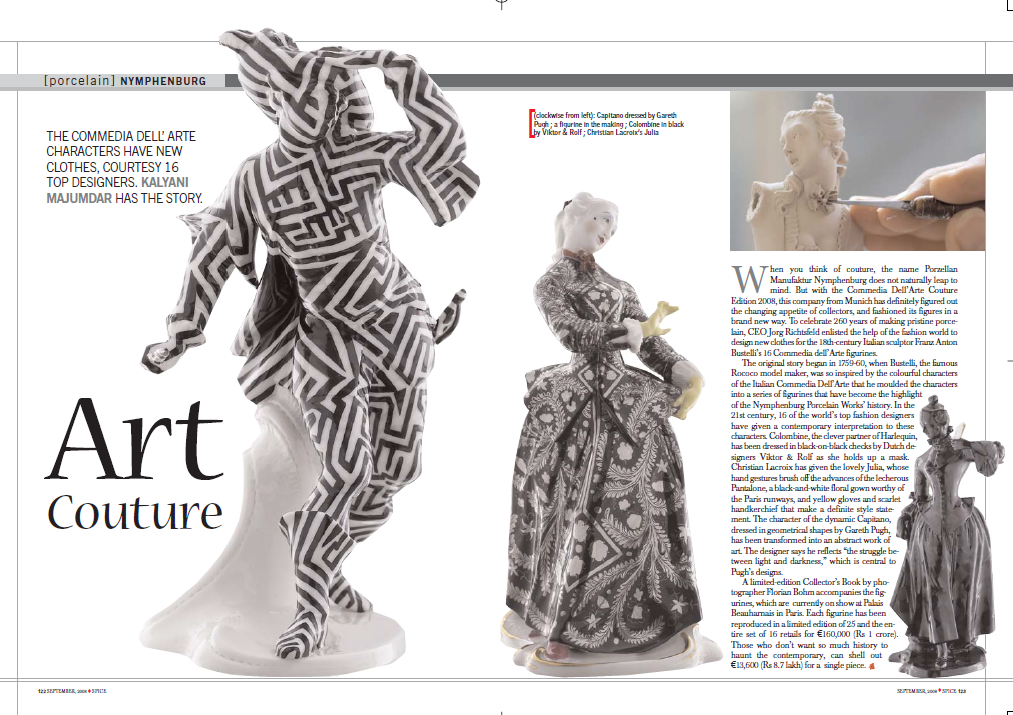
    When you think of couture, the name Porzellan ManufakturNymphenburg does not naturally leap to mind. But with the Commedia Dell’Arte Couture Edition 2008, this company from Munich has definitely figured out the changing appetite of collectors, and fashioned its figures in a brand new way. To celebrate 260 years of making pristine porcelain, CEO Jorg Richtsfeld enlisted the help of the fashion world to design new clothes for the 18th-century Italian sculptor Franz Anton Bustelli’s 16 Commedia dell’Arte figurines.

    The original story began in 1759-60, when Bustelli, the famous Rococo model maker, was so inspired by the colourful characters of the Italian Commedia Dell’Arte that he moulded the characters into a series of figurines that have become the highlight of the Nymphenburg Porcelain Works’ history. In the 21st century, 16 of the world’s top fashion designers have given a contemporary interpretation to these characters. Colombine, the clever partner of Harlequin, has been dressed in black-on-black checks by Dutch designers Viktor & Rolf as she holds up a mask.

    Christian Lacroix has given the lovely Julia, whose hand gestures brush off the advances of the lecherous Pantalone, a black-and-white floral gown worthy of the Paris runways, and yellow gloves and scarlet handkerchief that make a definite style statement.

    The character of the dynamic Capitano, dressed in geometrical shapes by Gareth Pugh, has been transformed into an abstract work of art. The designer says he reflects “the struggle between light and darkness,” which is central to Pugh’s designs.

    A limited-edition Collector’s Book by photographer Florian Bohm accompanies the figurines, which are currently on show at Palais Beauharnais in Paris. Each figurine has been reproduced in a limited edition of 25 and the entire set of 16 retails for €160,000 (Rs 1 crore). Those who don’t want so much history to haunt the contemporary, can shell out €13,600 (Rs 8.7 lakh) for a single piece.

  • Earthy innovation

    Earthy innovation

    Text by Kalyani Majumdar | Photos by Bhati N. & Mansukh Prajapati |

    Published in Domus India & Italian edition | Nov 2011

    Despite the challenges of moulding clay products in a world populated with plastics and electronics, Mansukh Prajapati continues to harness green technology from clay for the village and the city

    Those in town, city and suburb who alike have experienced the nightmare of relocating to a new house and finding out that one needs more electrical sockets than the place provides, surely remember the wish for certain appliances that could function without electricity. Even as the urban world throws such challenges at us, a humble potter in Gujarat decided to further develop the art and science of moulding clay with his innovative applications and designs to answer a fundamental problem related to household gadgets.

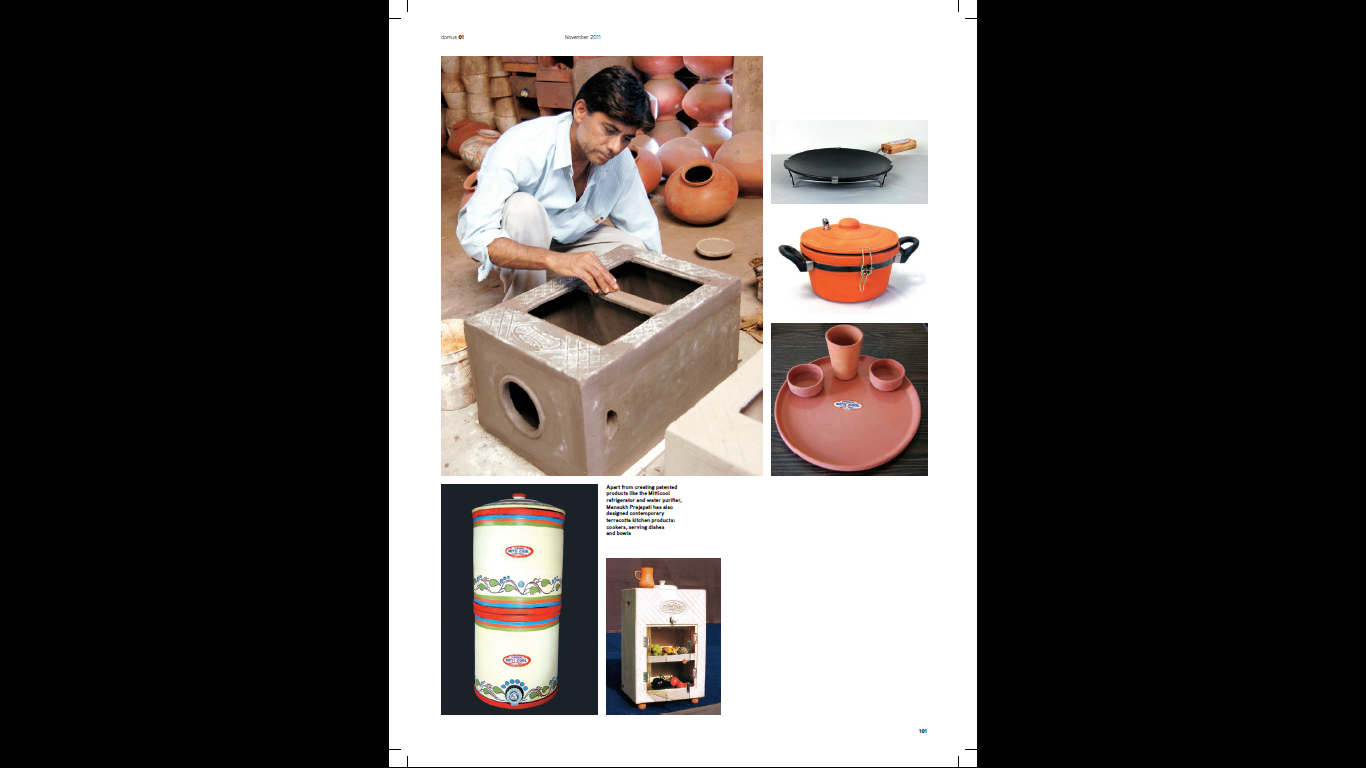
    Mansukhbhai Prajapati is an ordinary potter with extra-ordinary ideas and has proven the truth of that famous adage—necessity is the mother of all invention. Hailing from Rajkot, Gujarat, Mansukhbhai belongs to a traditional potter family. While working in a tile-making factory he learnt how the big terracotta-manufacturing units worked. Then in 1988, securing a loan of r30,000 from a local lender, he started out on his own. For the next three years he improved on the design and material for the manufacture of clay tavas and in 1992 he came up with a tava that was far more durable than the ones then being made. Since his constant inspiration has been the needs of common people, and knowing the perils of not having access to clean drinking water, he began designing water purifiers made of clay with the dual-function of purifying and cooling at the same time. Durable and reasonably priced, the product was an instant success with the local rural population.

    Mansukh Prajapati posing with his Mitticool products

    But, the real innovation was yet to come. In the aftermath of the 2001 earthquake epicentered at Bhuj, which shook the entire region of Gujarat bringing heavy loss of life and material, mostvillagers lost the clay pots they used to store and cool water in. The plight they faced motivated Mansukhbhai to engineer a refrigerator made out of clay—cheap and free of the need for an electrical outlet. It took four years of work on a suitable moulding technique and to develop a machine that could separate clay from sand to make a purer form of clay, and then work on the technique of firing it at a controlled temperature of 1250 degree Celsius—this process is used to increase the porosity of clay, to successfully prototype the idea. The handmade Mitticool refrigerator which emerged from this research can store 10 litres of water and vegetables for eight days, and dairy products for one day with a total storagecapacity of five kilograms of vegetables; this technology also helps preserve the original freshness of vegetables. This clay product works without electricity and uses the same principle of cooling as traditional terracotta pots. It takes about eight days to produce one and is priced at r2,500. Facilitators like the Gujarat Grassroots Innovation Augmentation Network (GIAN) have helped him for the past six years with patents, market visibility and technical inputs for his products, while design assistance has been provided by the National Institute of Design (NID). Interestingly, the Mitticool range of products is slowly gaining popularity among city dwellers. Today, in addition to Ahmedabad he supplies to vendors in Pune, Mumbai, Gujarat, Hyderabad and Chennai.

    In a world populated with cheap plastics and electronics, the unassuming Mansukhbhai is considering the marketing of these products internationally, while continuing to focus on building as many Mitticool products for village-dwellers and city-folk as he can practically produce. One of his ambitions, at a very different scale, is to build eco-friendly houses from organic materials which consume negligible electricity and are earthquake-proof.

    Apart from creating patented products like the Mitticool refrigerator and water purifier, Mansukh Prajapati has also designed contemporary terracotta kitchen products: cookers, serving dishes
    and bowls

    It is a modern paradox that even as the world begins to slowly crave for sustainable everyday products, a small town potter like Mansukhbhai, with creations which are a proven precursor to deeper innovation in clean technologies at the mass level of everyday products, still struggles to achieve a firm grasp on the market which began foremost as a market built on a bank of traditional intelligence.

  • MANY HANDS, MANY FORMS – KUMARTULI

    MANY HANDS, MANY FORMS – KUMARTULI

    Photo essay by Kalyani Majumdar | Published in Domus India | Nov, 2013

    Ceaseless monsoon rain and scorching hot and humid weather cannot dampen the spirit of the kumors/kumars (potters) of Kumartuli as they continue shaping clay to create idols for more than two centuries.

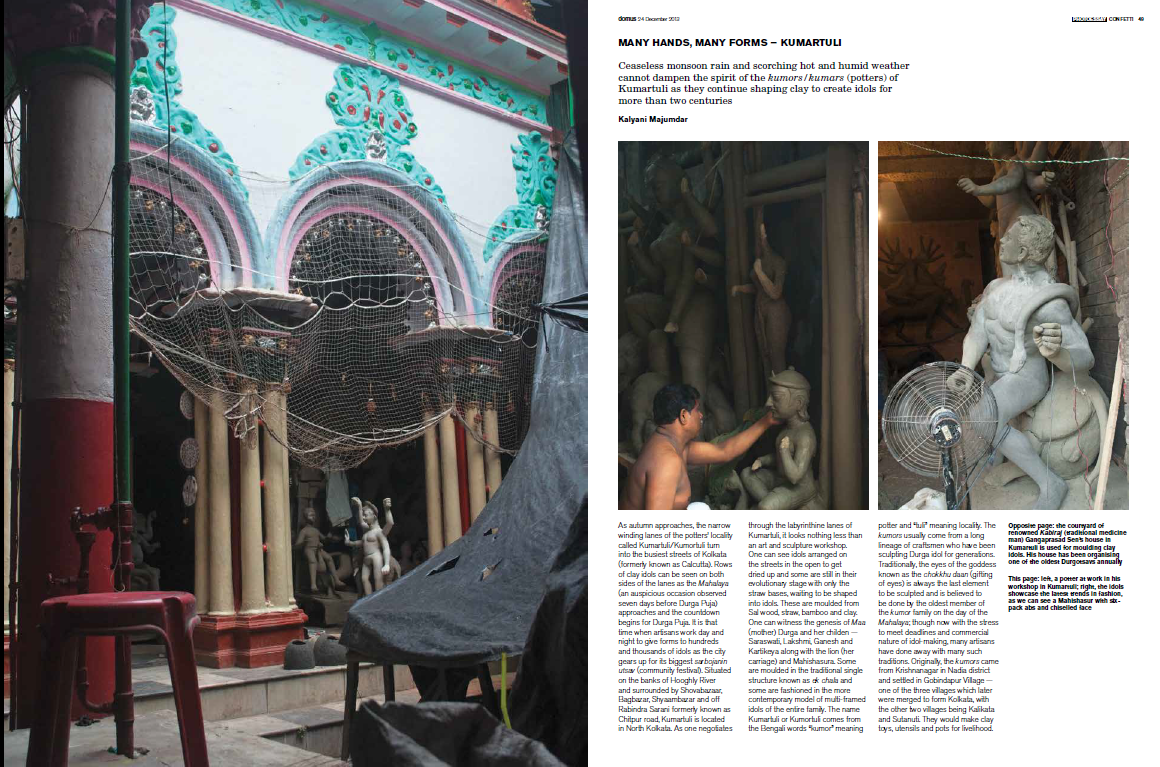
    The courtyard of
    renowned Kabiraj (traditional medicine
    man) Gangaprasad Sen’s house in
    Kumartuli is used for moulding clay
    idols. His house has been organising
    one of the oldest Durgotsavs annually

    As autumn approaches, the narrow winding lanes of the potters’ locality called Kumartuli/Kumortuli turn into the busiest streets of Kolkata (formerly known as Calcutta). Rows of clay idols can be seen on both sides of the lanes as the Mahalaya (an auspicious occasion observed seven days before Durga Puja) approaches and the countdown begins for Durga Puja. It is that time when artisans work day and night to give forms to hundreds and thousands of idols as the city gears up for its biggest sarbojaninm utsav (community festival). Situated on the banks of Hooghly River and surrounded by Shovabazaar, Bagbazar, Shyaambazar and off Rabindra Sarani formerly known as Chitpur road, Kumartuli is located in North Kolkata. As one negotiates through the labyrinthine lanes of Kumartuli, it looks nothing less than an art and sculpture workshop.

    One can see idols arranged on the streets in the open to get dried up and some are still in their evolutionary stage with only the straw bases, waiting to be shaped into idols. These are moulded from Sal wood, straw, bamboo and clay. One can witness the genesis of Maa (mother) Durga and her childen —Saraswati, Lakshmi, Ganesh and Kartikeya along with the lion (her carriage) and Mahishasura. Some are moulded in the traditional single structure known as ek chala and some are fashioned in the more contemporary model of multi-framed idols of the entire family. The name Kumartuli or Kumortuli comes from the Bengali words “kumor” meaning potter and “tuli” meaning locality. The kumors usually come from a long lineage of craftsmen who have been sculpting Durga idol for generations.

    Traditionally, the eyes of the goddess known as the chokkhu daan (gifting of eyes) is always the last element to be sculpted and is believed to be done by the oldest member of the kumor family on the day of the Mahalaya; though now with the stress to meet deadlines and commercial nature of idol-making, many artisans have done away with many such traditions. Originally, the kumors came from Krishnanagar in Nadia district and settled in Gobindapur Village — one of the three villages which later were merged to form Kolkata, with the other two villages being Kalikata and Sutanuti. They would make clay toys, utensils and pots for livelihood decided to build Fort William at Gobindapur village, the inhabitants of that area migrated to Sutanati and it is believed that under the instruction of the Company, John Holwell was given orders to designate areas according to the nature of profession of the inhabitants; Kumartuli was one such area that was designated as a residential area for all the potters and craftsmen. In those days these kumors were invited by the old and nouveau rich Indian households —mostly the Zamindars who were also the first few patrons and organised Durga puja in their houses — to make clay images of Durga and other idols. These houses had thakurdalans/thakurbaris (separate building used for annual festivals).

    The thakurdalans were high-ceilinged flat-roofed buildings. Apart from the autumn festival, the artisans were called round the year to sculpt ornamental elements such as the fairies, foliages, other patterns and inlay works on brackets and columns of the houses as many modelled after the Western influence, thus giving rise to a fusion of Indo-Bengal form of ornamental art for residential built forms. With time, as Durgotsav shifted out of the thakurdalans and became a community festival, the common people became the new patrons of Kumartuli. Also, every year one can easily predict the current trends in vogue by looking at the idols; this time it was Mahishasurs’ six-pack abs and chiselled faces that were in popular demand — straight out of a Greek mythology.

    A potter at work in his
    workshop in Kumartuli
    The idols
    showcase the latest trends in fashion,
    as we can see a Mahishasur with sixpack
    abs and chiselled face

    From its humble beginning to post- Independence, Kumartuli has risen to become the exclusive exporter of idols of the goddess to the Bengalis settled in different parts of the world. Clearly, Kumartuli is more than just an urban space in Kolkata that produces clay idols for Durga Puja. It has been an active participant for more than two centuries in maintaining a continuity of cultural tradition and craftsmanship, and has witnessed the trajectory of the changing socioeconomic and political climate of the city — the transition from pre to Post- Independent India and from Calcutta to Kolkata.

    All photographs and text copyright with Kalyani Majumdar

  • THE SPACE AROUND THE CORNER

    THE SPACE AROUND THE CORNER

    Text by Kalyani Majumdar | Published in Domus India | 2014 | Photos & Drawings by NilaA Architecture & Urban Design

    Understanding the immediacy of a built form and the need of the place and the area around is the idea behind KONA — a cohesive and dynamic space in the heart of Delhi — that demonstrates a design solution for urban spaces in cities where ambitions and aspirations can be merged.

    Is architecture limited to the built form? What is the fundamental task of architecture? Is it not connected with all the aspects of a human life; how we eat and live? Can architecture provide an inspiring experience for people inside and outside of it, and is it not responsible, at the very least, to its immediate context and inhabitants? These are some of the questions that are tenaciously revisited as the discussions continue globally on the concept of a ‘human city’ in relation to megacities.

    In the last decade Delhi has transformed into a megacity with endless construction of new buildings, shopping malls and offices. With new development ventures such as the ongoing metro project, Delhi is more connected now from all directions than ever before. But this extreme pace of urbanisation of Delhi has thrown open pressing questions and discussions revolving around the role of architects and urban designers to design spaces that are holistic; in other words, something that is sustainable and cohesive.

    With new structures coming up everywhere, what happens to the abandoned buildings that were built once, and now the city has forgotten about? And even as the city struggles to accommodate more people, there are buildings that lay abandoned in prime locations and otherwise; what is the fate of those modern ruins in the present context?

    The exterior view of the corner block that has been converted into KONA

    1, Jor Bagh Market in centralDelhi makes a plausible example in this context. ‘Kona’ in Hindi means corner, and that is precisely the location of this two-storeyed gallery space above a public corridor, in a prime central Delhi location with neighbourhoods such as Golf Links and Lodhi Garden surrounding this quiet and posh residential area. Designed by Delhi-based architect Nishant Lall of NilaA Architecture & Urban Design, KONA was an abandoned space in the corner block of Jor Bagh Market. And now it has been transformed into a community space for collaboration of design, art, architecture and organic farming, thus providing an informal space in the heart of the city that is accessible to all. While there are many examples in the city where abandoned properties have been transformed into commercial setups, those are strictly gentrified. But, not this space. KONA is supported by Inderpal Kochhar of Sewara Group, who is also the owner of the abandoned site that houses this space, and wanted the disused space to cater to creative pursuits of people from across India, and thus KONA came into being.

    For people who grew up in Delhi, Jor Bagh Market in central Delhi needs no introduction as it is known for its book shop, fashion boutiques and shops selling furniture, art ware, handicrafts and collectibles. Jor Bagh residential area was developed around the 1950s and the 60s and KONA is housed in a 1950s era local convenience centre built by the government. 1, Jor Bagh market is a two-storeyed corner block and had a famous restaurant called Mini Mughal and a halwai; both have shifted now to other localities. The ground floor had eight shops, of which only three are presently functioning, and the shopkeepers had living quarters on the first floor. But it has been around five years that the top floor and the terrace have been vacant and have been lying disused, in a dilapidated state. So, when Kona gallery was opened up on the first floor, it was a blank canvas ready to be rethought and revisualised. The structure was upgraded using micro concreting and carbon fibre strengthening of beams; the raw walls have been preserved in their natural state for aesthetic reasons for the pop-up art shows. In fact the ruggedness and raw-look works well for the space, as in an area like Jor Bagh, it stands out amongst the other built forms around. The abandoned shops on the ground floor have been turned into a gallery space along with the first floor. The six interconnected rooms on the first floor that were once living quarters have been connected and redeveloped into smaller gallery spaces. The toilet has been converted into a media room.


    Recycled wooden crates have been used as display props for an exhibition in the L-shape gallery space.

    Recycled wooden crates were used as props for display purposes during the exhibitions and later used as book stacks. The wall space is available to be used as a visual gallery and is open for experimental works in the future.

    The rear screen was made out of cement bags.
    Artists making graffittis on the terrace walls
    The once disused terrace space has been converted into an organic farm

    The space opened in January 2013 with an interdisciplinary pop-up art show. The events and talks are curated by one of the KONA members, Sonya Fatah. In April 2013, a multidisciplinary pop-up art exhibition titled Lateral was curated by Heidi Fichtner with site-specific artworks, painting, sculpture, video, photographs, drawing and a sound installation by artists across three generations. The corner space is largely a platform to promote dialogue amongst professionals from different fields and think, discuss and provide ideas that would act as catalyst in the near future for a new ways to live in urban India. Innovation in the form of juggad (making do) technology can be seen at every step as the exhibition space was refurbished with recycled materials such as the rear screen was made out of cement bags, and bubble wrap was used as screen wrap for uniform lighting for the galleryspace during the shows, and was later used to pack the artworks.

    The space on the first floor above the public corridor is an L-shaped gallery space. And the entrance to the gallery space was renovated with leftover building materials as stone slabs and crushed bricks gravel beds. The entry to the gallery on the first floor is from rear of the building and the entry court acts as visual connector between all the floors. The first floor also has an interactive open space. The terrace of the corner block has been converted into a space for organic farming. Every Sunday, KONA is turned into a space for organic farmers’ market and apart from selling organic fresh farm food, KONA is also aiming at helping horticulturalist from the city to convert their balconies or gardens into small-scale vegetable beds.

    Sketches by the architects.

    The corner block in Jor Bagh market is a perfect illustration of how a modern ruin need not be erased; rather, it can be remodeled and reused. The architect manages the challenging task of not overdoing and has exercised restraint throughout the design intervention, as there was an original context already existing and to rebuild upon it was more like recycling an architectural space to provide alternative experimental platform. KONA is indeed a unique participatory space and is housed in a posh area, yet from the outside it is unintimidating. However, the challenge for the sustainability of such projects is entwined with economics, as even the most innovative ways to display, design and organise an interactive and creative space would cost something, no matter how inexpensive it might seem at face value. But, for now, this space in Jor Bagh is a stepping ‘corner’ for a design and lifestyle revolution in the megacity, Delhi, and bringing it closer to the concept of a “human city”.

  • An anthology on women in Indian photography

    An anthology on women in Indian photography

    By Kalyani Majumdar; Published in Domus India magazine; News section; 2014

    Group Portrait, circa 1875

    The advent of photography brought many changes especially in terms of how we document the historical, social, gender and political aspects of a society in which the image stems from. Prior to photography, it was only painting of portraits that could capture an aspect of a person or place or culture that was closest to what reality was, but it was nowhere close to the accurateness of photographs. As it provided a real-time image, it was more objective than subjective, and many preferred the exactness of science.

    The British in India introduced many important technological/scientific innovations and photography was one of them. In fact, as early as the 1850s photography was available in India. In a recently held exhibition by Tasveer in collaboration with Saffron Art threw light on an absolutely rare aspect of Indian photographs — the women. Aptly titled Subjects & spaces, women in Indian photography showcases rare photographs taken from the 1850s to 1960s, of women from different backgrounds posing for the latest device of that time — the camera.

    The reclining lady, c 1870

    Initially photographs were mostly clicked by the British for archiving purposes, and some photographed as amateurs for their personal albums to take back to England as memories of India and its people. Mostly the portraitures were clicked inside studios with elaborate backgrounds of architectural elements and the postures were mostly a reflection of Western style and design. These images were meant for displaying at home or private spaces rather than for public display. The collection shows an interesting aspect of how these women interacted with the camera with a stranger behind the lens clicking those photographs, especially during the 18th and the 19th century Indian society, where women were mostly behind veils and were not accustomed to meet or talk to strangers, let alone pose for the camera. But, in the image titled Group portrait, c1875 showing a group of presumably Marathi women is quite interesting, as the subjects defy any form of femininity in their posture or even the way they look at the camera, rather they exude dominance and power. It takes a while to spot the little boy standing next to them. Also, one must remember that in the 19th century, it was extremely difficult to photograph large groups of people, getting them to stay still for the long exposure time. A photograph titled Palanquin with bearers; c1860 is an interesting one, as these were the carriages that women used to travel in, so that no one could see them in public spaces. Another image that draws attention is The Reclining lady; c1870 shows an Indian woman posing in a sensuous manner but her face holds a blank expression. Since it has been clicked in a studio, one can see in the background the column and the posture has a hint of Western influence in the photograph.

    Ladies in a bathing ghat, c 1870

    Other works such as a scene from the movie set Dahej, 1950 shows women performing their respective roles in the household; another scene from Boot Polish, 1954 portrays the woman as a mother. Also, a photograph worth mentioning is a demure image of Maharani Gayatri Devi, c 1945 that reflects the image of a woman that was acceptable to the Indian sensibility of the mid-20th century society in terms of her expression and attire. Looking at the group photos; Ladies in a bathing ghat, c1870, Group portrait, c1880 and First lady cyclist, 1920 describes the country and its people in real time and makes one wonder how life in those days was for the women of India. The images from this exhibition are for sale, and are sold as a limited edition boxed folio of Archival Pigment Prints. (www.tasveerarts.com)

  • Elvis Presley birth anniversary: Rocking tribute to the King

    Published in Free Press Journal; Date: 07.01.2018

    As a teenager, Elvis Presley used to hang around at the iconic Beale Street, the hub of the music scene in Memphis. Little did he know then that in few years he would become not only Rock ‘n’ Roll’s biggest star, but also a cultural force of the 50s. Kalyani Majumdar pays tribute to the King.

    Even today Elvis Presley’s soulful voice evoke the same magic that made him a star when the audience heard him on air for the first time. His music, dance moves and persona was something of a shock for the conservative 50’s American society, and it is safe to say that he did pave the way for the rock ‘n’ roll stars of the 60s. “Before Elvis there was nothing,” said John Lennon. That is just how big the Elvis phenomenon was.

    A humble beginning

    Elvis Presley was born on January 8, 1935 in Tupelo, Mississippi to Gladys and Vernon Presley. He had a twin brother who was still born. His parents did several day jobs to get by. On his eleventh birthday he wanted a bicycle and apparently his second choice was a rifle. The bicycle was too expensive and the gun obviously was a bad idea, so his mother got him a guitar instead. In 1948, the family moved to Memphis, and it was here that young Presley got his music influences from. During his teenage years he spent his free time at the black part of Memphis. Beale Street was known for its Blues and Jazz clubs. He would regularly go there to listen to B.B King and other popular black artists of the time. He finished his schooling from Humes High in 1953. He took up a job as a truck driver, but he never quit singing.

    Meteoric rise of Elvis Presley to stardom

    Elvis Presley performing Jailhouse Rock

    In 1954, DJ Dewey Philips played Presley’s version of That’s All Right on his radio show for the first time. It was recorded at the legendary Sun Studio situated at downtown Memphis. After the song was aired the phones won’t stop ringing. The listeners were ecstatic and numerous requests poured in to play the song again. This was only the beginning of Presley’s popularity. In 1956, Presley became a national star. His songs, Heartbreak Hotel, Don’t Be Cruel, Hound Dog, Love Me Tender were all chart toppers. He was unstoppable.  He made his TV appearance with the Dorsey Brothers’ Stage Show and then on The Ed Sullivan Show. After conquering the radio and television, it was his turn to light up the big screen. Love Me Tender released in 1956 did not do that well. However, Jailhouse Rock in 1957 made an impact on the big screen. It had a strong storyline, fantastic songs along with Presley’s signature dance moves. One could even say that the title track of this movie was perhaps the first music video ever made.

    Elvis, the cultural movement

    It was the 1950s when Elvis Presley arrived in the music scene. The American society was conservative then. The demarcation between Black and White people was very stark. Cultural biases were very evident. However, Presley managed to blur that colour line between what was considered Black music and White music. No one before Presley had ever blended African-American R & B with country blues and gospel music, let alone a white Southerner. Unknowingly, he had broken the racial barrier through his music. His dance moves were considered provocative and he exuded sex appeal. He was not conventional and his music did not conform to the norms of that time. He was shaking and stirring the American society. His distinct edgy hairstyle and clothing were becoming a fashion statement for the teenagers. His fame was a clear sign that the youth wanted a change and he was epitome of that change.

    His dance moves were considered provocative and he exuded sex appeal.

    The King had arrived

    People would either like or dislike him, but no one could ignore Elvis Presley. Initially, the popular family television programme, The Ed Sullivan Show had announced that he would not feature Elvis Presley on his show because his music and dance was considered vulgar and was posing a threat to the American society, especially the youth. But seeing the viewership ratings for other shows featuring Presley, Ed Sullivan could not ignore him anymore. However, Presley was shown performing waist up and even then the viewership was phenomenal for that particular episode. Never before had the world seen such hysteria at a music concert. His good looks coupled with his voice made women go frenzy at the sight of him. Teenagers were tattooing his name. America didn’t know what to make of it. Elvis Presley was a phenomenon and was creating the same magic internationally too. Presley was nominated 14 times for Grammy and had won the Grammy three times and was also the recipient of the Grammy Lifetime Achievement Award. He is believed to have sold more than one billion records worldwide, and his American sales alone had earned him gold and platinum awards.

    The U.S Army and Personal Life

    He was at the pinnacle of his music career when in 1958 he had to join the U.S Army. He served his country till 1960. It was also at that time that he met his future wife Priscilla Beaulieu. Post his stint in the army, Presley continued to give hits such as Are You Lonesome Tonight in 1960 and Can’t Help Falling In Love in 1961 to name a few. He married Priscilla in 1967, however the marriage didn’t last long and they divorced in 1972.

    If I can dream

    In 1968, Presley came out with his comeback special with a soul searching and socially conscious song, If I Can Dream. Till this day, it is one of the most powerful and emotional performances by him. It was recorded two months after Martin Luther King Junior’s assassination and it made the lyrics and the song even more relevant for the time.

    Graceland

    In 1957, Presley bought the stately mansion, Graceland. It is now Elvis Presley museum and is one of the most visited houses in the United States. Millions of fans from all over the world visit his house which is now a pilgrimage of sorts. Elvis Presley was known for his kindness, humility and generosity. He would often give money to strangers and was always dedicated to his fans.

    On August 16, 1977 he was found dead by his then girlfriend, Ginger Alden in his bathroom in Graceland, reportedly of a heart attack. He was only 42.

    Play it again, Elvis

    While we may or may not see the ghost of Elvis walking in Memphis, he surely comes alive the moment his deep and heartfelt voice floats from the speakers and we can’t help falling in love with him all over again.

  • The French connection in Bengal

    The French connection in Bengal

    Nestled along the Hooghly River is a tiny town just 35 kilometres from Kolkata that is steeped in history and is definitely worth exploring, writes KALYANI MAJUMDAR.

    Published in Free Press Journal; Date 21.05.2017

    Clock Tower; Image credit: Kalyani Majumdar

    A gentle breeze welcomes you as you step on the Strand. The beautiful promenade along the Hooghly River is a lovely stretch and across it stands a row of beautiful French colonial buildings.  Wait, French? Yes, you read it right! It is a general perception for most that in India the French existed only in Pondicherry. In fact this quaint place called Chandernagore was and still is, the La petit French—the little France—in West Bengal and is only 19 square kilometres in total area. Chandernagore might be a small town but its historical significance cannot be trifled with.

    A town with many names
    The name of the town itself has many derivatives. Some say that the bank of the river forms the shape of the moon—chandra—inBengali; others say it is named after the oldest temple of Goddess Chandi. According to some it was believed to be a centre for selling sandal (chandan). The best way to explore this lovely town is to walk it.

    The advent of the French
    Chandernagore became a French colony in 1673, wherein they established their trading banks, and it became a permanent French settlement by 1688. After the 1757 war with the British the town changed hands a couple of times between the British and the French. However, from 1816 it remained with France till 1950. Although Chandernagore was a French colony, it had a strong convergence of the French and Bengali cultures as many Bengali merchants flourished and played an important role in development of the town.

    Institute de Chandernagore – Dupleix Palace ; Photo credit: Kalyani Majumdar

    Institute de Chandernagore – Dupleix Palace
    In 1730, Joseph François Dupleix was appointed governor of Chandernagore. It was during his time that the town became the main center of commerce in Bengal. The Fort d’Orléans, was also built during his time. Today the reminiscence of Dupleix’s glorious years in Chandernagore is housed in the Institute de Chandernagore that stands in a grand manner located on the Strand commanding a view of the Hooghly River. It is a French colonial building with spacious verandahs enveloping the entire building supported by columns. A flight of steps take you to the entrance to the museum that showcases artefacts, old photographs and Dupleix’s personal belongings. You can spend a good few hours strolling in the garden or sit in the verandah and enjoy the scenic view.

    Every building has a story
    Built in 1904, the Patal Bari (underground house) on the Strand is worth a visit as its lowest floor is submerged in the river. Some very prominent personalities have resided in this house during their visit to the town including Rabindranath Tagore. A clock given by Joseph Daumain sits on the tower facing the promenade reminding everyone of the times that this town has seen. The other grand building on this stretch is the sub-divisional court of Chandernagore. However, it was not always a court. It was the Hotel de Paris. You could very well imagine the spacious verandahs and gardenslit up for the typical Parisian evening soirees. The road off the Strand takes you to Sacred Heart Church. This Roman Catholic Church was built around 1875 and has beautiful stained glass paintings. As you continue walking past the church you come across shops, and old houses competing with new buildings.

    Nandodulal temple ; Photo credit: Kalyani Majumdar

    The temple that withstood cannon fire
    This town played a pivotal role in the famous Battle of Plassey in 1757 when Robert Clive destroyed the Fort de Orleans along with houses and places of worship. There are few buildings that still stand as mute witnesses to Clive’s cannon balls. The temple that still exists from that time is the Nandodulal temple. Built in 1740, it is believed to be the largest dui chala (double-sloped roof) temple in Bengal. Located on a picturesque landscape with a little pond on the rear, the wall still carries theimprint of Clive’s cannon balls.

    Refuge for Indian freedom fighters
    As you peel one layer of history of this town you unravel another layer beneath.  Since Chandernagore was a French colony during the same time when Calcutta was under the British, many freedom fighters from British Bengaltook refuge in French Bengal. The most famous name is of Sri Aurobindo Ghosh. The house where Sri Aurobindo went into hiding and used the space to make bombs still stands. In fact many brave hearts such as Kanailala Dutt and Rajbihari Ghosh that fought for the Indian freedom against the British hailed from this town. You can visit the Prabartak Ashram that was established by Motilal Roy. It used to be a safe haven for freedom fighters.One should not miss the Laldighi on the Grand Trunk road, the cemetery across it, and the old library building not very far from there.

    Local flavour
    Although most of Chandernagore’s identity comes from its French association, but one that continues to have the local Bengali flavour is the Jagaddharti Puja. It is celebrated with much fervor. After a heavy duty history tour one should not miss the lovely evenings at Strand. It looks like the entire town is on the promenade. With shopping carts and ferries on either side of the Strand selling trinkets, street food, icecream carts. Music floating from the Rabindra Bhawan across the street and the sight of old people discussing politics and Tagore on the same breath is quiet a sight, not to be missed by anyone. Albeit, officially Chandernagore merged with West Bengal and became part of India in 1951, the vestiges of the Liberty gate on the south of the town acts as a reminder of the French connection with the inscription sayingLiberté, égalité, fraternité—Liberty, equality, fraternity—the three pillars of the French revolution. We tip the hat for those lovely words that continue to give us hope.

  • Celebrating Oscar Wilde, the iconic writer

    Published in Free Press Journal; Date: 15.10.2017

    Known for his wit and flamboyant style, Oscar Wilde needs no introduction in the literary world. He was certainly a non-conformist, trapped in the narrow-mindedness of the late Victorian English Society. KALYANI MAJUMDAR celebrates the iconic writer.

    Oscar Wilde once wrote, “The world is yours for a season.” Startlingly, the quote came to reflect the trajectory of his own life. He was basking in the glory of his literary works when his life quite dramatically took an unfortunate turn that finally led to his eventual downfall. And, what a great tragedy it was for the world to have lost a brilliant playwright, novelist, essayist and poet. Was he far too bold for the 19th century? Perhaps, he was.

    The early life

    Born in Dublin, Ireland on October 16, 1854, Oscar Wilde was a bright boy with avid interest in Greek and Roman studies. His father Sir William Wilde was a renowned doctor and his mother Jane Wilde was a poet, who wrote under her pen name Speranza. Her liberal ideas had a strong influence on Wilde’s early life. While studying at Portora Royal School, he was awarded a scholarship to attend Trinity College in Dublin. Afterwards, he went on to complete his graduation from Oxford University. At Oxford, he wrote a prize winning poetry titled, Raveena, in 1878.

    A fashion icon

    When Wilde went to New York on a lecture tour, he drew a lot of attention due to his stylish attire and flowing wavy hair that was unlike the fashion that was prevalent then. Not surprisingly, he strongly supported the Dress Reform Movement of the 19th century.

    Feminist, family and children’s stories

    In 1884, he married Constance Lloyd, a wealthy Englishwoman and had two sons Cyril and Vyvyan. He took up a job as the Editor of a magazine on women’s fashion, called The Woman’s World. Wilde expanded the range of content in the magazine by focusing on not just what women should wear but also of what they think and feel. It gave a platform for women to voice their opinion. Simultaneously, Wilde published The Happy Prince and Other Tales, a collection of stories for children in 1888. The popularity of the stories garnered him significant attention and praise.

    Aestheticism and Dorian Grey

    A scene from the movie Picture of Dorian Gray, 1945

    From his Oxford days, Wilde was deeply influenced by Aestheticism. The movement emphasised on the aesthetic value of a creative work that should be independent of vices and virtues. Oscar Wilde was devoted to this idea and his works reflected that fully. In 1891, he published his first and only novel, The Picture of Dorian Grey. It was a story of an attractive young man, Dorian Grey, who traded his soul with his portrait, so that he would remain young while his painting would age. Alas, the novel did not go down well with the Victorian English society, as they felt it had a sheer absence of morality and the lead protagonist lacked virtue. However, Wilde stayed committed to his devotion to aestheticism. While defending his work, he said that right and wrong are just material for the artist to work with. Of course, the book is now revered as one of the finest classics from 19th century and has been adapted into numerous movies, plays and television series.

    The brilliant satirical playwright

    Wilde’s natural wit won the hearts of the masses with his plays. In 1892, he penned his first play, Lady Windermere’s Fan. It received critical acclaim. It was followed by A Woman of No Importance in 1893, again a huge success. Then in 1895 he wrote two plays, An Ideal Husband and The Importance of Being Earnest. The latter went on to become his most popular play. Wilde was the toast of the town. His name was resonating on every socialite’s living room.

    The infamous case

    During the time when Wilde was riding high on his literary success, he got involved with a young man, Lord Alfred Douglas. In his private life Wilde was homosexual and it was an open secret. But in Victorian England being homosexual was a crime. When Douglas’ father, Marquess of Queensberry, got a whiff of the affair, he left a calling card for Oscar Wilde addressing him as a posing sodomite. It was evident that Queensberry wanted to ruin Wilde’s reputation and popularity. When Wilde sued Queensberry for libel, a lengthy trial began and evidences were presented by Queensberry of Wilde’s homosexuality. Although, the credibility of the evidences was rather questionable in nature, Wilde was arrested on charges of ‘gross indecency’. He was convicted for two years of hard labour in prison. Overnight his playbills were removed from every theatre.  Wilde became a pariah. His name was not to be uttered in public.

    The last days

    In 1897 when he was released from prison he was impoverished and alone. He left for Paris. He wrote very little in the last years of his life. In 1898 he wrote The Ballad of Reading Gaol describing his experience at the prison. Wilde died in a cheap hotel in Paris in1900 due to cerebral meningitis at the age of 46. He rests at the Père Lachaise Cemetery in Paris and it is one of the most visited graves.

    Questions left unanswered

    In the strange turn of events in his life, there are many ambiguities in the charges that were made against him. Apparently, some documents from the trial went missing. Throughout the trial, few of Wilde’s close friends felt that he was trying to protect Douglas and did not defend himself adequately for some of the outrageous accusations that were brought against him. Clearly, Wilde paid a steep price for his affection for Douglas.

    Literary legend

    Although, Oscar Wilde’s last days were spent as an outcast, he remains immortalised through his brilliant works that he has left behind. His quotes are timeless, and even after more than a century has passed, his writing does not fail to find an eager audience.

  • Revisiting Brutalism

    Text by Kalyani Majumdar

    Published in Domus; Date: May 2014

    SESC Pompeia in Sao Paulo, Brazil designed by Lina Bo Bardi

     The term Brutalism evokes a myriad of responses from the architecture and design community — some are extremely critical and some see it as a utopian moment in architecture, but mostly it evokes extreme emotions and debates. And thus it did not come as a surprise that when an event curated by Mohile Parikh Center in collaboration with Studio X, Mumbai had Prof. Yehuda Safran revisiting Brutalism through a presentation, followed by a conversation with architect Mustansir Dalvi, had full attendance at the spacious Studio X. Originating from a French term béton brut, when translated stands for “raw concrete” defines it as literally as possible. Brutalist buildings were known for their sculptural qualities and the rawness that was evident from the display of true materiality — raw concrete. It is believed that this form of architecture was developed between 1950s to the mid 1970s. Some say that Brutalism sprung out of a need to create a classless society and against gentrification in a city. Post-war Britain saw Brutalist buildings coming up everywhere and it was evident that this movement was seen as an evocative solution to create a classless society and to create mini-societies that would comprise schools, hospital, shops/ community centre, banks and other basic amenities for the people living around. Also, there was a grand cost-cutting due to in-situ casting. Among Prof Safran’s presentation of Brutalist buildings was the infamous Robin Hood Gardens in Poplar, London designed by Alison and Peter Smithson in the late 1960s and realised in 1972.

    The idea behind this structure was indeed pragmatic with Smithsons’ social intentions that integrated through the concept of “streets in the sky” and one must admit was a wonderful idea for any city where people crave to get a glimpse of the sky. Every third level of the buildings was designed with a wide concrete balcony jutting off towards the centre of the site, overlooking the garden. After much deliberation Tower Hamlets Council passed the demolition plans for Robin Hood Gardens and just last year it was razed to make way for new structure. During the talk, Prof Safran mentioned that Brutalism by many is associated with the term satanic. One might think probably because it was a movement that did trigger radical thoughts to design cities which did not go down well with many from the design communities. Another Brutalist building from Prof Safran’s presentation was the SESC Pompeia in Sao Paulo, Brazil. After the end of a 20-year military regime SESC Pompeia in Sao Paulo, Brazil designed by Lina Bo Bardi was an important addition to the Sao Paulo skyline and was a fresh start for the country as its two concrete towers connected to each other with pre-stressed concrete walkways. Even though the conversation lasted for two hours, but it did make us ponder on the current take on Brutalism. Is demolishing of these buildings the only way forward? To sum up all the facts Brutalism was a movement of a particular time and it had a great influence and played a part in modern form of architecture. Isn’t it possible to repurpose the architectural form that after all stemmed out of a novel idea to lessen disparity amongst the city dwellers and prevent urban gentrification?


    Event detail:

    Mohile Parikh Center
    www.mohileparikhcenter.org
    Studio X, Mumbai
    www.arch.columbia.edu
    SESC

  • The French connection in Bengal

    The French connection in Bengal

    Nestled along the Hooghly River is a tiny town just 35 kilometres from Kolkata that is steeped in history and is definitely worth exploring, writes KALYANI MAJUMDAR.

    Published in Free Press Journal; Date 21.05.2017

    Clock Tower; Image credit: Kalyani Majumdar

    A gentle breeze welcomes you as you step on the Strand. The beautiful promenade along the Hooghly River is a lovely stretch and across it stands a row of beautiful French colonial buildings.  Wait, French? Yes, you read it right! It is a general perception for most that in India the French existed only in Pondicherry. In fact this quaint place called Chandernagore was and still is, the La petit French—the little France—in West Bengal and is only 19 square kilometres in total area. Chandernagore might be a small town but its historical significance cannot be trifled with.

    A town with many names
    The name of the town itself has many derivatives. Some say that the bank of the river forms the shape of the moon—chandra—inBengali; others say it is named after the oldest temple of Goddess Chandi. According to some it was believed to be a centre for selling sandal (chandan). The best way to explore this lovely town is to walk it.

    The advent of the French
    Chandernagore became a French colony in 1673, wherein they established their trading banks, and it became a permanent French settlement by 1688. After the 1757 war with the British the town changed hands a couple of times between the British and the French. However, from 1816 it remained with France till 1950. Although Chandernagore was a French colony, it had a strong convergence of the French and Bengali cultures as many Bengali merchants flourished and played an important role in development of the town.

    Institute de Chandernagore – Dupleix Palace ; Photo credit: Kalyani Majumdar

    Institute de Chandernagore – Dupleix Palace
    In 1730, Joseph François Dupleix was appointed governor of Chandernagore. It was during his time that the town became the main center of commerce in Bengal. The Fort d’Orléans, was also built during his time. Today the reminiscence of Dupleix’s glorious years in Chandernagore is housed in the Institute de Chandernagore that stands in a grand manner located on the Strand commanding a view of the Hooghly River. It is a French colonial building with spacious verandahs enveloping the entire building supported by columns. A flight of steps take you to the entrance to the museum that showcases artefacts, old photographs and Dupleix’s personal belongings. You can spend a good few hours strolling in the garden or sit in the verandah and enjoy the scenic view.

    Every building has a story
    Built in 1904, the Patal Bari (underground house) on the Strand is worth a visit as its lowest floor is submerged in the river. Some very prominent personalities have resided in this house during their visit to the town including Rabindranath Tagore. A clock given by Joseph Daumain sits on the tower facing the promenade reminding everyone of the times that this town has seen. The other grand building on this stretch is the sub-divisional court of Chandernagore. However, it was not always a court. It was the Hotel de Paris. You could very well imagine the spacious verandahs and gardenslit up for the typical Parisian evening soirees. The road off the Strand takes you to Sacred Heart Church. This Roman Catholic Church was built around 1875 and has beautiful stained glass paintings. As you continue walking past the church you come across shops, and old houses competing with new buildings.

    Nandodulal temple ; Photo credit: Kalyani Majumdar

    The temple that withstood cannon fire
    This town played a pivotal role in the famous Battle of Plassey in 1757 when Robert Clive destroyed the Fort de Orleans along with houses and places of worship. There are few buildings that still stand as mute witnesses to Clive’s cannon balls. The temple that still exists from that time is the Nandodulal temple. Built in 1740, it is believed to be the largest dui chala (double-sloped roof) temple in Bengal. Located on a picturesque landscape with a little pond on the rear, the wall still carries theimprint of Clive’s cannon balls.

    Refuge for Indian freedom fighters
    As you peel one layer of history of this town you unravel another layer beneath.  Since Chandernagore was a French colony during the same time when Calcutta was under the British, many freedom fighters from British Bengaltook refuge in French Bengal. The most famous name is of Sri Aurobindo Ghosh. The house where Sri Aurobindo went into hiding and used the space to make bombs still stands. In fact many brave hearts such as Kanailala Dutt and Rajbihari Ghosh that fought for the Indian freedom against the British hailed from this town. You can visit the Prabartak Ashram that was established by Motilal Roy. It used to be a safe haven for freedom fighters.One should not miss the Laldighi on the Grand Trunk road, the cemetery across it, and the old library building not very far from there.

    Local flavour
    Although most of Chandernagore’s identity comes from its French association, but one that continues to have the local Bengali flavour is the Jagaddharti Puja. It is celebrated with much fervor. After a heavy duty history tour one should not miss the lovely evenings at Strand. It looks like the entire town is on the promenade. With shopping carts and ferries on either side of the Strand selling trinkets, street food, icecream carts. Music floating from the Rabindra Bhawan across the street and the sight of old people discussing politics and Tagore on the same breath is quiet a sight, not to be missed by anyone. Albeit, officially Chandernagore merged with West Bengal and became part of India in 1951, the vestiges of the Liberty gate on the south of the town acts as a reminder of the French connection with the inscription sayingLiberté, égalité, fraternité—Liberty, equality, fraternity—the three pillars of the French revolution. We tip the hat for those lovely words that continue to give us hope.