THE COMMEDIA DELL’ ARTE CHARACTERS HAVE NEW CLOTHES, COURTESY 16 TOP DESIGNERS. KALYANI MAJUMDAR HAS THE STORY.
Published in India Today, Spice Solo | 2009
When you think of couture, the name Porzellan ManufakturNymphenburg does not naturally leap to mind. But with the Commedia Dell’Arte Couture Edition 2008, this company from Munich has definitely figured out the changing appetite of collectors, and fashioned its figures in a brand new way. To celebrate 260 years of making pristine porcelain, CEO Jorg Richtsfeld enlisted the help of the fashion world to design new clothes for the 18th-century Italian sculptor Franz Anton Bustelli’s 16 Commedia dell’Arte figurines.
The original story began in 1759-60, when Bustelli, the famous Rococo model maker, was so inspired by the colourful characters of the Italian Commedia Dell’Arte that he moulded the characters into a series of figurines that have become the highlight of the Nymphenburg Porcelain Works’ history. In the 21st century, 16 of the world’s top fashion designers have given a contemporary interpretation to these characters. Colombine, the clever partner of Harlequin, has been dressed in black-on-black checks by Dutch designers Viktor & Rolf as she holds up a mask.
Christian Lacroix has given the lovely Julia, whose hand gestures brush off the advances of the lecherous Pantalone, a black-and-white floral gown worthy of the Paris runways, and yellow gloves and scarlet handkerchief that make a definite style statement.
The character of the dynamic Capitano, dressed in geometrical shapes by Gareth Pugh, has been transformed into an abstract work of art. The designer says he reflects “the struggle between light and darkness,” which is central to Pugh’s designs.
A limited-edition Collector’s Book by photographer Florian Bohm accompanies the figurines, which are currently on show at Palais Beauharnais in Paris. Each figurine has been reproduced in a limited edition of 25 and the entire set of 16 retails for €160,000 (Rs 1 crore). Those who don’t want so much history to haunt the contemporary, can shell out €13,600 (Rs 8.7 lakh) for a single piece.
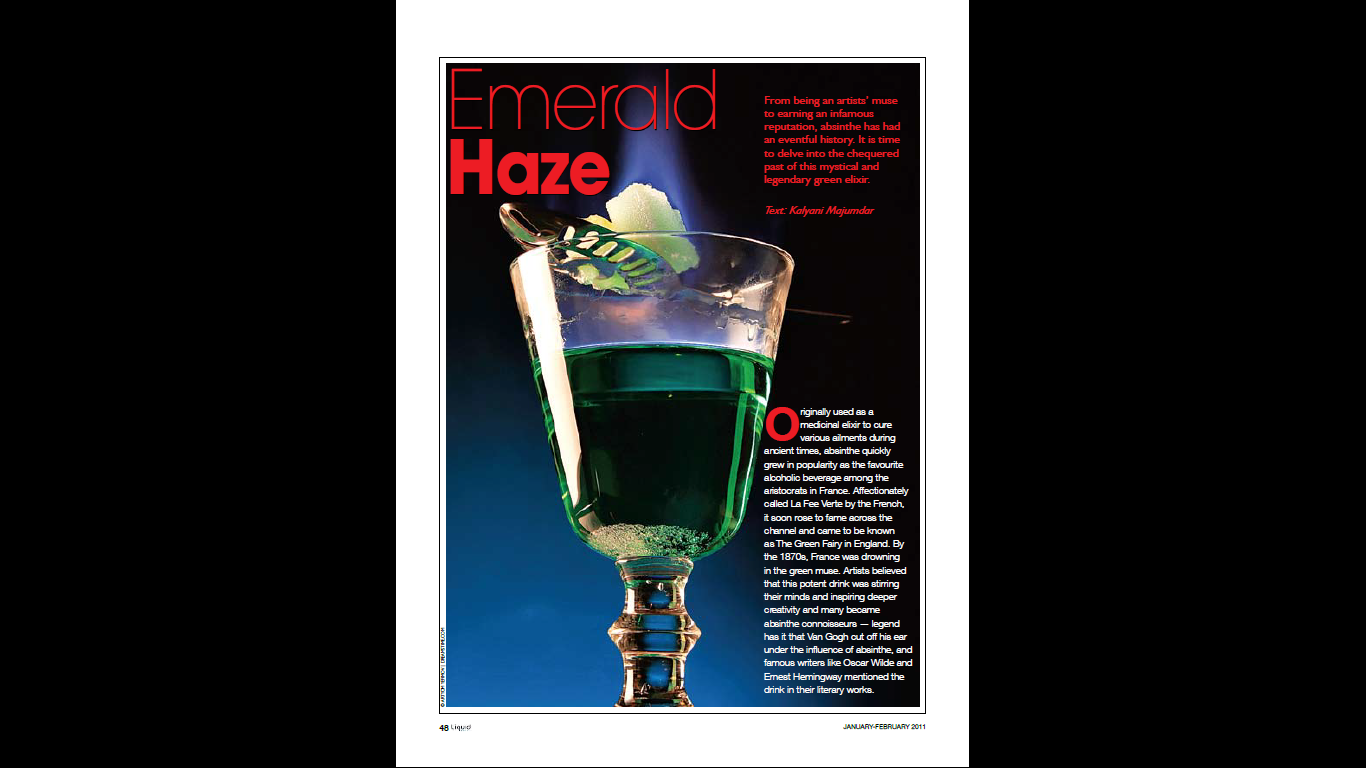
From being an artists’ muse to earning an infamous reputation, absinthe has had an eventful history. It is time to delve into the chequered past of this mystical and legendary green elixir.
Text by Kalyani Majumdar | Published in Liquid magazine | 2011
Originally used as a medicinal elixir to cure various ailments during ancient times, absinthe quickly grew in popularity as the favourite alcoholic beverage among the aristocrats in France. Affectionately called La Fee Verte by the French, it soon rose to fame across the channel and came to be known as The Green Fairy in England. By the 1870s, France was drowning in the green muse. Artists believed that this potent drink was stirring their minds and inspiring deeper creativity and many became absinthe connoisseurs — legend has it that Van Gogh cut off his ear under the influence of absinthe, and famous writers like Oscar Wilde and Ernest Hemingway mentioned the drink in their literary works.
With an alcoholic proof ranging from 45% to 75% and the presence of wormwood in the spirit, which is derived from the essence thujone, absinthe soon gained notoriety among drinkers. The ‘Fairy’ was associated with transformation, a freer state of mind and artistic expressions. In 1893, Edgar Degas painted L’Absinthe, portraying a French actress drinking absinthe in a Parisian café. The artwork was too nouvelle for England’s straightlaced Victorian taste and was, as a consequence, removed from the Christie’s auction. The tide began to turn against absinthe, and it was suddenly being associated with society’s evils.
Interestingly, it is believed that the 1870s blight in France led to a wine shortage and resulted in the popularity of absinthe, and by the end of the 19th century, France was gulping down more than two million litres of the spirit. This popularity, however, ended in the 20th century when the Belgians, the Swiss and then the French banned the alcohol. Absinthe was a great leveller in society, as it was popular across all classes, but the notorious legends attached to it, coupled with the global temperance movement — a social movement urging the reduced use of alcoholic beverages — instigated the ban.
Adding fuel to the fire was the bad press that was generated when a Monsieur Lanfray from Switzerland killed his entire family while under the influence of absinthe. However, the fact that he had also consumed several litres of wine and brandy was overlooked. This was the last blow to the already bruised reputation of the green fairy. After enduring an almost 100-year ban, this elusive green elixir is back on bar tables all over the world. Christophe Clement, a celebrated freelance bartender in France, comments, “It is not an easy drink to mix, and only a few chosen ones have the passion and the guts to make good and innovative cocktails with absinthe.” When asked about the popularity of absinthe among regular drinkers, he said, “I think people are not scared to try absinthe anymore as it is very safe, and every bar should have a bottle of absinthe on its shelves because it is one of the legendary alcoholic beverages.”
Making an absinthe drink is considered an art. Absinthe is elegantly served with a sugar cube sitting atop a slotted silver spoon. Water is then slowly poured onto the sugar cube, which slides through the spoon and mixes into the absinthe, creating a misty jade drink – a magical ritual indeed! Traversing from the bohemian bars of Paris, absinthe has made its way to India and is gaining popularity here. The familiar flavours of aniseeds — often chewed as a palate cleanser between meals — also find adaptability with the taste profiles in the country. “Absinthe has just been introduced in India, hence there are few takers. But, the good news is that, we have tried two recipes, Long Island Iced Tea with absinthe and Absinthe Bull, and both have received great response,” said Leorith Ashtamkar, a freelance bartender in India.
The Green Fairy Absinthe Company (TGFAC) imports absinthe in India from the Pontarlier district of France – the holy grail of absinthe. Initially, TGFAC was importing Green Fairy absinthe by Liqueurs de France (LDF), but now it has been replaced by Enigma, also a product by LDF. Both are distilled absinthes, prepared in the traditional way with the herbs that give absinthe its unique flavour. This year, TGFAC has also introduced another product in the Indian market called Nemesinthe. It is a developed quality oil-mix priced at R3,300. It is much lighter on the wallet compared to the classic distilled high quality Enigma, which is priced at Rs 5,200. Farrokh Maneckshaw of TGFAC says, “We think that this will be a popular and affordable drink for the club-goers, and looking at the response in Goa, I can clearly say that absinthe is already a very popular drink among young Indians.” So, next time when you go out drinking, order a glass of absinthe and experience the legend in every sip of this enchanting green spirit. Sante!
Photo essay by Kalyani Majumdar | Published in Domus India | Nov, 2013
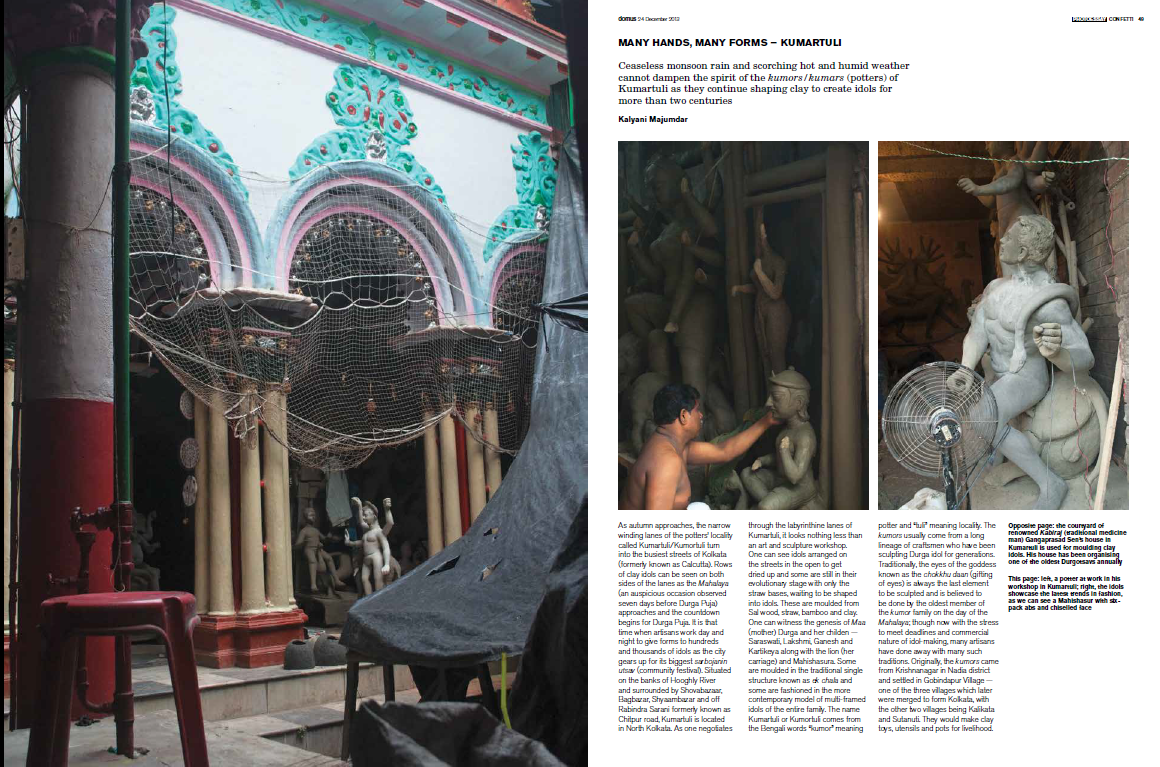
Ceaseless monsoon rain and scorching hot and humid weather cannot dampen the spirit of the kumors/kumars (potters) of Kumartuli as they continue shaping clay to create idols for more than two centuries.
The courtyard of renowned Kabiraj (traditional medicine man) Gangaprasad Sen’s house in Kumartuli is used for moulding clay idols. His house has been organising one of the oldest Durgotsavs annually
As autumn approaches, the narrow winding lanes of the potters’ locality called Kumartuli/Kumortuli turn into the busiest streets of Kolkata (formerly known as Calcutta). Rows of clay idols can be seen on both sides of the lanes as the Mahalaya (an auspicious occasion observed seven days before Durga Puja) approaches and the countdown begins for Durga Puja. It is that time when artisans work day and night to give forms to hundreds and thousands of idols as the city gears up for its biggest sarbojaninm utsav (community festival). Situated on the banks of Hooghly River and surrounded by Shovabazaar, Bagbazar, Shyaambazar and off Rabindra Sarani formerly known as Chitpur road, Kumartuli is located in North Kolkata. As one negotiates through the labyrinthine lanes of Kumartuli, it looks nothing less than an art and sculpture workshop.
One can see idols arranged on the streets in the open to get dried up and some are still in their evolutionary stage with only the straw bases, waiting to be shaped into idols. These are moulded from Sal wood, straw, bamboo and clay. One can witness the genesis of Maa (mother) Durga and her childen —Saraswati, Lakshmi, Ganesh and Kartikeya along with the lion (her carriage) and Mahishasura. Some are moulded in the traditional single structure known as ek chala and some are fashioned in the more contemporary model of multi-framed idols of the entire family. The name Kumartuli or Kumortuli comes from the Bengali words “kumor” meaning potter and “tuli” meaning locality. The kumors usually come from a long lineage of craftsmen who have been sculpting Durga idol for generations.
Traditionally, the eyes of the goddess known as the chokkhu daan (gifting of eyes) is always the last element to be sculpted and is believed to be done by the oldest member of the kumor family on the day of the Mahalaya; though now with the stress to meet deadlines and commercial nature of idol-making, many artisans have done away with many such traditions. Originally, the kumors came from Krishnanagar in Nadia district and settled in Gobindapur Village — one of the three villages which later were merged to form Kolkata, with the other two villages being Kalikata and Sutanuti. They would make clay toys, utensils and pots for livelihood decided to build Fort William at Gobindapur village, the inhabitants of that area migrated to Sutanati and it is believed that under the instruction of the Company, John Holwell was given orders to designate areas according to the nature of profession of the inhabitants; Kumartuli was one such area that was designated as a residential area for all the potters and craftsmen. In those days these kumors were invited by the old and nouveau rich Indian households —mostly the Zamindars who were also the first few patrons and organised Durga puja in their houses — to make clay images of Durga and other idols. These houses had thakurdalans/thakurbaris (separate building used for annual festivals).
The thakurdalans were high-ceilinged flat-roofed buildings. Apart from the autumn festival, the artisans were called round the year to sculpt ornamental elements such as the fairies, foliages, other patterns and inlay works on brackets and columns of the houses as many modelled after the Western influence, thus giving rise to a fusion of Indo-Bengal form of ornamental art for residential built forms. With time, as Durgotsav shifted out of the thakurdalans and became a community festival, the common people became the new patrons of Kumartuli. Also, every year one can easily predict the current trends in vogue by looking at the idols; this time it was Mahishasurs’ six-pack abs and chiselled faces that were in popular demand — straight out of a Greek mythology.
A potter at work in his workshop in KumartuliThe idols showcase the latest trends in fashion, as we can see a Mahishasur with sixpack abs and chiselled face
From its humble beginning to post- Independence, Kumartuli has risen to become the exclusive exporter of idols of the goddess to the Bengalis settled in different parts of the world. Clearly, Kumartuli is more than just an urban space in Kolkata that produces clay idols for Durga Puja. It has been an active participant for more than two centuries in maintaining a continuity of cultural tradition and craftsmanship, and has witnessed the trajectory of the changing socioeconomic and political climate of the city — the transition from pre to Post- Independent India and from Calcutta to Kolkata.
All photographs and text copyright with Kalyani Majumdar
By Kalyani Majumdar; Published in Domus India magazine; News section; 2014
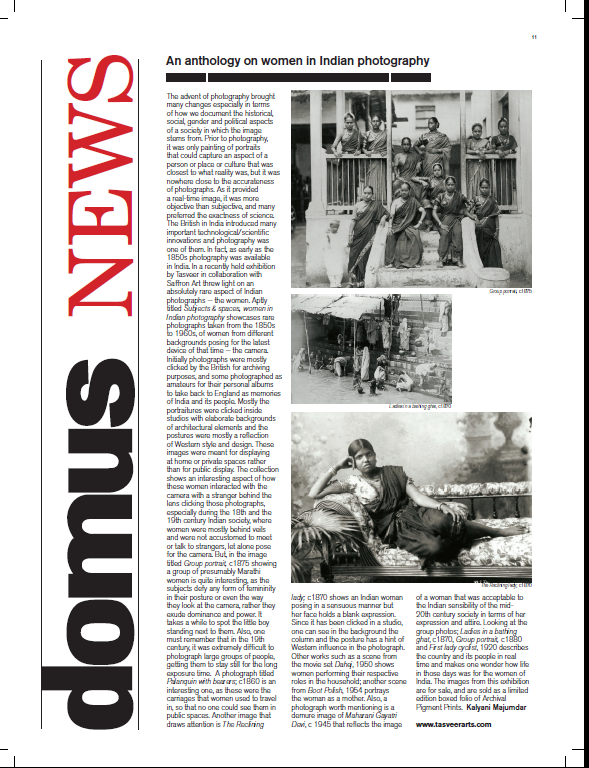
Group Portrait, circa 1875
The advent of photography brought many changes especially in terms of how we document the historical, social, gender and political aspects of a society in which the image stems from. Prior to photography, it was only painting of portraits that could capture an aspect of a person or place or culture that was closest to what reality was, but it was nowhere close to the accurateness of photographs. As it provided a real-time image, it was more objective than subjective, and many preferred the exactness of science.
The British in India introduced many important technological/scientific innovations and photography was one of them. In fact, as early as the 1850s photography was available in India. In a recently held exhibition by Tasveer in collaboration with Saffron Art threw light on an absolutely rare aspect of Indian photographs — the women. Aptly titled Subjects & spaces, women in Indian photography showcases rare photographs taken from the 1850s to 1960s, of women from different backgrounds posing for the latest device of that time — the camera.
The reclining lady, c 1870
Initially photographs were mostly clicked by the British for archiving purposes, and some photographed as amateurs for their personal albums to take back to England as memories of India and its people. Mostly the portraitures were clicked inside studios with elaborate backgrounds of architectural elements and the postures were mostly a reflection of Western style and design. These images were meant for displaying at home or private spaces rather than for public display. The collection shows an interesting aspect of how these women interacted with the camera with a stranger behind the lens clicking those photographs, especially during the 18th and the 19th century Indian society, where women were mostly behind veils and were not accustomed to meet or talk to strangers, let alone pose for the camera. But, in the image titled Group portrait, c1875 showing a group of presumably Marathi women is quite interesting, as the subjects defy any form of femininity in their posture or even the way they look at the camera, rather they exude dominance and power. It takes a while to spot the little boy standing next to them. Also, one must remember that in the 19th century, it was extremely difficult to photograph large groups of people, getting them to stay still for the long exposure time. A photograph titled Palanquin with bearers; c1860 is an interesting one, as these were the carriages that women used to travel in, so that no one could see them in public spaces. Another image that draws attention is The Reclining lady; c1870 shows an Indian woman posing in a sensuous manner but her face holds a blank expression. Since it has been clicked in a studio, one can see in the background the column and the posture has a hint of Western influence in the photograph.
Ladies in a bathing ghat, c 1870
Other works such as a scene from the movie set Dahej, 1950 shows women performing their respective roles in the household; another scene from Boot Polish, 1954 portrays the woman as a mother. Also, a photograph worth mentioning is a demure image of Maharani Gayatri Devi, c 1945 that reflects the image of a woman that was acceptable to the Indian sensibility of the mid-20th century society in terms of her expression and attire. Looking at the group photos; Ladies in a bathing ghat, c1870, Group portrait, c1880 and First lady cyclist, 1920 describes the country and its people in real time and makes one wonder how life in those days was for the women of India. The images from this exhibition are for sale, and are sold as a limited edition boxed folio of Archival Pigment Prints. (www.tasveerarts.com)
Nestled along the Hooghly River is a tiny town just 35 kilometres from Kolkata that is steeped in history and is definitely worth exploring, writes KALYANI MAJUMDAR.
A gentle breeze welcomes you as you step on the Strand. The beautiful promenade along the Hooghly River is a lovely stretch and across it stands a row of beautiful French colonial buildings. Wait, French? Yes, you read it right! It is a general perception for most that in India the French existed only in Pondicherry. In fact this quaint place called Chandernagore was and still is, the La petit French—the little France—in West Bengal and is only 19 square kilometres in total area. Chandernagore might be a small town but its historical significance cannot be trifled with.
A town with many names The name of the town itself has many derivatives. Some say that the bank of the river forms the shape of the moon—chandra—inBengali; others say it is named after the oldest temple of Goddess Chandi. According to some it was believed to be a centre for selling sandal (chandan). The best way to explore this lovely town is to walk it.
The advent of the French Chandernagore became a French colony in 1673, wherein they established their trading banks, and it became a permanent French settlement by 1688. After the 1757 war with the British the town changed hands a couple of times between the British and the French. However, from 1816 it remained with France till 1950. Although Chandernagore was a French colony, it had a strong convergence of the French and Bengali cultures as many Bengali merchants flourished and played an important role in development of the town.
Institute de Chandernagore – Dupleix Palace ; Photo credit: Kalyani Majumdar
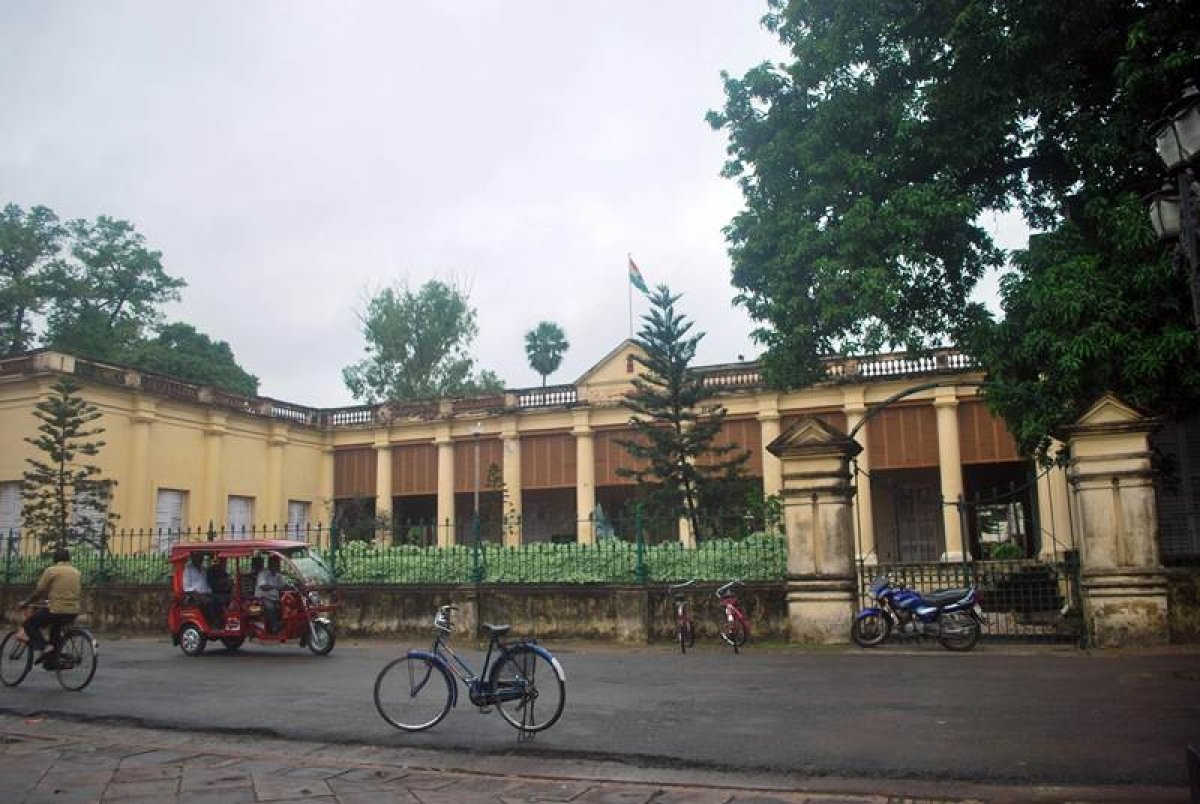
Institute de Chandernagore – Dupleix Palace In 1730, Joseph François Dupleix was appointed governor of Chandernagore. It was during his time that the town became the main center of commerce in Bengal. The Fort d’Orléans, was also built during his time. Today the reminiscence of Dupleix’s glorious years in Chandernagore is housed in the Institute de Chandernagore that stands in a grand manner located on the Strand commanding a view of the Hooghly River. It is a French colonial building with spacious verandahs enveloping the entire building supported by columns. A flight of steps take you to the entrance to the museum that showcases artefacts, old photographs and Dupleix’s personal belongings. You can spend a good few hours strolling in the garden or sit in the verandah and enjoy the scenic view.
Every building has a story Built in 1904, the Patal Bari (underground house) on the Strand is worth a visit as its lowest floor is submerged in the river. Some very prominent personalities have resided in this house during their visit to the town including Rabindranath Tagore. A clock given by Joseph Daumain sits on the tower facing the promenade reminding everyone of the times that this town has seen. The other grand building on this stretch is the sub-divisional court of Chandernagore. However, it was not always a court. It was the Hotel de Paris. You could very well imagine the spacious verandahs and gardenslit up for the typical Parisian evening soirees. The road off the Strand takes you to Sacred Heart Church. This Roman Catholic Church was built around 1875 and has beautiful stained glass paintings. As you continue walking past the church you come across shops, and old houses competing with new buildings.
The temple that withstood cannon fire This town played a pivotal role in the famous Battle of Plassey in 1757 when Robert Clive destroyed the Fort de Orleans along with houses and places of worship. There are few buildings that still stand as mute witnesses to Clive’s cannon balls. The temple that still exists from that time is the Nandodulal temple. Built in 1740, it is believed to be the largest dui chala (double-sloped roof) temple in Bengal. Located on a picturesque landscape with a little pond on the rear, the wall still carries theimprint of Clive’s cannon balls.
Refuge for Indian freedom fighters As you peel one layer of history of this town you unravel another layer beneath. Since Chandernagore was a French colony during the same time when Calcutta was under the British, many freedom fighters from British Bengaltook refuge in French Bengal. The most famous name is of Sri Aurobindo Ghosh. The house where Sri Aurobindo went into hiding and used the space to make bombs still stands. In fact many brave hearts such as Kanailala Dutt and Rajbihari Ghosh that fought for the Indian freedom against the British hailed from this town. You can visit the Prabartak Ashram that was established by Motilal Roy. It used to be a safe haven for freedom fighters.One should not miss the Laldighi on the Grand Trunk road, the cemetery across it, and the old library building not very far from there.
Local flavour Although most of Chandernagore’s identity comes from its French association, but one that continues to have the local Bengali flavour is the Jagaddharti Puja. It is celebrated with much fervor. After a heavy duty history tour one should not miss the lovely evenings at Strand. It looks like the entire town is on the promenade. With shopping carts and ferries on either side of the Strand selling trinkets, street food, icecream carts. Music floating from the Rabindra Bhawan across the street and the sight of old people discussing politics and Tagore on the same breath is quiet a sight, not to be missed by anyone. Albeit, officially Chandernagore merged with West Bengal and became part of India in 1951, the vestiges of the Liberty gate on the south of the town acts as a reminder of the French connection with the inscription sayingLiberté, égalité, fraternité—Liberty, equality, fraternity—the three pillars of the French revolution. We tip the hat for those lovely words that continue to give us hope.
Published in Free Press Journal; Date: 12.11.2017; Reviewed by Kalyani Majumdar
Are we heading towards the third world war? If yes, then will it be in the year 2020? Paul Cornish and Kingsley Donaldson in their book, 2020 World Of War, intricately poses all the different scenarios in the current world order that might eventually lead to the world going to war.
The book offers a comprehensive account of the changing nature of war in today’s world. As we all understand that linear warfare is a thing of the past. It has become far more complex, from cyber security to rapid up gradation and development in weapon technology. The impact of automation technologies on battlefield, such as the unmanned drones are changing the nature of conflicts. Economics and geopolitics have their intricate roles in initiating a war-like situation almost in any part of the world. It helps that both, Cornish and Donaldson come from army backgrounds.
Paul Cornish was educated at the University of St Andrews and the London School of Economics. He then served in the British Army (Royal Tank Regiment) and the Foreign and Commonwealth Office. Kingsley Donaldson is a retired Army officer. He has served on operations in a number of European and Middle Eastern countries in various roles that span from countering weapons of mass destruction through to negotiating with armed groups in Iraq.
2020 World Of War, makes for a compelling read as the authors bring their personal experiences and inside knowledge to every plot that they talk about. Does the book give an impression of a grim future? Yes, it does to some extent, as Cornish and Donaldson says, “This book is knowingly and deliberately an exercise in worst-case analysis and as such it is, arguably, precisely how security and policy-makers and analysts should be spending much of their time in a chaotic and often confusing world.”
Will there be a cyber-attack on the pentagon that might crash the greatest military power in the world? Will there be a standoff between India and Pakistan over Afghanistan? What will happen in Putin’s Russia? And what would be the repercussion of Trump’s policy of isolating US gradually from the rest of the world? Not to forget the pressing issues pertaining to mass migration in Europe due to ISIS. These and many more questions would rise in the reader’s mind while reading 2020 World Of War.
The book says, “Across Europe, established political systems are experiencing a crisis in public confidence, resulting in the rise of anti-establishment figures, parties and movements, as evinced in extreme right-wing movements gaining popularity, in the Scottish referendum and in the UK ‘Brexit’ referendum in June 2016, and the US Presidential election later the same year.” The book provides a good understanding on why the world is struggling to contain conflicts and offers expert analysis and solutions to combat these situations.
The book is thought-provoking and insightful. However, some of the scenarios provided in the book seems a bit far-fetched, although time will only tell if everything that 2020 World Of War says is plausible or not. We can only hope for the best, but plan for the worst. It is a must read for those who are eager to understand how our world would look like in the near future.
Published in Free Press Journal; Date: 25.02.2018; Reviewed by Kalyani Majumdar
With three states in the Northeast of India — Meghalaya, Nagaland and Tripura — busy with the assembly elections this February, all of a sudden there is a surge in the amount of coverage the Northeastern states are getting by news channels that are otherwise largely ignored. Unfortunately, the ignorance regarding the Northeast that comprises of eight states, by the people of the rest of India is equally pitiful.
Thus, the book Strangers No More: New Narratives from India’s Northeast by Sanjoy Hazarika, is a must-read for those that would like to understand the ground realities of the Northeastern states, from socio-economic and political perspectives. It has been twenty years that Hazarika wrote his first book on Northeast, Strangers of the Mist. It was perhaps the first comprehensive book on India’s Northeast and even till this day, his book is referred by researchers, journalists and students pertaining to information on Northeast India. And, now with Strangers No More, Hazarika continues his journey in the Northeast with stories and interviews that provide an in-depth overview of where the Northeast stands, today.
Hazarika uses his exemplary narrative style to tell the stories that otherwise might go untold. The author not only highlights the issues that are being currently faced by the people of the Northeastern states, but also, provides suggestions and effective solutions to these issues. Hence, this book can be treated as a handbook by political leaders, non-governmental organisations, activists and specialists that are working at grassroots level, to get a holistic view of the Northeastern states of India, and in turn, help them to focus on the betterment of the people in these states.
The author has suggestions in the book pertaining to gargantuan sized projects that are planned for Northeastern states, that could also apply to other states in India, “It’s better to improve what we have instead of launching ambitious projects that would lead to endless corruption, delays, frustration, growing anger and confrontation and massive destruction of irreplaceable species. We have no right to do that.”
While discussing Arunachal Pradesh, the author says, “Arunachal’s political and social stability as well as those of ‘national interest’ mesh and merge at every point in this distant border state.” This aspect makes Arunachal Pradesh an extremely tricky area to tread on, in terms of policies and governance.
Every page of the book is a minefield of information and stories that upholds everything that one needs to understand about Northeastern states. While for most Indians, Sikkim is a beautiful tourist spot, which holds true, but the other glaring truth is that most are oblivious of its history and how it became part of India. As Indians, perhaps we should ask ourselves, how much do we really know about this Indian state and how much of a concern it generates in the public domain.
Hazarika brings forth facts that would force the reader to ponder upon issues that are mostly brushed under the carpet. While mentioning about Meghalaya, the author writes, “A closer examination shows that power-broking, moneymaking, environment exploitation and traditional systems and processes are all caught up and bound together in this mesh. Otherwise, how else can one explain the fact that large parts of Shillong, which gets an annual average rainfall of about 2,167 centimetres spread over the summer depend on frantic calls to water tanker companies?”
“The past always intrudes into the present here and elsewhere in the Northeast.”
Book title: Strangers No More: New Narratives from India’s Northeast
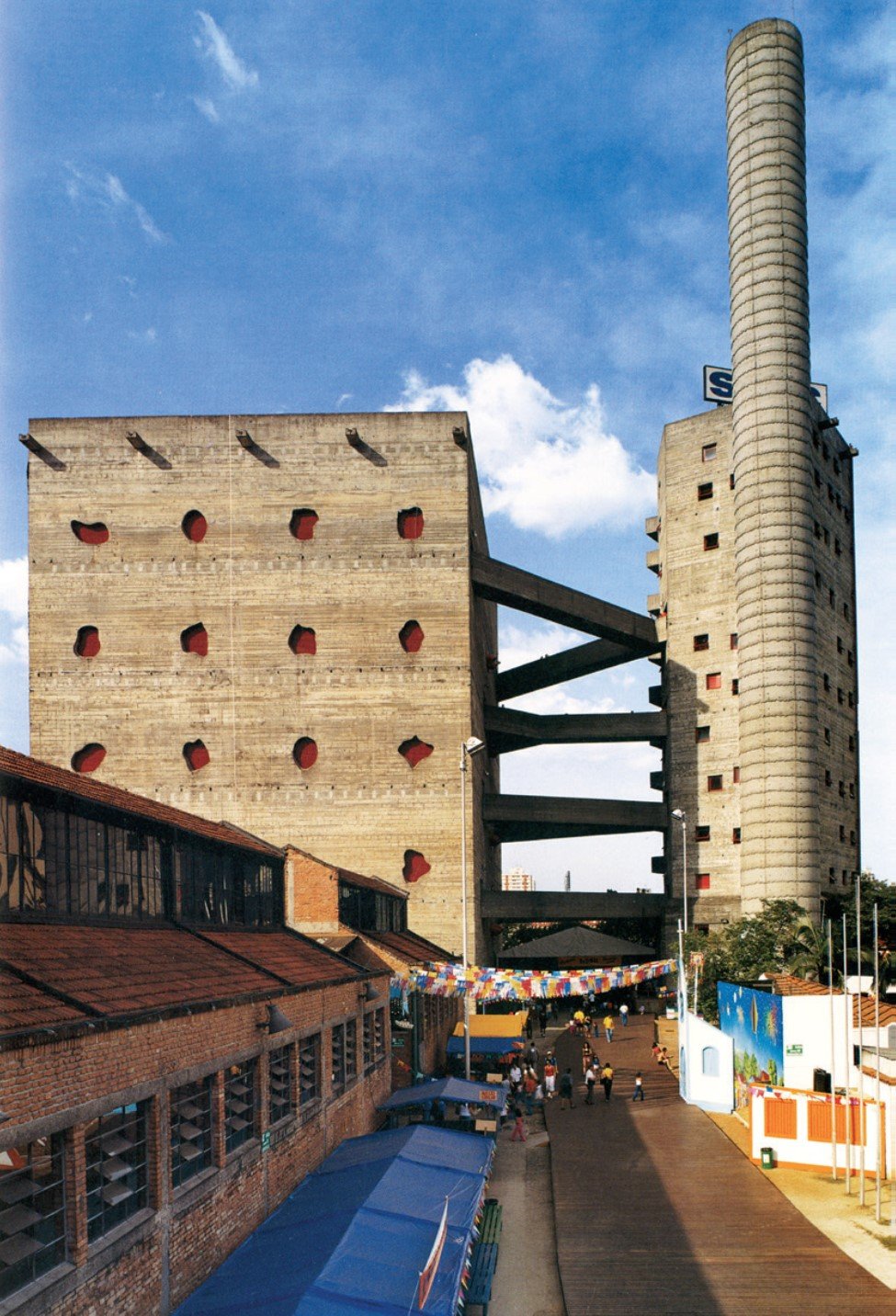
SESC Pompeia in Sao Paulo, Brazil designed by Lina Bo Bardi
The term Brutalism evokes a myriad of responses from the architecture and design community — some are extremely critical and some see it as a utopian moment in architecture, but mostly it evokes extreme emotions and debates. And thus it did not come as a surprise that when an event curated by Mohile Parikh Center in collaboration with Studio X, Mumbai had Prof. Yehuda Safran revisiting Brutalism through a presentation, followed by a conversation with architect Mustansir Dalvi, had full attendance at the spacious Studio X. Originating from a French term béton brut, when translated stands for “raw concrete” defines it as literally as possible. Brutalist buildings were known for their sculptural qualities and the rawness that was evident from the display of true materiality — raw concrete. It is believed that this form of architecture was developed between 1950s to the mid 1970s. Some say that Brutalism sprung out of a need to create a classless society and against gentrification in a city. Post-war Britain saw Brutalist buildings coming up everywhere and it was evident that this movement was seen as an evocative solution to create a classless society and to create mini-societies that would comprise schools, hospital, shops/ community centre, banks and other basic amenities for the people living around. Also, there was a grand cost-cutting due to in-situ casting. Among Prof Safran’s presentation of Brutalist buildings was the infamous Robin Hood Gardens in Poplar, London designed by Alison and Peter Smithson in the late 1960s and realised in 1972.
The idea behind this structure was indeed pragmatic with Smithsons’ social intentions that integrated through the concept of “streets in the sky” and one must admit was a wonderful idea for any city where people crave to get a glimpse of the sky. Every third level of the buildings was designed with a wide concrete balcony jutting off towards the centre of the site, overlooking the garden. After much deliberation Tower Hamlets Council passed the demolition plans for Robin Hood Gardens and just last year it was razed to make way for new structure. During the talk, Prof Safran mentioned that Brutalism by many is associated with the term satanic. One might think probably because it was a movement that did trigger radical thoughts to design cities which did not go down well with many from the design communities. Another Brutalist building from Prof Safran’s presentation was the SESC Pompeia in Sao Paulo, Brazil. After the end of a 20-year military regime SESC Pompeia in Sao Paulo, Brazil designed by Lina Bo Bardi was an important addition to the Sao Paulo skyline and was a fresh start for the country as its two concrete towers connected to each other with pre-stressed concrete walkways. Even though the conversation lasted for two hours, but it did make us ponder on the current take on Brutalism. Is demolishing of these buildings the only way forward? To sum up all the facts Brutalism was a movement of a particular time and it had a great influence and played a part in modern form of architecture. Isn’t it possible to repurpose the architectural form that after all stemmed out of a novel idea to lessen disparity amongst the city dwellers and prevent urban gentrification?
Event detail:
Mohile Parikh Center www.mohileparikhcenter.org Studio X, Mumbai www.arch.columbia.edu SESC
As we celebrate the World Radio Day on 13th of February, KALYANI MAJUMDAR sums up the trajectory of one of the significant inventions of humankind that shaped our world and saw us through some of the epochal moments in history.
The sound crackled a bit. You turned the knob to clear the radio static as the song Radio Ga Ga by Queen came alive on air, and you sang along the lines… ‘Radio…someone still loves you.” There was a time, when if you wanted to listen to a song you loved, you had to go all the way to a music store to buy music, or you had to wait for your radio show to play that song and even then you were left at the mercy of the announcer to play that song. Sounds unbelievable now, right? Today, if you like a song, just stream it online and buy it in a second. However, radio was not just for entertainment purpose, it was also a source to get news and information.
Invention: The twists and turns
Guglielmo Marconi
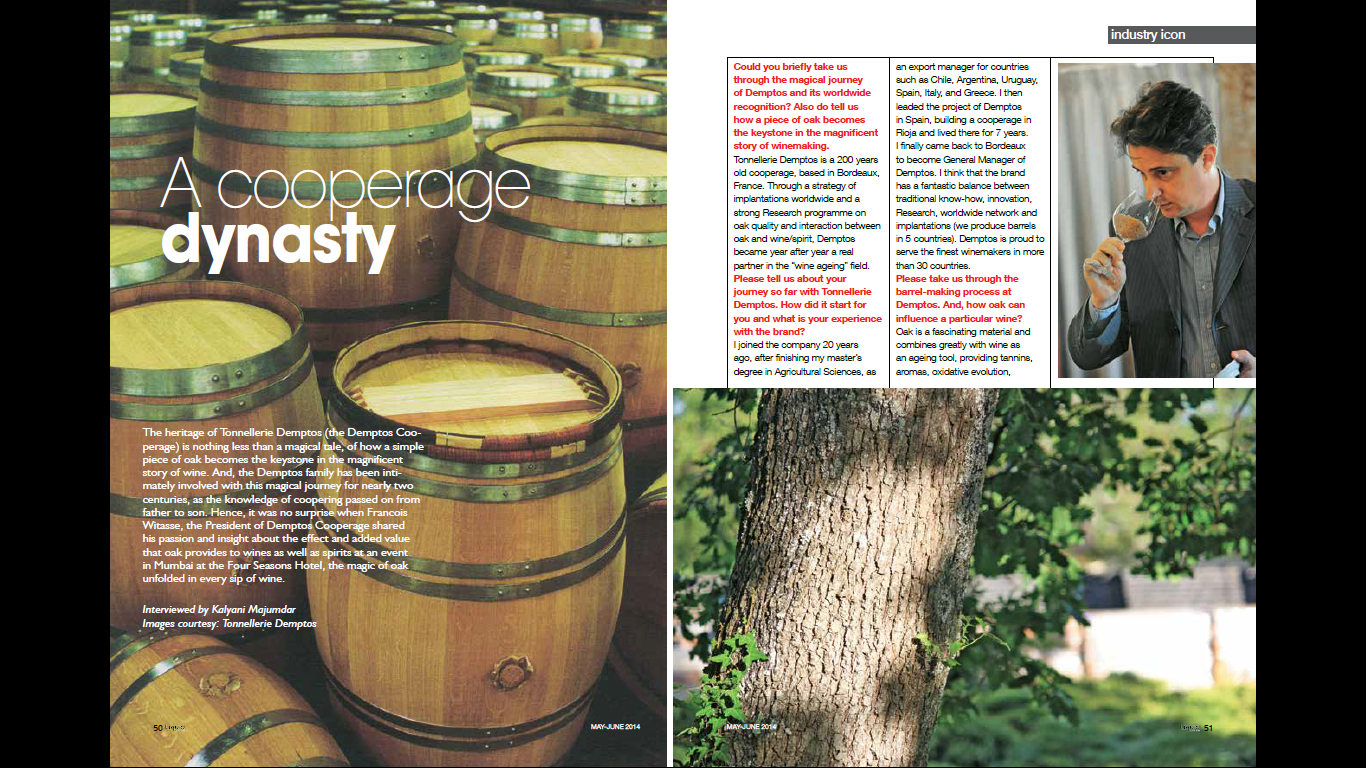
The idea of developing radio came from the invention of the telegraph and the telephone. Based on Scottish scientist, James Clerk Maxwell’s theory on the existence of radio waves, in 1886, German scientist Heinrich Rudolph Hertz, demonstrated the projection of electric current of rapid variation into space, in the form of radio waves.But the real question was, could it transmit music and speech invisibly?Although, the credit for inventing radio goes to an Italian Guglielmo Marconi, the Mercury Coherer that was used by Marconi was the exact copy of the one invented by Jagadish Chandra Bose in Calcutta, India. In fact, in 1895 Bose gave a public demonstration of electromagnetic waves at the Calcutta Town Hall.
He
solved Hertz’s problem and the waves could penetrate through walls or
water. His demonstration had left everyone spellbound, especially when
he passed the wave through the body of Lt Governor of Bengal. However,
Bose was looking at it from an academic point of view whereas, Marconi
was looking at its commercial viability. Also, Bose believed in free
sharing of knowledge and didn’t go for a patent initially. The story
doesn’t end there. Nikolas Tesla was another contender for the invention
of radio. He was working on it since 1884. He even took Marconi to the
court. However, one must understand that often a number of scientists
work simultaneously to find different solutions to one problem and
sometimes their research is built on works of other scientists. Hence,
such overlaps does happen in the world of scientific inventions.
Radio during the World Wars
During
the First World War, radio technology was still in its early stages of
development. The equipment was still bulky, thus difficult to be carried
around in the war field. Interestingly, the US army had adapted the
design that was known as the horse-pack set, wherein, the entire radio
transmitter and receiver could fit into a saddle.During the Second World
War, radio transmitters were used by aircrafts, submarines, tanks, and
on battlefields. There were codes used for communication. Winning wars
depended on breaking codes. Radio played a crucial role.
Radio and India’s freedom struggle
Azad
Hind Radio was a propaganda radio service that was started under the
leadership of Netaji Subhash Chandra Bose in Germany to encourage
Indians to fight for freedom. Bose addressed the people of India from
Berlin. You can listen to the recordings online. During the Quit India
Movement in 1942, when the British had banned free circulation of news
within India, an underground radio station was operated by the Indian
nationalists. Freedom fighter, Dr Usha Mehta organised it with the help
of ham radio operators. People of India would hear her voice announcing:
“This is the Congress Radio calling on (a wavelength of) 42.34 meters
from somewhere in India.”
When Radio was the star
Before television really became popular, it was the radio that was the main source of listening to news and music. Therefore, radio stood witness to some of the greatest events in history and was broadcasting those events real time. It was the radio that announced the Indian independence when Jawaharlal Nehru gave his momentous speech: “Tryst with destiny”. It was the radio that broadcasted HG Wells’ famous novel, War of the Worlds as a radio drama presented by an entertainer Orson Welles. He performed it as if the alien invasion was happening real time. That radio show caused widespread panic among the audience. Overnight, Welles became a star. You can listen to the radio show online.
‘You are listening to All India Radio’
In
India, radio had its humble beginnings. In 1923, the Radio Club of
Bombay made the first broadcast in the country and in few months it was
followed by Calcutta Radio Club. In 1930, the Indian Broadcasting
Service was commenced under the Department of Industries and Labour and
in 1936 it became All India Radio (AIR). From only six stations in 1947,
today AIR’s home service comprises around 420 stations and is a
broadcasting giant that broadcasts in 23 languages and 146 dialects. It
also operates FM stations and is the main source of information and
entertainment for the masses. Prime Minister Narendra Modi chose the
radio as the medium to address the nation through his programme called Mann Ki Baat.
Did internet kill the radio?
Radio
networks worldwide have made a comeback. Recently, a radio and digital
project called Radio Garden by Netherlands Institute for Sound and
Vision came up with an idea to bring the world closer through radio
broadcasts. You can download the application and enjoy a global
experience. While radio might have competition from all the new
technologies, but radio comes with its heritage, nostalgia and identity
that is unique. While listening to radio, there is always a certain
amount of anticipation of what would be the next song and that element
of surprise is missing when you play songs online, isn’t it?
Nestled along the Hooghly River is a tiny town just 35 kilometres from Kolkata that is steeped in history and is definitely worth exploring, writes KALYANI MAJUMDAR.
A gentle breeze welcomes you as you step on the Strand. The beautiful promenade along the Hooghly River is a lovely stretch and across it stands a row of beautiful French colonial buildings. Wait, French? Yes, you read it right! It is a general perception for most that in India the French existed only in Pondicherry. In fact this quaint place called Chandernagore was and still is, the La petit French—the little France—in West Bengal and is only 19 square kilometres in total area. Chandernagore might be a small town but its historical significance cannot be trifled with.
A town with many names The name of the town itself has many derivatives. Some say that the bank of the river forms the shape of the moon—chandra—inBengali; others say it is named after the oldest temple of Goddess Chandi. According to some it was believed to be a centre for selling sandal (chandan). The best way to explore this lovely town is to walk it.
The advent of the French Chandernagore became a French colony in 1673, wherein they established their trading banks, and it became a permanent French settlement by 1688. After the 1757 war with the British the town changed hands a couple of times between the British and the French. However, from 1816 it remained with France till 1950. Although Chandernagore was a French colony, it had a strong convergence of the French and Bengali cultures as many Bengali merchants flourished and played an important role in development of the town.
Institute de Chandernagore – Dupleix Palace ; Photo credit: Kalyani Majumdar
Institute de Chandernagore – Dupleix Palace In 1730, Joseph François Dupleix was appointed governor of Chandernagore. It was during his time that the town became the main center of commerce in Bengal. The Fort d’Orléans, was also built during his time. Today the reminiscence of Dupleix’s glorious years in Chandernagore is housed in the Institute de Chandernagore that stands in a grand manner located on the Strand commanding a view of the Hooghly River. It is a French colonial building with spacious verandahs enveloping the entire building supported by columns. A flight of steps take you to the entrance to the museum that showcases artefacts, old photographs and Dupleix’s personal belongings. You can spend a good few hours strolling in the garden or sit in the verandah and enjoy the scenic view.
Every building has a story Built in 1904, the Patal Bari (underground house) on the Strand is worth a visit as its lowest floor is submerged in the river. Some very prominent personalities have resided in this house during their visit to the town including Rabindranath Tagore. A clock given by Joseph Daumain sits on the tower facing the promenade reminding everyone of the times that this town has seen. The other grand building on this stretch is the sub-divisional court of Chandernagore. However, it was not always a court. It was the Hotel de Paris. You could very well imagine the spacious verandahs and gardenslit up for the typical Parisian evening soirees. The road off the Strand takes you to Sacred Heart Church. This Roman Catholic Church was built around 1875 and has beautiful stained glass paintings. As you continue walking past the church you come across shops, and old houses competing with new buildings.
The temple that withstood cannon fire This town played a pivotal role in the famous Battle of Plassey in 1757 when Robert Clive destroyed the Fort de Orleans along with houses and places of worship. There are few buildings that still stand as mute witnesses to Clive’s cannon balls. The temple that still exists from that time is the Nandodulal temple. Built in 1740, it is believed to be the largest dui chala (double-sloped roof) temple in Bengal. Located on a picturesque landscape with a little pond on the rear, the wall still carries theimprint of Clive’s cannon balls.
Refuge for Indian freedom fighters As you peel one layer of history of this town you unravel another layer beneath. Since Chandernagore was a French colony during the same time when Calcutta was under the British, many freedom fighters from British Bengaltook refuge in French Bengal. The most famous name is of Sri Aurobindo Ghosh. The house where Sri Aurobindo went into hiding and used the space to make bombs still stands. In fact many brave hearts such as Kanailala Dutt and Rajbihari Ghosh that fought for the Indian freedom against the British hailed from this town. You can visit the Prabartak Ashram that was established by Motilal Roy. It used to be a safe haven for freedom fighters.One should not miss the Laldighi on the Grand Trunk road, the cemetery across it, and the old library building not very far from there.
Local flavour Although most of Chandernagore’s identity comes from its French association, but one that continues to have the local Bengali flavour is the Jagaddharti Puja. It is celebrated with much fervor. After a heavy duty history tour one should not miss the lovely evenings at Strand. It looks like the entire town is on the promenade. With shopping carts and ferries on either side of the Strand selling trinkets, street food, icecream carts. Music floating from the Rabindra Bhawan across the street and the sight of old people discussing politics and Tagore on the same breath is quiet a sight, not to be missed by anyone. Albeit, officially Chandernagore merged with West Bengal and became part of India in 1951, the vestiges of the Liberty gate on the south of the town acts as a reminder of the French connection with the inscription sayingLiberté, égalité, fraternité—Liberty, equality, fraternity—the three pillars of the French revolution. We tip the hat for those lovely words that continue to give us hope.