Category: Literature

  • An anthology on women in Indian photography

    An anthology on women in Indian photography

    By Kalyani Majumdar; Published in Domus India magazine; News section; 2014

    Group Portrait, circa 1875

    The advent of photography brought many changes especially in terms of how we document the historical, social, gender and political aspects of a society in which the image stems from. Prior to photography, it was only painting of portraits that could capture an aspect of a person or place or culture that was closest to what reality was, but it was nowhere close to the accurateness of photographs. As it provided a real-time image, it was more objective than subjective, and many preferred the exactness of science.

    The British in India introduced many important technological/scientific innovations and photography was one of them. In fact, as early as the 1850s photography was available in India. In a recently held exhibition by Tasveer in collaboration with Saffron Art threw light on an absolutely rare aspect of Indian photographs — the women. Aptly titled Subjects & spaces, women in Indian photography showcases rare photographs taken from the 1850s to 1960s, of women from different backgrounds posing for the latest device of that time — the camera.

    The reclining lady, c 1870

    Initially photographs were mostly clicked by the British for archiving purposes, and some photographed as amateurs for their personal albums to take back to England as memories of India and its people. Mostly the portraitures were clicked inside studios with elaborate backgrounds of architectural elements and the postures were mostly a reflection of Western style and design. These images were meant for displaying at home or private spaces rather than for public display. The collection shows an interesting aspect of how these women interacted with the camera with a stranger behind the lens clicking those photographs, especially during the 18th and the 19th century Indian society, where women were mostly behind veils and were not accustomed to meet or talk to strangers, let alone pose for the camera. But, in the image titled Group portrait, c1875 showing a group of presumably Marathi women is quite interesting, as the subjects defy any form of femininity in their posture or even the way they look at the camera, rather they exude dominance and power. It takes a while to spot the little boy standing next to them. Also, one must remember that in the 19th century, it was extremely difficult to photograph large groups of people, getting them to stay still for the long exposure time. A photograph titled Palanquin with bearers; c1860 is an interesting one, as these were the carriages that women used to travel in, so that no one could see them in public spaces. Another image that draws attention is The Reclining lady; c1870 shows an Indian woman posing in a sensuous manner but her face holds a blank expression. Since it has been clicked in a studio, one can see in the background the column and the posture has a hint of Western influence in the photograph.

    Ladies in a bathing ghat, c 1870

    Other works such as a scene from the movie set Dahej, 1950 shows women performing their respective roles in the household; another scene from Boot Polish, 1954 portrays the woman as a mother. Also, a photograph worth mentioning is a demure image of Maharani Gayatri Devi, c 1945 that reflects the image of a woman that was acceptable to the Indian sensibility of the mid-20th century society in terms of her expression and attire. Looking at the group photos; Ladies in a bathing ghat, c1870, Group portrait, c1880 and First lady cyclist, 1920 describes the country and its people in real time and makes one wonder how life in those days was for the women of India. The images from this exhibition are for sale, and are sold as a limited edition boxed folio of Archival Pigment Prints. (www.tasveerarts.com)

  • The French connection in Bengal

    The French connection in Bengal

    Nestled along the Hooghly River is a tiny town just 35 kilometres from Kolkata that is steeped in history and is definitely worth exploring, writes KALYANI MAJUMDAR.

    Published in Free Press Journal; Date 21.05.2017

    Clock Tower; Image credit: Kalyani Majumdar

    A gentle breeze welcomes you as you step on the Strand. The beautiful promenade along the Hooghly River is a lovely stretch and across it stands a row of beautiful French colonial buildings.  Wait, French? Yes, you read it right! It is a general perception for most that in India the French existed only in Pondicherry. In fact this quaint place called Chandernagore was and still is, the La petit French—the little France—in West Bengal and is only 19 square kilometres in total area. Chandernagore might be a small town but its historical significance cannot be trifled with.

    A town with many names
    The name of the town itself has many derivatives. Some say that the bank of the river forms the shape of the moon—chandra—inBengali; others say it is named after the oldest temple of Goddess Chandi. According to some it was believed to be a centre for selling sandal (chandan). The best way to explore this lovely town is to walk it.

    The advent of the French
    Chandernagore became a French colony in 1673, wherein they established their trading banks, and it became a permanent French settlement by 1688. After the 1757 war with the British the town changed hands a couple of times between the British and the French. However, from 1816 it remained with France till 1950. Although Chandernagore was a French colony, it had a strong convergence of the French and Bengali cultures as many Bengali merchants flourished and played an important role in development of the town.

    Institute de Chandernagore – Dupleix Palace ; Photo credit: Kalyani Majumdar

    Institute de Chandernagore – Dupleix Palace
    In 1730, Joseph François Dupleix was appointed governor of Chandernagore. It was during his time that the town became the main center of commerce in Bengal. The Fort d’Orléans, was also built during his time. Today the reminiscence of Dupleix’s glorious years in Chandernagore is housed in the Institute de Chandernagore that stands in a grand manner located on the Strand commanding a view of the Hooghly River. It is a French colonial building with spacious verandahs enveloping the entire building supported by columns. A flight of steps take you to the entrance to the museum that showcases artefacts, old photographs and Dupleix’s personal belongings. You can spend a good few hours strolling in the garden or sit in the verandah and enjoy the scenic view.

    Every building has a story
    Built in 1904, the Patal Bari (underground house) on the Strand is worth a visit as its lowest floor is submerged in the river. Some very prominent personalities have resided in this house during their visit to the town including Rabindranath Tagore. A clock given by Joseph Daumain sits on the tower facing the promenade reminding everyone of the times that this town has seen. The other grand building on this stretch is the sub-divisional court of Chandernagore. However, it was not always a court. It was the Hotel de Paris. You could very well imagine the spacious verandahs and gardenslit up for the typical Parisian evening soirees. The road off the Strand takes you to Sacred Heart Church. This Roman Catholic Church was built around 1875 and has beautiful stained glass paintings. As you continue walking past the church you come across shops, and old houses competing with new buildings.

    Nandodulal temple ; Photo credit: Kalyani Majumdar

    The temple that withstood cannon fire
    This town played a pivotal role in the famous Battle of Plassey in 1757 when Robert Clive destroyed the Fort de Orleans along with houses and places of worship. There are few buildings that still stand as mute witnesses to Clive’s cannon balls. The temple that still exists from that time is the Nandodulal temple. Built in 1740, it is believed to be the largest dui chala (double-sloped roof) temple in Bengal. Located on a picturesque landscape with a little pond on the rear, the wall still carries theimprint of Clive’s cannon balls.

    Refuge for Indian freedom fighters
    As you peel one layer of history of this town you unravel another layer beneath.  Since Chandernagore was a French colony during the same time when Calcutta was under the British, many freedom fighters from British Bengaltook refuge in French Bengal. The most famous name is of Sri Aurobindo Ghosh. The house where Sri Aurobindo went into hiding and used the space to make bombs still stands. In fact many brave hearts such as Kanailala Dutt and Rajbihari Ghosh that fought for the Indian freedom against the British hailed from this town. You can visit the Prabartak Ashram that was established by Motilal Roy. It used to be a safe haven for freedom fighters.One should not miss the Laldighi on the Grand Trunk road, the cemetery across it, and the old library building not very far from there.

    Local flavour
    Although most of Chandernagore’s identity comes from its French association, but one that continues to have the local Bengali flavour is the Jagaddharti Puja. It is celebrated with much fervor. After a heavy duty history tour one should not miss the lovely evenings at Strand. It looks like the entire town is on the promenade. With shopping carts and ferries on either side of the Strand selling trinkets, street food, icecream carts. Music floating from the Rabindra Bhawan across the street and the sight of old people discussing politics and Tagore on the same breath is quiet a sight, not to be missed by anyone. Albeit, officially Chandernagore merged with West Bengal and became part of India in 1951, the vestiges of the Liberty gate on the south of the town acts as a reminder of the French connection with the inscription sayingLiberté, égalité, fraternité—Liberty, equality, fraternity—the three pillars of the French revolution. We tip the hat for those lovely words that continue to give us hope.

  • Celebrating Oscar Wilde, the iconic writer

    Published in Free Press Journal; Date: 15.10.2017

    Known for his wit and flamboyant style, Oscar Wilde needs no introduction in the literary world. He was certainly a non-conformist, trapped in the narrow-mindedness of the late Victorian English Society. KALYANI MAJUMDAR celebrates the iconic writer.

    Oscar Wilde once wrote, “The world is yours for a season.” Startlingly, the quote came to reflect the trajectory of his own life. He was basking in the glory of his literary works when his life quite dramatically took an unfortunate turn that finally led to his eventual downfall. And, what a great tragedy it was for the world to have lost a brilliant playwright, novelist, essayist and poet. Was he far too bold for the 19th century? Perhaps, he was.

    The early life

    Born in Dublin, Ireland on October 16, 1854, Oscar Wilde was a bright boy with avid interest in Greek and Roman studies. His father Sir William Wilde was a renowned doctor and his mother Jane Wilde was a poet, who wrote under her pen name Speranza. Her liberal ideas had a strong influence on Wilde’s early life. While studying at Portora Royal School, he was awarded a scholarship to attend Trinity College in Dublin. Afterwards, he went on to complete his graduation from Oxford University. At Oxford, he wrote a prize winning poetry titled, Raveena, in 1878.

    A fashion icon

    When Wilde went to New York on a lecture tour, he drew a lot of attention due to his stylish attire and flowing wavy hair that was unlike the fashion that was prevalent then. Not surprisingly, he strongly supported the Dress Reform Movement of the 19th century.

    Feminist, family and children’s stories

    In 1884, he married Constance Lloyd, a wealthy Englishwoman and had two sons Cyril and Vyvyan. He took up a job as the Editor of a magazine on women’s fashion, called The Woman’s World. Wilde expanded the range of content in the magazine by focusing on not just what women should wear but also of what they think and feel. It gave a platform for women to voice their opinion. Simultaneously, Wilde published The Happy Prince and Other Tales, a collection of stories for children in 1888. The popularity of the stories garnered him significant attention and praise.

    Aestheticism and Dorian Grey

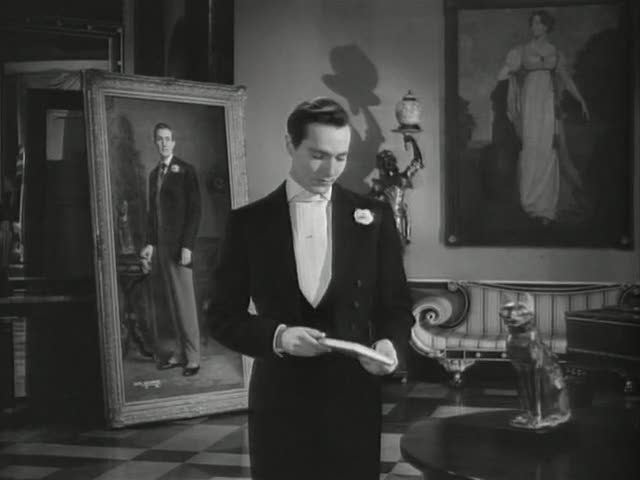
    A scene from the movie Picture of Dorian Gray, 1945

    From his Oxford days, Wilde was deeply influenced by Aestheticism. The movement emphasised on the aesthetic value of a creative work that should be independent of vices and virtues. Oscar Wilde was devoted to this idea and his works reflected that fully. In 1891, he published his first and only novel, The Picture of Dorian Grey. It was a story of an attractive young man, Dorian Grey, who traded his soul with his portrait, so that he would remain young while his painting would age. Alas, the novel did not go down well with the Victorian English society, as they felt it had a sheer absence of morality and the lead protagonist lacked virtue. However, Wilde stayed committed to his devotion to aestheticism. While defending his work, he said that right and wrong are just material for the artist to work with. Of course, the book is now revered as one of the finest classics from 19th century and has been adapted into numerous movies, plays and television series.

    The brilliant satirical playwright

    Wilde’s natural wit won the hearts of the masses with his plays. In 1892, he penned his first play, Lady Windermere’s Fan. It received critical acclaim. It was followed by A Woman of No Importance in 1893, again a huge success. Then in 1895 he wrote two plays, An Ideal Husband and The Importance of Being Earnest. The latter went on to become his most popular play. Wilde was the toast of the town. His name was resonating on every socialite’s living room.

    The infamous case

    During the time when Wilde was riding high on his literary success, he got involved with a young man, Lord Alfred Douglas. In his private life Wilde was homosexual and it was an open secret. But in Victorian England being homosexual was a crime. When Douglas’ father, Marquess of Queensberry, got a whiff of the affair, he left a calling card for Oscar Wilde addressing him as a posing sodomite. It was evident that Queensberry wanted to ruin Wilde’s reputation and popularity. When Wilde sued Queensberry for libel, a lengthy trial began and evidences were presented by Queensberry of Wilde’s homosexuality. Although, the credibility of the evidences was rather questionable in nature, Wilde was arrested on charges of ‘gross indecency’. He was convicted for two years of hard labour in prison. Overnight his playbills were removed from every theatre.  Wilde became a pariah. His name was not to be uttered in public.

    The last days

    In 1897 when he was released from prison he was impoverished and alone. He left for Paris. He wrote very little in the last years of his life. In 1898 he wrote The Ballad of Reading Gaol describing his experience at the prison. Wilde died in a cheap hotel in Paris in1900 due to cerebral meningitis at the age of 46. He rests at the Père Lachaise Cemetery in Paris and it is one of the most visited graves.

    Questions left unanswered

    In the strange turn of events in his life, there are many ambiguities in the charges that were made against him. Apparently, some documents from the trial went missing. Throughout the trial, few of Wilde’s close friends felt that he was trying to protect Douglas and did not defend himself adequately for some of the outrageous accusations that were brought against him. Clearly, Wilde paid a steep price for his affection for Douglas.

    Literary legend

    Although, Oscar Wilde’s last days were spent as an outcast, he remains immortalised through his brilliant works that he has left behind. His quotes are timeless, and even after more than a century has passed, his writing does not fail to find an eager audience.

  • World Radio Day

    As we celebrate the World Radio Day on 13th of February, KALYANI MAJUMDAR sums up the trajectory of one of the significant inventions of humankind that shaped our world and saw us through some of the epochal moments in history.

    Published in Free Press Journal

    The sound crackled a bit. You turned the knob to clear the radio static as the song Radio Ga Ga by Queen came alive on air, and you sang along the lines… ‘Radio…someone still loves you.” There was a time, when if you wanted to listen to a song you loved, you had to go all the way to a music store to buy music, or you had to wait for your radio show to play that song and even then you were left at the mercy of the announcer to play that song. Sounds unbelievable now, right? Today, if you like a song, just stream it online and buy it in a second. However, radio was not just for entertainment purpose, it was also a source to get news and information.

    Invention: The twists and turns

    Guglielmo Marconi

    The idea of developing radio came from the invention of the telegraph and the telephone. Based on Scottish scientist, James Clerk Maxwell’s theory on the existence of radio waves, in 1886, German scientist Heinrich Rudolph Hertz, demonstrated the projection of electric current of rapid variation into space, in the form of radio waves.But the real question was, could it transmit music and speech invisibly?Although, the credit for inventing radio goes to an Italian Guglielmo Marconi, the Mercury Coherer that was used by Marconi was the exact copy of the one invented by Jagadish Chandra Bose in Calcutta, India. In fact, in 1895 Bose gave a public demonstration of electromagnetic waves at the Calcutta Town Hall.

    He solved Hertz’s problem and the waves could penetrate through walls or water. His demonstration had left everyone spellbound, especially when he passed the wave through the body of Lt Governor of Bengal. However, Bose was looking at it from an academic point of view whereas, Marconi was looking at its commercial viability. Also, Bose believed in free sharing of knowledge and didn’t go for a patent initially. The story doesn’t end there. Nikolas Tesla was another contender for the invention of radio. He was working on it since 1884. He even took Marconi to the court. However, one must understand that often a number of scientists work simultaneously to find different solutions to one problem and sometimes their research is built on works of other scientists. Hence, such overlaps does happen in the world of scientific inventions.

    Radio during the World Wars

    During the First World War, radio technology was still in its early stages of development. The equipment was still bulky, thus difficult to be carried around in the war field. Interestingly, the US army had adapted the design that was known as the horse-pack set, wherein, the entire radio transmitter and receiver could fit into a saddle.During the Second World War, radio transmitters were used by aircrafts, submarines, tanks, and on battlefields. There were codes used for communication. Winning wars depended on breaking codes. Radio played a crucial role.

    Radio and India’s freedom struggle

    Azad Hind Radio was a propaganda radio service that was started under the leadership of Netaji Subhash Chandra Bose in Germany to encourage Indians to fight for freedom. Bose addressed the people of India from Berlin. You can listen to the recordings online. During the Quit India Movement in 1942, when the British had banned free circulation of news within India, an underground radio station was operated by the Indian nationalists. Freedom fighter, Dr Usha Mehta organised it with the help of ham radio operators. People of India would hear her voice announcing: “This is the Congress Radio calling on (a wavelength of) 42.34 meters from somewhere in India.”

    When Radio was the star

    Before television really became popular, it was the radio that was the main source of listening to news and music. Therefore, radio stood witness to some of the greatest events in history and was broadcasting those events real time. It was the radio that announced the Indian independence when Jawaharlal Nehru gave his momentous speech: “Tryst with destiny”. It was the radio that broadcasted HG Wells’ famous novel, War of the Worlds as a radio drama presented by an entertainer Orson Welles. He performed it as if the alien invasion was happening real time. That radio show caused widespread panic among the audience. Overnight, Welles became a star. You can listen to the radio show online.

    ‘You are listening to All India Radio’

    In India, radio had its humble beginnings. In 1923, the Radio Club of Bombay made the first broadcast in the country and in few months it was followed by Calcutta Radio Club. In 1930, the Indian Broadcasting Service was commenced under the Department of Industries and Labour and in 1936 it became All India Radio (AIR). From only six stations in 1947, today AIR’s home service comprises around 420 stations and is a broadcasting giant that broadcasts in 23 languages and 146 dialects. It also operates FM stations and is the main source of information and entertainment for the masses. Prime Minister Narendra Modi chose the radio as the medium to address the nation through his programme called Mann Ki Baat.

    Did internet kill the radio?

    Radio networks worldwide have made a comeback. Recently, a radio and digital project called Radio Garden by Netherlands Institute for Sound and Vision came up with an idea to bring the world closer through radio broadcasts. You can download the application and enjoy a global experience. While radio might have competition from all the new technologies, but radio comes with its heritage, nostalgia and identity that is unique. While listening to radio, there is always a certain amount of anticipation of what would be the next song and that element of surprise is missing when you play songs online, isn’t it?

  • The French connection in Bengal

    The French connection in Bengal

    Nestled along the Hooghly River is a tiny town just 35 kilometres from Kolkata that is steeped in history and is definitely worth exploring, writes KALYANI MAJUMDAR.

    Published in Free Press Journal; Date 21.05.2017

    Clock Tower; Image credit: Kalyani Majumdar

    A gentle breeze welcomes you as you step on the Strand. The beautiful promenade along the Hooghly River is a lovely stretch and across it stands a row of beautiful French colonial buildings.  Wait, French? Yes, you read it right! It is a general perception for most that in India the French existed only in Pondicherry. In fact this quaint place called Chandernagore was and still is, the La petit French—the little France—in West Bengal and is only 19 square kilometres in total area. Chandernagore might be a small town but its historical significance cannot be trifled with.

    A town with many names
    The name of the town itself has many derivatives. Some say that the bank of the river forms the shape of the moon—chandra—inBengali; others say it is named after the oldest temple of Goddess Chandi. According to some it was believed to be a centre for selling sandal (chandan). The best way to explore this lovely town is to walk it.

    The advent of the French
    Chandernagore became a French colony in 1673, wherein they established their trading banks, and it became a permanent French settlement by 1688. After the 1757 war with the British the town changed hands a couple of times between the British and the French. However, from 1816 it remained with France till 1950. Although Chandernagore was a French colony, it had a strong convergence of the French and Bengali cultures as many Bengali merchants flourished and played an important role in development of the town.

    Institute de Chandernagore – Dupleix Palace ; Photo credit: Kalyani Majumdar

    Institute de Chandernagore – Dupleix Palace
    In 1730, Joseph François Dupleix was appointed governor of Chandernagore. It was during his time that the town became the main center of commerce in Bengal. The Fort d’Orléans, was also built during his time. Today the reminiscence of Dupleix’s glorious years in Chandernagore is housed in the Institute de Chandernagore that stands in a grand manner located on the Strand commanding a view of the Hooghly River. It is a French colonial building with spacious verandahs enveloping the entire building supported by columns. A flight of steps take you to the entrance to the museum that showcases artefacts, old photographs and Dupleix’s personal belongings. You can spend a good few hours strolling in the garden or sit in the verandah and enjoy the scenic view.

    Every building has a story
    Built in 1904, the Patal Bari (underground house) on the Strand is worth a visit as its lowest floor is submerged in the river. Some very prominent personalities have resided in this house during their visit to the town including Rabindranath Tagore. A clock given by Joseph Daumain sits on the tower facing the promenade reminding everyone of the times that this town has seen. The other grand building on this stretch is the sub-divisional court of Chandernagore. However, it was not always a court. It was the Hotel de Paris. You could very well imagine the spacious verandahs and gardenslit up for the typical Parisian evening soirees. The road off the Strand takes you to Sacred Heart Church. This Roman Catholic Church was built around 1875 and has beautiful stained glass paintings. As you continue walking past the church you come across shops, and old houses competing with new buildings.

    Nandodulal temple ; Photo credit: Kalyani Majumdar

    The temple that withstood cannon fire
    This town played a pivotal role in the famous Battle of Plassey in 1757 when Robert Clive destroyed the Fort de Orleans along with houses and places of worship. There are few buildings that still stand as mute witnesses to Clive’s cannon balls. The temple that still exists from that time is the Nandodulal temple. Built in 1740, it is believed to be the largest dui chala (double-sloped roof) temple in Bengal. Located on a picturesque landscape with a little pond on the rear, the wall still carries theimprint of Clive’s cannon balls.

    Refuge for Indian freedom fighters
    As you peel one layer of history of this town you unravel another layer beneath.  Since Chandernagore was a French colony during the same time when Calcutta was under the British, many freedom fighters from British Bengaltook refuge in French Bengal. The most famous name is of Sri Aurobindo Ghosh. The house where Sri Aurobindo went into hiding and used the space to make bombs still stands. In fact many brave hearts such as Kanailala Dutt and Rajbihari Ghosh that fought for the Indian freedom against the British hailed from this town. You can visit the Prabartak Ashram that was established by Motilal Roy. It used to be a safe haven for freedom fighters.One should not miss the Laldighi on the Grand Trunk road, the cemetery across it, and the old library building not very far from there.

    Local flavour
    Although most of Chandernagore’s identity comes from its French association, but one that continues to have the local Bengali flavour is the Jagaddharti Puja. It is celebrated with much fervor. After a heavy duty history tour one should not miss the lovely evenings at Strand. It looks like the entire town is on the promenade. With shopping carts and ferries on either side of the Strand selling trinkets, street food, icecream carts. Music floating from the Rabindra Bhawan across the street and the sight of old people discussing politics and Tagore on the same breath is quiet a sight, not to be missed by anyone. Albeit, officially Chandernagore merged with West Bengal and became part of India in 1951, the vestiges of the Liberty gate on the south of the town acts as a reminder of the French connection with the inscription sayingLiberté, égalité, fraternité—Liberty, equality, fraternity—the three pillars of the French revolution. We tip the hat for those lovely words that continue to give us hope.

  • Bangalore: Exploring the multi-layered history of the city

    Published in Free Press Journal; Date: 14.02.2018

    If the soul of a city is uncovered by walking the streets, then definitely it holds true for Bangalore as it reveals itself beyond its IT hub and impersonal glass buildings. Kalyani Majumdar explores the multi-layered history of the city.

    As you look past the traffic and catch sight of rows of pink and yellow flowers against the clear blue sky, for a second you forget the traffic, and savour the moment. Welcome to Bangalore/Bengaluru.

    Rise of a modern city

    Bangalore came into significance in 1537 AD, when Kempe Gowda I, a feudatory of Vijaynagar Empire laid the foundation of the city by building a mud Fort, wherein people of different vocation had their settlements. After him, it changed many hands from the Marathas to the Mughals, followed by Hyder Ali and then his son Tipu Sultan and finally, the British Empire. They have all left their imprints on Bangalore. However, Bangalore flourished as a city once the British took over. It started with the shifting of British Headquarters from Mysore to Bangalore in 1837. Gradually, the city witnessed a steady development of wider roads, boulevards, railway lines, improved post and telegraph facilities, and buildings.

    A royal experience

    A grand view of the Bangalore Palace; Photo credit: Kalyani Majumdar

    As you approach the Bangalore Palace, it is hard to miss the close resemblance of the exterior with the Windsor Palace in England. It is a magnificent Tudor-style structure facing a beautiful garden and has royalty written all over its façade. The plot was bought by King Chamaraja Wadiyar’s guardians in 1873. The palace was built in 1887. Once inside it is hard to miss the bright yellow-coloured ballroom with its decorated columns, ceiling and arches. After taking in the splendour of the ball room walk up a wooden staircase to the Durbar Hall. The huge room with its embellished interiors, huge chandeliers and a beautiful collection of art is indeed a rich experience. The corridors have exhibits from Maharajas hunting escapades. One of the courtyards has a beautiful coloured-tile bench gifted by an erstwhile Spanish royal. It is highly recommended that you walk the lane lined up with trees on your way to the exit.

    From South Parade to M.G Road

    It is not just now that M.G Road in Bangalore is famous for being the centre of social life. Even during the British era, it had a similar character and was known as South Parade. The building that now has the office of Deccan Herald was once where the popular Funnel’s Restaurant stood. Next to it, is the iconic Higginbotham book store. It has been there since 1905. Recently, it revamped its interiors and now it has reopened with a colourful interior and the façade looks bright as well. The book store has a fantastic collection. There is certainly a sentimental factor attached to this bookshop that has catered to generations of booklovers and still continues to do so. It is lovely to see how the old and the new has blended effectively on this particular stretch. Across the road, alongside the metro station there is a lovely boulevard. The walkway is almost half a kilometer and is lined up with white and pink bougainvillea. It is so refreshing even though it is right next to a busy road.

    The roads from the past 

    Book Society on St. Marks Road; Photo credit: Kalyani Majumdar

    At the intersection where M.G Road meets St. Marks Road, you can see a gothic building with etching in bold letters that say, ‘Book Society’. It was built in 1912. Part of the building is now the Hard Rock Café and apparently, sometime back it also had a HMV record store. As you continue further on St Mark Road the prestigious Bowring Institute is on view. From there you can easily negotiate through wide streets to reach the Museum Road, lest you are not wearing comfortable shoes. In 1865, part of the Cantonment Jail building on this road, now Good Shepherd Convent, served as the Government Museum, before it was shifted to its present location on a beautiful neoclassical structure in Kasturba Road, in 1878. Nevertheless, the road retained its name, thus keeping alive a part of history. Also, on the same road right next to the Post Office stands a 150-year-old tiled-roof building that serve as the office of the senior superintendent of post office.

    Cubbon Park 

    A statue of Queen Victoria stands at one corner of the Cubbon Park; Photo credit: Kalyani Majumdar

    If you approach Cubbon Park from Kasturba Road then you will come across a statue of Queen Victoria standing at the corner of the Park, facing the busy street, perhaps wondering how much the city has changed since 1906. The Cubbon Park was established in 1870 by John Meade and the landscaping was done by Richard Sankey. It is a lovely place to park yourself under a tree with a book.

    Imprints from the past 

    The Glass House at Lalbagh Botanical Garden; Photo credit: Kalyani Majumdar

    At the entrance of the Lalbagh Botanical Garden there is a peninsular gneissic rock, dated to about 3,000 million years, making it one of the oldest rock formations on the planet. And atop the rock is the Kempe Gowda tower. Hyder Ali laid its foundation in 1760. It was a pleasure garden till William New, a gardener from Kew in London came to Lalbagh in 1858 and turned the place into a scientific research centre and maintained a regular inventory of the trees. He lived in a small cottage inside Lalbagh which is now the Lalbagh library. In 1874, John Cameron took over as superintendent of Lalbagh. He too did many experimental cultivations within the garden. He proposed the idea of a Glass House. It was built in 1889 inspired by the famous Crystal Palace of London. It houses many flower shows and is a must-see.

    Outside the Lalbagh gate, there are stalls selling fresh fruit juice in the morning. One might wonder, if this was perhaps the spot where Cameron enthusiastically distributed seeds of new vegetables that he grew, to the passing farmers. We do owe him Chayote, a popular vegetable in Karnataka. Stories such as these crop up when one steps out on the streets of this city to listen to the echoes from the past and weave them into an urban narrative.

  • Remembering the great Indian bard

    On the 157th birth anniversary of Rabindranath Tagore we take a moment to remember the polymath as he continues to ignite our creative consciousness and inspires us to see the world from a fresh perspective. KALYANI MAJUMDAR pays homage to the Nobel Laureate.

    Published in Free Press Journal; Date: 06.05.2018

    On the 157th birth anniversary of Rabindranath Tagore we take a moment to remember the polymath as he continues to ignite our creative consciousness and inspires us to see the world from a fresh perspective. Kalyani Majumdar pays homage to the Nobel Laureate

    “Where the mind is without fear and the head is held high

    Where knowledge is free,

    Where the world has not broken into fragments…”

    These profound words were written by Rabindranath Tagore in 1910, and even today these words remain relevant. Tagore is the only known personality who has penned the national anthem for two countries. The Jana Gana Mana was chosen for India and Aamar Shonar Bangla was selected for Bangladesh.

    Tagore believed that humanity was the highest spiritual practice and he believed in the idea of ‘One World’. Thus, it is no wonder that his works have an immense capacity to transcend nationality, religion, geographical regions and has the natural ability to touch every soul. Tagore was one of the prominent faces of the Indian Renaissance. Not only did he changed the landscape of Bengali literature, but also redefined modern Indian art, and presented Indian literature, philosophy and culture to an international audience.

    Movie clip from Charulata. The movie is based on Tagore’s novel Noshto neer (broken nest).

    The early years

    Rabindranath Tagore was born in a highly educated and influential Bengali-Hindu family to Debendranath Tagore and Sarada Devi in Jorasanko Thakur Bari in Calcutta (now Kolkata) in British India in 1861 on the 25th day of Baisakh, which according to the Gregorian calendar usually falls either on the 7th or on the 9th of May. His family owned lands and estates mostly in East Bengal, which later became Bangladesh.

    He was never interested in the formal education system that was prevalent at that time and dropped out from school. His interest in art and literature developed from a very young age as his family was progressive and was leading the way in culture, art and literature in Bengal. But it was Rabindranath Tagore, who was destined to shine through as the brightest star among all the Tagores.  His father was an extensive traveler and young Tagore travelled with him for months at stretch to different parts of India. These travels left a lasting impression in the young mind of Tagore that found expression later on through his writings.

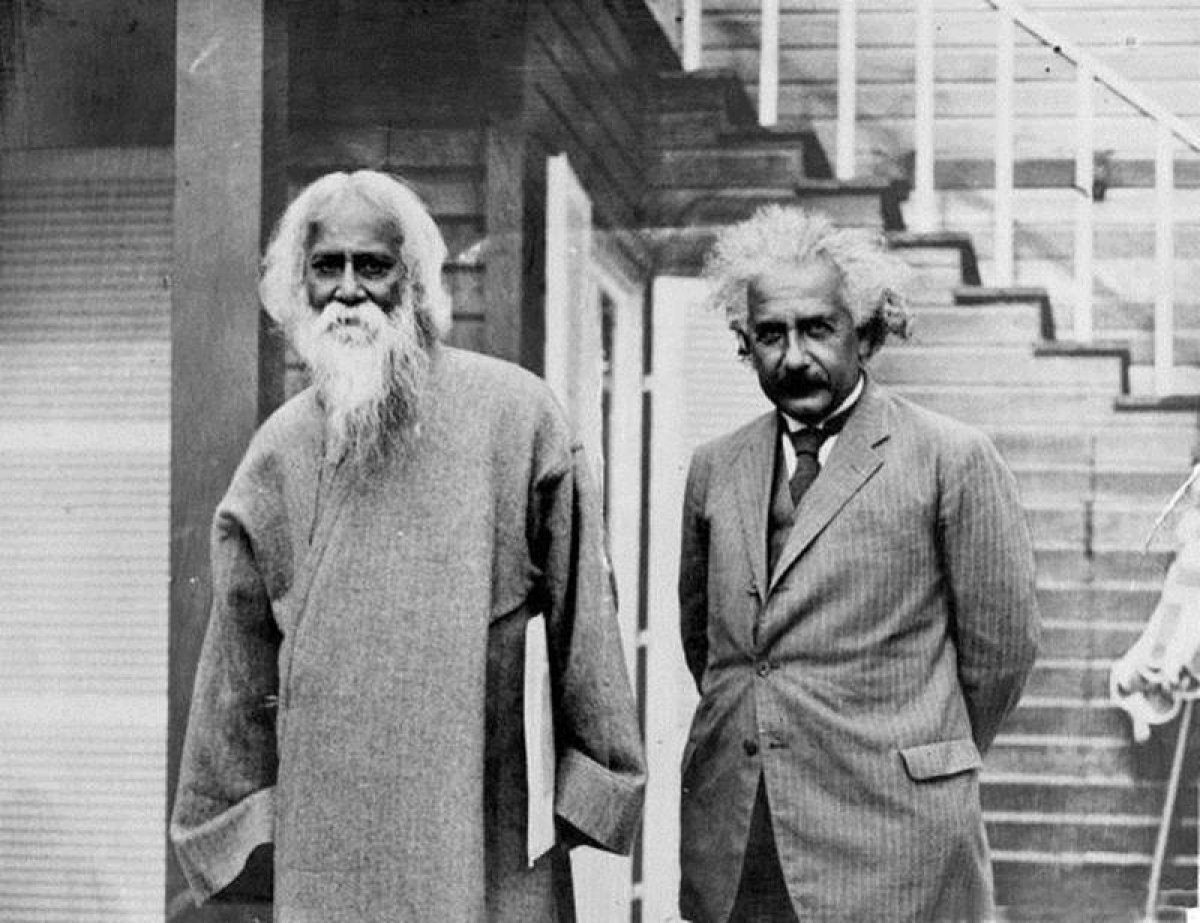
    Tagore with Einstein

    A polymath

    Rabindranath Tagore did not limit himself to one form of creative expression. Apart from writing poetry, short stories and novels, he was a great essayist, dramatist, song writer, composer and painter. When gramophone was introduced in India, he recorded his songs. He was an exceptionally curious man who wanted to learn as much as was humanly possible in one life. Some of his very popular short stories include Kabuliwalla, Khudita pashan, and Bhikarini.

    Apart from his short stories, his novels Ghare Baire (At Home and Outside) and Nastanirh (Broken Nest) were made into fantastic films by none other than Satyajit Ray, the latter was called Charulata. Both had strong female protagonists. It is said that no one understood women as beautifully as Tagore did. In 1913, he became the first non-European to win a Nobel Prize for Geetanjali—a collection of poems that was originally written in Bengali and were translated to English by Tagore. He never stopped exploring new avenues of self-expression. Tagore was in his sixties when he started painting. He was not formally trained in fine art, but that did not stop him from pursuing painting and he used his sensibilities and visual vocabulary to develop a distinct style of his own.

    A global phenomenon

    Tagore was inspired by both Eastern and Western philosophies. As an avid traveler, he had a keen understanding of different cultures and till his last days even with his failing health, he continued with his travels. He had visited around thirty countries in his lifetime, including Japan, Mexico, United States, and England to name a few. He wanted to spread his idea of ‘One World’ and gave lectures in universities in different countries. He was on a constant quest to facilitate a dialogue between the East and the West based on concepts of humanity, freedom and creative expression. He met some of the world’s greatest minds including Albert Einstein and shared ideas with them.

    An educationist

    Tagore’s pursuit to impart knowledge without the barriers of nation, geography, race or religion continued as he went on to set up a school at Santiniketan with the aim to focus on humanity and its creative expressions based on a Guru-Shishya method of schooling system. His father had bought a large stretch of land around 136 km from Kolkata and had established an ashram with a temple. Tagore shifted there in 1901 and set up an educational institution that was experimental. The classes were held under trees, close to nature. Later on, he turned it into the Visva Bharati University.

    The personal tragedies

    In Tagore’s life he had to confront several deaths of his near and loved ones. He lost his mother when he was very young and he found comfort when he identified his mother’s love in nature. But then the untimely death of his sister-in-law, Kadambari Devi, left him devastated. She was his muse and an anchor for the budding writer that he was, then. The loss was reflected in many of his stories, songs and poetry.  Between 1902 and 1918 he lost his wife, father, son and two daughters. Despite facing these personal tragedies in his life, Tagore never lost the optimism that life had to offer. Instead of drowning into the sea of sorrows he channeled his energy towards creative pursuits.

    It was on 7th August 1941, that Tagore breathed his last. He died in Jorasanko Thakur Bari, the place where he was born and had his first tryst with writing. Tagore wrote a poem Aaji hote shoto borsho pore (100 years from now), wherein, he was curious to know who would be his readers after 100 years. Perhaps, when he wrote that poem, he didn’t know that even after 76 years since Tagore’s demise, he continues to live through his writing, music and ideas in the collective consciousness of people from around the world.