Tag: art gallery

  • Of bodies, armour and cages

    Art installation by Shakuntala Kulkarni; Photo courtesy: Chemould Prescott Road

    What does physical protection mean and what are the solutions? These are some of the questions that Shakuntala Kulkarni explores in her recent project.

    Text: Kalyani Majumdar

    Published in Domus India; Date: October 2012

    If only we could walk around the city with a house-like structure around us then we would have protected ourselves from the assault that our physical form is subjected to every day. The constant invasion of personal space is unavoidable in the over-populated Indian cities and Shakuntala Kulkarni has been working on this idea and her recent exhibition at Chemould Prescott Road gallery titled, Of bodies, armour and cages showcased cane armours and costumes that could possibly be used as mediums for protection when walking around in the cities. She has brought historical armours in the modern context but has given them the format of elaborate period costumes and dresses from different times and cultures. Shakuntala is fascinated by the idea of armours made of cane as even though it is masculine, rigid and stiff yet the cane armour has a sense of fluidity and is linear, fragile and has a feminine quality about it.

    Interestingly, her project has conflicting theories as while the armour is protecting the physical self, at the same time it is also restricting the body from exploring and being flexible. The feeling of claustrophobia is clearly reflected in these cane structures. Shakuntala has worked with metals, wires, rubber and leather in her previous projects but somehow none of those mediums worked for her this time. She has always been fond of cane but she never thought of exploring it for her projects. She added, “When Dinesh Pardeshi, a cane worker from the city burnt the cane to give a particular shape to it, the yellow colour of the cane changed to a brownish-black, which I really liked. Initially it was just the visual liking, but then I really fell in love with this material because of the possibilities. And I went by how the cane spoke to me.”

    The cane armours look very delicate and yet they are very strong. Shakuntala worked on the mechanics of the costume. In this project, her work explores outside the realms of photographs and two-dimensional medium to another form of visual space. As part of her art performance she wore the cane costume and walked around the city and she could experience the feeling of being caged and it was difficult to move and the discomfort caused by the armour set limits to her movement, which again represented the limitations that the society imposes on women. When she narrates her experience of wearing the costume, she said that sometimes her hand or her fingers would come in the way while wearing the costume, and it translated to a feeling of binding oneself. The entire costume also involved accessories — bangles, rings — made of cane in order to protect the parts of her body that were exposed. Another interesting fact that Shakuntala observed was that when the cane armour was dismantled and lying on the floorit formed different shapes  crabs, flowers and lamp shades  and the same when assembled to form the costume imbibed a different aura. The project involved her walking around the city and standing amidst the unplanned urbanisation and re-development of the city and here her armour acts as a metaphor for the issues that are plaguing the city. The armour symbolises a medium for protection of the physical space at one level, and also represents the resistance of the physical form towards the ad hoc changes in the urban fabric at another, but this entire process of protection has trapped the form itself in a cage-like structure.

  • Printmaking in Bengal

    Printmaking in Bengal

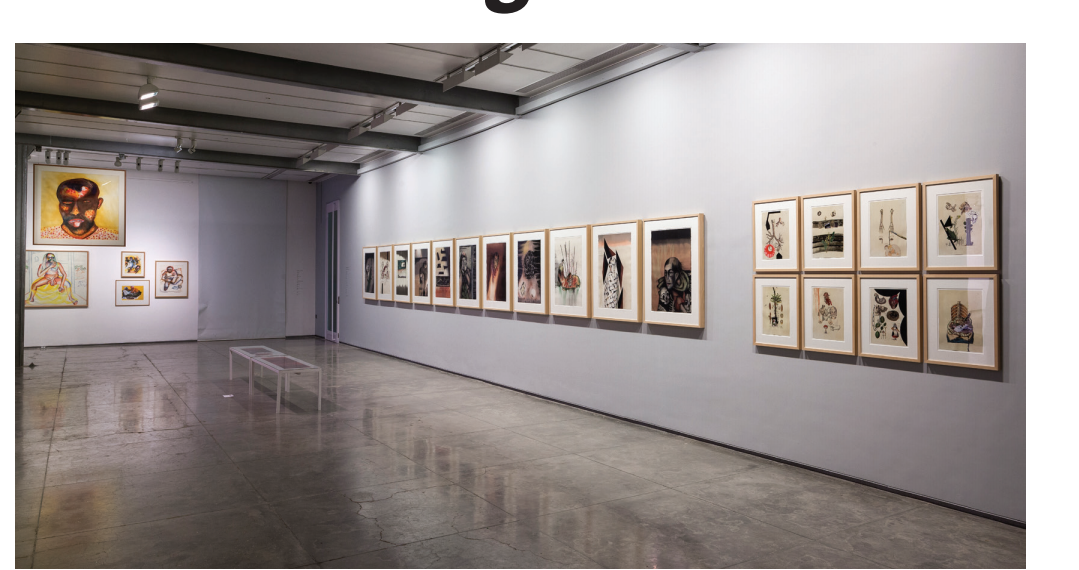
    The ongoing exhibition at Project 88 on Prints from Bengal: Modernism in Colonial India explores the process of printmaking in Bengal and its role in understanding the socio-political climate in British India of the early to mid-20th century. Kalyani Majumdar brings the story.

    Published in Free Press Journal; Date: 10.06.2018

    Ramkinkar Baij, Untitled, Woodcut on Paper, 5 x 7.5 inch

    An active art space now, Project 88 was once a century-old metal printing press, situated in Colaba, Mumbai. So, when the art gallery decided to organise an art show on prints from Bengal, it came full circle with its own history. The exhibition explores the nuances involved in printmaking as an art form, by some of the stalwarts from the art world who changed the modern Indian art scene of the twentieth century.

    Art as an expression

    Artists have often used art to express their observations especially during the time of unrest, human suffering and oppression. Hence, when one looks at the series of prints exhibited at Project 88, it provides a keen understanding of the social life of Bengal and also the political scene in colonial India. The artists whose prints are exhibited at the gallery are, Gaganendranath Tagore (1867 – 1938), Mukul Chandra Dey (1895 – 1989), Ramendranath Chakravorty (1902-1955), Ramkinkar Baij (1906 – 1980) and Rani (Dey) Chanda (1912 – 1997). They were all born in the undivided Bengal in British India and were all associated to Santiniketan.

    Ramendranath Chakravarty, Untitled, 1935, Woodcut

    They grew up during a period when Bengal was going through a lot of political and social upheavals. These artists saw the unrest caused due to partition of Bengal in 1905 on communal lines. Followed by the shifting of the capital from Calcutta to Delhi and its repercussions, they played their part in the Swadeshi movement and attempted to find an Indian identity in colonial India. Apart from Gaganendranath Tagore, who died in 1938, the other artists also saw the, Bengal famine, communal violence followed by the partition of Bengal and the Indian independence. These events had great impact on the artists’ works. Also, all the five artists were highly inspired by the 19th century Bengal Renaissance and that too played an important role in how they communicated through their art.

    From Bichitra Club to Kala Bhavan

    Founded in 1915 by the Tagores in their Jorasankho house in North Kolkata, the primary aim of Bichitra Club was to explore different styles of printmaking and painting. Bichitra, which means, variety, was spearheaded by the three nephews of Rabindranath Tagore — Gaganendranath, Samarendranath and Abanindranath. They had turned the south veranda of the Jorasankho house into a club, fashioned on the concept of an art salon. The club offered classes on printmaking, painting, music, pottery, carpentry and so on. Rabindranath Tagore defined it as the model school and its members and students also had Pratima Devi and Sunayani Devi from the Tagore family as students. It was here that the printmaking techniques were explored in a manner that saw the emergence of woodcuts and lithographs as art forms.

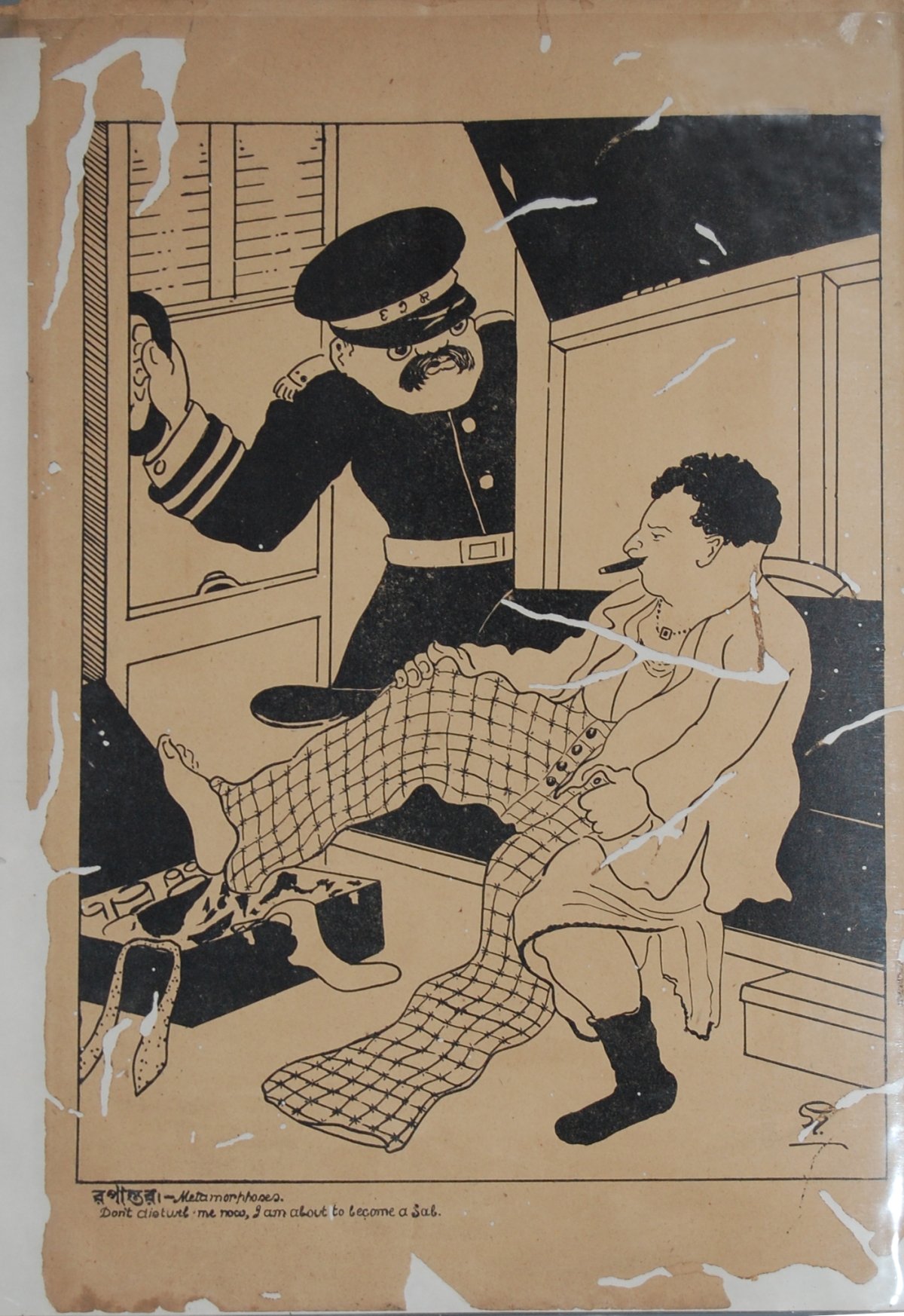
    Gaganendranath Tagore, Metamorphoses, 1917, Lithograph on Paper, 17 x 11 inch

    The practice of printmaking as a fine art medium became extremely popular with the establishment of Kala Bhavan in 1919. It is the fine arts faculty of the Visva Bharati University, Santiniketan. And, it was none other than Nandalal Bose, a student of Abanindranath Tagore, and also the creator of the logo for Bichitra Club, who made printmaking a popular art form in Kala Bhavana. Ramendranath Chakravorty, Mukul Chandra Dey, Rani Dey (Chanda), Ramkinkar Baij were all trained at Santiniketan.

    Tagore’s satirical depiction of urban life

    Artist Gaganendranath Tagore had special interest in lithography, and even went on to set up his own lithographic press in 1917.  He was anti-colonial and had no qualms to express it openly through his art. His prints exhibited at the gallery shows, caricatures that made satiric commentaries on colonial Indian urban life. One of his works on display, titled, Metamorphosis: Don’t disturb me now, I am about to become a sab show a Bengali babu pretending to be a European, as he is shown wearing a trouser on top of his dhuti. Through his humour, he would often take on the corrupt politicians and showcase the hypocrisy that existed in the Indian society. Even today, Tagore is considered one of the finest and influential modernist printmakers, India ever had.

    Depiction of rural and tribal life

    The prints by Chakravorty, Dey, Baij and Chanda at the exhibition, depicts the rural and tribal (santhal) life.  Ramendranath Chakravorty began his formal art education in Government School of Art, Calcutta/Kolkata in 1919, but in two years he left for Santiniketan for the newly established Kala Bhavan. It was here that he found his mentor, Nandalal Bose. Chakravorty’s ability to capture the rural Bengal life can be seen clearly in his wood engravings. His work, Untitled, woodcut from 1935 is one such example. His works often expressed a duality, wherein, it finds influences from both the revivalist movement in Bengal and the Swadeshi Movement that was rising during that period. However, he was always keen on exploring techniques prevalent in Japan and Europe.

    Mukul Dey, Filling the Pitchers, Hand Coloured Dry point Etching on Paper, 6 x 8 inch

    Mukul Chandra Dey, was one of the prominent member of the Bichitra Club. In 1916, he went to US to learn the technique of dry-point etching. He came back to Santiniketan in the 1920s. His exhibit at the gallery titled, Filling the Pitcher looks hand-painted as the artist has used a variety of tints and smudges to define his subjects.

    Ramkinkar Baij went to Santiniketan to become a sculptor and painter, however he also found interest in the process of printmaking. He connected easily with the tribal lifestyle and throughout his lifetime his works revolved around his tribal subjects. In one of his prints at the show, the Vande Mataram chant is inscribed on the top along with a partially visible face of a man and on the foreground the print has jagged uneven broken shapes. His monochromatic woodcuts has dynamic characteristics, combined with a certain ruggedness that makes his prints stand out from the rest.

    Rani (Dey) Chanda, was Mukul Dey’s sister. It was Rabindranath Tagore who encouraged her to pursue art. She went to Santiniketan and studied painting, music and dancing. She was imprisoned for anti-British activities for a while. In 1932, Mukul Dey published a portfolio of 25 linocuts by his sister. Her prints are a beautiful contrast of black-and-white compositions creating a dreamlike effect of rural Bengal. Whether it’s the huts in moonlit night or a boat riding the waves, she created magic with her perfect lines and balance of black and white.

    Event Detail:

    When: On till June 16

    Timings: 11 AM to 7 PM

    Venue: Project 88, Ground Floor, B.M.P. Building, Narayan A Sawant Rd, Azad Nagar, Colaba, Mumbai

    (Image credit courtesy: The artist, Galerie 88 & Project 88, Mumbai)