Tag: bengal

  • Six must-do activities in Kolkata

    Six must-do activities in Kolkata

    By Kalyani Majumdar | Published in Free Press Journal |10.06.2017

    Whether you are a foodie, an architecture enthusiast, a book worm, a history buff, or a poet at heart, Kolkata has something for everyone, says Kalyani Majumdar who lists six must-do activities to do in the city

    Through the meandering streets and by lanes flanked with a mix of colonial, vernacular and modern built structures you land on a busy street where along with cars, bikes and buses you see a tram moving at its own pace. That is Kolkata for you! With all the hustle and bustle of a city it still manages to have a whiff of leisurely pace to it.

    The Trams from yore
    Did you know that the trams in Kolkata are the oldest electrically operated trams in Asia?At first when it was introduced by the British in 1873 it was horse drawn. In 1902 they became electric. This is the only tram network in India which is still operating. The slow pace of a tram ride gives you an opportunity to enjoy the sight and sound of the city properly and has the added feel good factor that your mode of transport is environment friendly. The old trams still have wooden interiors. If you want to feel nostalgic of the good old days then choose a tram ride that take you northwards of the city as that is the old part of Kolkata.

    Trams still run on Kolkata streets | Image credit: Kalyani Majumdar

    College Street and Coffee House
    The name College Street goes back to 1817 when Sir David Hare started the Hindu College. Now of course, it also has Kolkata’s most prestigious and renowned academic institutions such as the University Of Calcutta, Calcutta Medical College, Presidency College, Sanskrit College and Hare School. This stretch is a paradise for book lovers. It is a one stop place for all your book search.

    Once you are done with your book browsing, stop at the legendary Coffee House. Even if the coffee they serve is too sweet for your palate, and the fact that the place does not have fancy amenities, it can beat any modern coffee shop for its old world charm.  A spiral staircase takes you to the coffee house. Waiters wearing headdress greets you, as a young Rabindranath Tagore looks on over everyone from his life size portrait. The place has been graced by notable personalities such as Rabindranath Tagore, Subhas Chandra Bose, Satyajit Ray, Manna Dey, Amartya Sen, Shashi Kapoor and Aparna Sen to name a few.

    Exploring the streets, museums and ghats

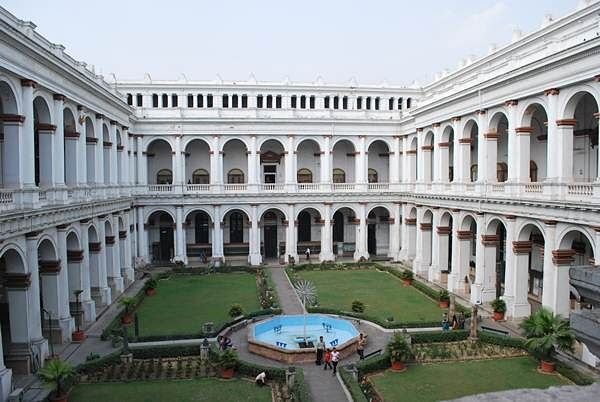
    The oldest museum in India The Indian Museum, Kolkata | Image credit: Kalyani Majumdar
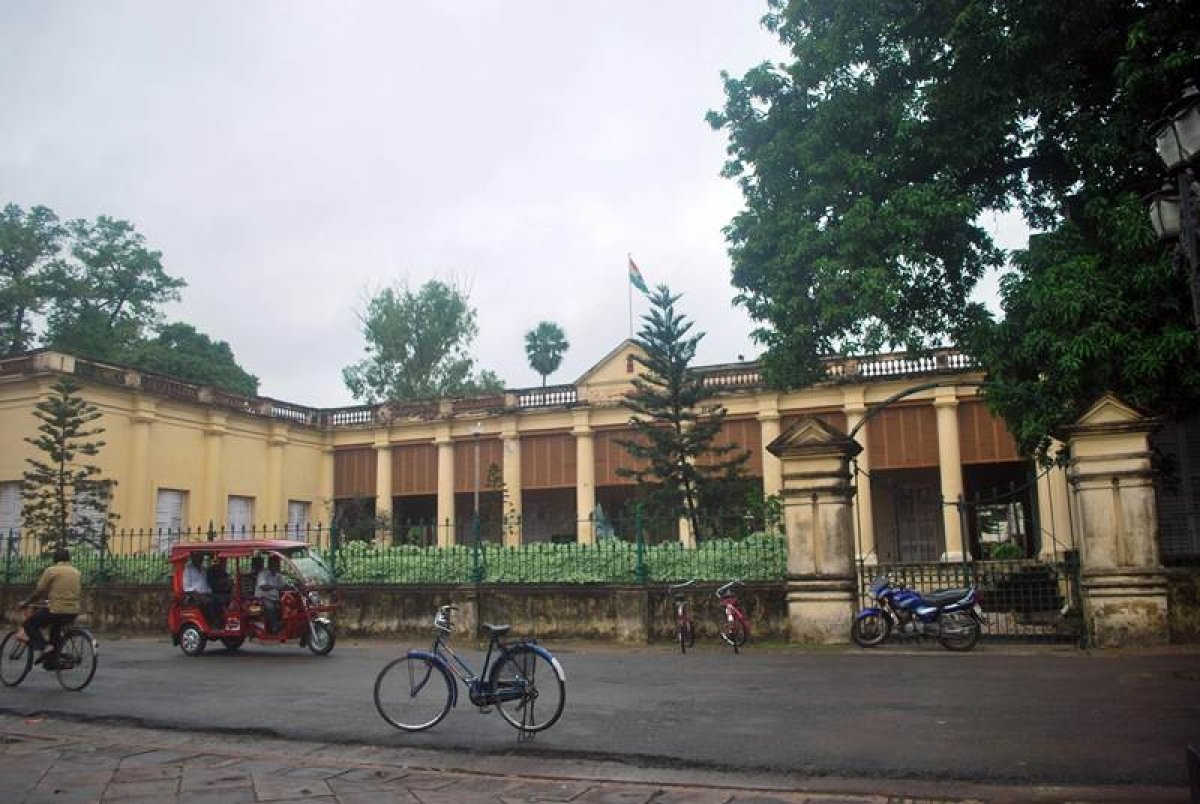
    Jorasankho is the house where Rabindranath Tagore lived, now it is a museum | Image credit: Kalyani Majumdar

    Walking is the best way to not miss the vibrant energy of the city. Amix of architectural styles can be observed such as the Victorian, Neo classical, Indo-Saracenic and also few art-deco buildings.Do not miss the majestic Esplanade mansion, built in 1910. Also, visit the Indian Museum. It is the oldest in India founded in 1814. In 1878 it was transferred to the present building. It houses an Egyptian mummy.

    Make a trip to the Marble Palace in North Kolkata. Walking around this property takes you back to the 19th century. It is a popular location for movie shoots. Also, nearby is the JorasankhoThakurbari. It was built in 1785and was the ancestral home of Rabindranath Tagore. It houses a lovely museum which is worth visiting.

    The Ganga ghat and the boat rides beacon | Image credit: Kalyani Majumdar

    After a good measure of history and culture take a leisurely walk either at the Princep Ghat or the Outram Ghat in the evening. It is highly recommended that you take a boat ride under the starlit sky and appreciate the Vidyasagar Setu, a cable-stayed bridge from the river.

    A dose of spirituality
    Plan an early morning visit to the beautiful Dakkhineshwar temple. It was built in 1855 by Rani Rashmoniand has a traditional Bengali nine-spired architectural style. The spacious temple complexis dedicated to Goddess Kali and is associated with the spiritual leader Shri Ramakrishna Paramhansa.From here take a boat ride across Hooghly River to visit Belur Math. It was founded in 1938 by Swami Vivekananda. The serene and quiet atmosphere at Belur is a perfect place to unwind while providing a splendid view of the river.

    The potters of Kumartuli (to read more about Kumartuli visit my article here)
    A trip to Kolkata is incomplete without visiting Kumartuli. The name Kumartuli or Kumortuli comes from the Bengali word kumor meaning potter and tuli meaning locality. As you negotiate through the labyrinthine lanes of this area it is like visiting an art and crafts workshop. Rows of idols of Durga and the entire pantheon can be seen standing on either sides of the narrow lanes as you see sculptors in action. The idols for Durga Puja are prepared here and also exported to different parts of the world. It is an amazing place for budding photographers and is a delightful experience to interact with the potters.

    Although the name of the city changed from Calcutta to Kolkata in 2001, the city has managed to keep the unique mix of both worlds alive in a graceful manner, and that is perhaps what adds to the extraordinary charm that Kolkata imbues.

  • MANY HANDS, MANY FORMS – KUMARTULI

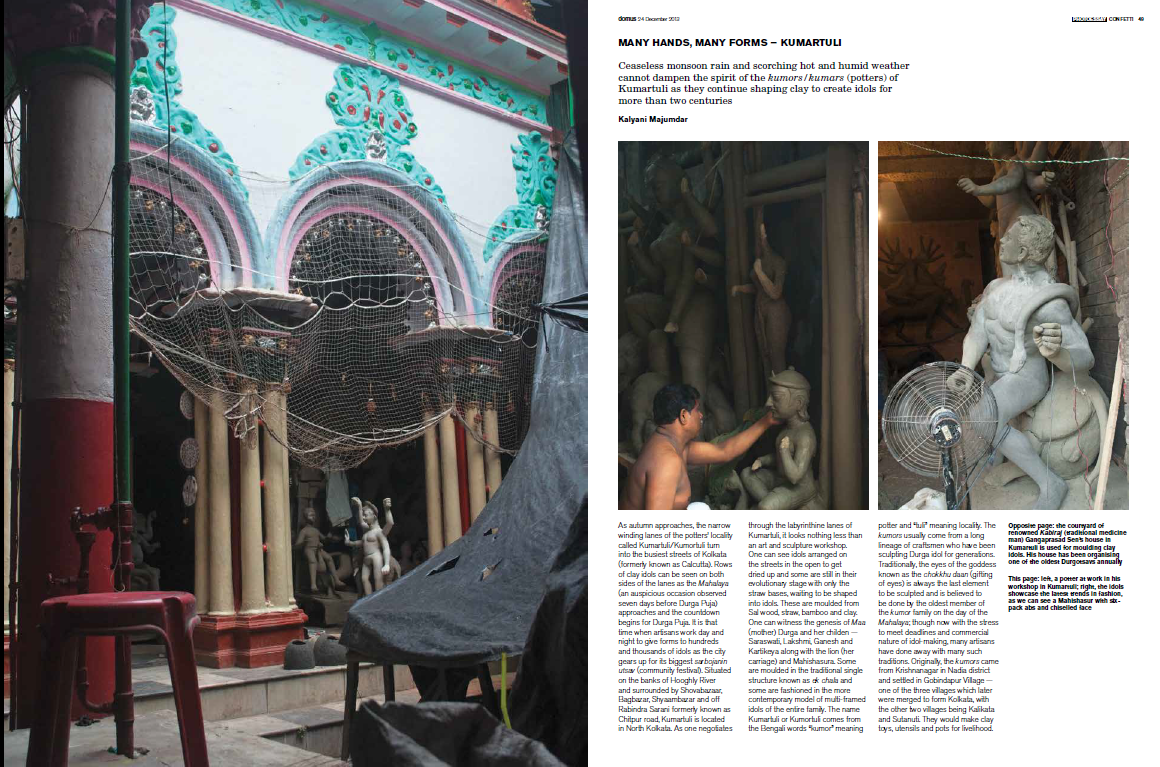
    MANY HANDS, MANY FORMS – KUMARTULI

    Photo essay by Kalyani Majumdar | Published in Domus India | Nov, 2013

    Ceaseless monsoon rain and scorching hot and humid weather cannot dampen the spirit of the kumors/kumars (potters) of Kumartuli as they continue shaping clay to create idols for more than two centuries.

    The courtyard of
    renowned Kabiraj (traditional medicine
    man) Gangaprasad Sen’s house in
    Kumartuli is used for moulding clay
    idols. His house has been organising
    one of the oldest Durgotsavs annually

    As autumn approaches, the narrow winding lanes of the potters’ locality called Kumartuli/Kumortuli turn into the busiest streets of Kolkata (formerly known as Calcutta). Rows of clay idols can be seen on both sides of the lanes as the Mahalaya (an auspicious occasion observed seven days before Durga Puja) approaches and the countdown begins for Durga Puja. It is that time when artisans work day and night to give forms to hundreds and thousands of idols as the city gears up for its biggest sarbojaninm utsav (community festival). Situated on the banks of Hooghly River and surrounded by Shovabazaar, Bagbazar, Shyaambazar and off Rabindra Sarani formerly known as Chitpur road, Kumartuli is located in North Kolkata. As one negotiates through the labyrinthine lanes of Kumartuli, it looks nothing less than an art and sculpture workshop.

    One can see idols arranged on the streets in the open to get dried up and some are still in their evolutionary stage with only the straw bases, waiting to be shaped into idols. These are moulded from Sal wood, straw, bamboo and clay. One can witness the genesis of Maa (mother) Durga and her childen —Saraswati, Lakshmi, Ganesh and Kartikeya along with the lion (her carriage) and Mahishasura. Some are moulded in the traditional single structure known as ek chala and some are fashioned in the more contemporary model of multi-framed idols of the entire family. The name Kumartuli or Kumortuli comes from the Bengali words “kumor” meaning potter and “tuli” meaning locality. The kumors usually come from a long lineage of craftsmen who have been sculpting Durga idol for generations.

    Traditionally, the eyes of the goddess known as the chokkhu daan (gifting of eyes) is always the last element to be sculpted and is believed to be done by the oldest member of the kumor family on the day of the Mahalaya; though now with the stress to meet deadlines and commercial nature of idol-making, many artisans have done away with many such traditions. Originally, the kumors came from Krishnanagar in Nadia district and settled in Gobindapur Village — one of the three villages which later were merged to form Kolkata, with the other two villages being Kalikata and Sutanuti. They would make clay toys, utensils and pots for livelihood decided to build Fort William at Gobindapur village, the inhabitants of that area migrated to Sutanati and it is believed that under the instruction of the Company, John Holwell was given orders to designate areas according to the nature of profession of the inhabitants; Kumartuli was one such area that was designated as a residential area for all the potters and craftsmen. In those days these kumors were invited by the old and nouveau rich Indian households —mostly the Zamindars who were also the first few patrons and organised Durga puja in their houses — to make clay images of Durga and other idols. These houses had thakurdalans/thakurbaris (separate building used for annual festivals).

    The thakurdalans were high-ceilinged flat-roofed buildings. Apart from the autumn festival, the artisans were called round the year to sculpt ornamental elements such as the fairies, foliages, other patterns and inlay works on brackets and columns of the houses as many modelled after the Western influence, thus giving rise to a fusion of Indo-Bengal form of ornamental art for residential built forms. With time, as Durgotsav shifted out of the thakurdalans and became a community festival, the common people became the new patrons of Kumartuli. Also, every year one can easily predict the current trends in vogue by looking at the idols; this time it was Mahishasurs’ six-pack abs and chiselled faces that were in popular demand — straight out of a Greek mythology.

    A potter at work in his
    workshop in Kumartuli
    The idols
    showcase the latest trends in fashion,
    as we can see a Mahishasur with sixpack
    abs and chiselled face

    From its humble beginning to post- Independence, Kumartuli has risen to become the exclusive exporter of idols of the goddess to the Bengalis settled in different parts of the world. Clearly, Kumartuli is more than just an urban space in Kolkata that produces clay idols for Durga Puja. It has been an active participant for more than two centuries in maintaining a continuity of cultural tradition and craftsmanship, and has witnessed the trajectory of the changing socioeconomic and political climate of the city — the transition from pre to Post- Independent India and from Calcutta to Kolkata.

    All photographs and text copyright with Kalyani Majumdar

  • The French connection in Bengal

    The French connection in Bengal

    Nestled along the Hooghly River is a tiny town just 35 kilometres from Kolkata that is steeped in history and is definitely worth exploring, writes KALYANI MAJUMDAR.

    Published in Free Press Journal; Date 21.05.2017

    Clock Tower; Image credit: Kalyani Majumdar

    A gentle breeze welcomes you as you step on the Strand. The beautiful promenade along the Hooghly River is a lovely stretch and across it stands a row of beautiful French colonial buildings.  Wait, French? Yes, you read it right! It is a general perception for most that in India the French existed only in Pondicherry. In fact this quaint place called Chandernagore was and still is, the La petit French—the little France—in West Bengal and is only 19 square kilometres in total area. Chandernagore might be a small town but its historical significance cannot be trifled with.

    A town with many names
    The name of the town itself has many derivatives. Some say that the bank of the river forms the shape of the moon—chandra—inBengali; others say it is named after the oldest temple of Goddess Chandi. According to some it was believed to be a centre for selling sandal (chandan). The best way to explore this lovely town is to walk it.

    The advent of the French
    Chandernagore became a French colony in 1673, wherein they established their trading banks, and it became a permanent French settlement by 1688. After the 1757 war with the British the town changed hands a couple of times between the British and the French. However, from 1816 it remained with France till 1950. Although Chandernagore was a French colony, it had a strong convergence of the French and Bengali cultures as many Bengali merchants flourished and played an important role in development of the town.

    Institute de Chandernagore – Dupleix Palace ; Photo credit: Kalyani Majumdar

    Institute de Chandernagore – Dupleix Palace
    In 1730, Joseph François Dupleix was appointed governor of Chandernagore. It was during his time that the town became the main center of commerce in Bengal. The Fort d’Orléans, was also built during his time. Today the reminiscence of Dupleix’s glorious years in Chandernagore is housed in the Institute de Chandernagore that stands in a grand manner located on the Strand commanding a view of the Hooghly River. It is a French colonial building with spacious verandahs enveloping the entire building supported by columns. A flight of steps take you to the entrance to the museum that showcases artefacts, old photographs and Dupleix’s personal belongings. You can spend a good few hours strolling in the garden or sit in the verandah and enjoy the scenic view.

    Every building has a story
    Built in 1904, the Patal Bari (underground house) on the Strand is worth a visit as its lowest floor is submerged in the river. Some very prominent personalities have resided in this house during their visit to the town including Rabindranath Tagore. A clock given by Joseph Daumain sits on the tower facing the promenade reminding everyone of the times that this town has seen. The other grand building on this stretch is the sub-divisional court of Chandernagore. However, it was not always a court. It was the Hotel de Paris. You could very well imagine the spacious verandahs and gardenslit up for the typical Parisian evening soirees. The road off the Strand takes you to Sacred Heart Church. This Roman Catholic Church was built around 1875 and has beautiful stained glass paintings. As you continue walking past the church you come across shops, and old houses competing with new buildings.

    Nandodulal temple ; Photo credit: Kalyani Majumdar

    The temple that withstood cannon fire
    This town played a pivotal role in the famous Battle of Plassey in 1757 when Robert Clive destroyed the Fort de Orleans along with houses and places of worship. There are few buildings that still stand as mute witnesses to Clive’s cannon balls. The temple that still exists from that time is the Nandodulal temple. Built in 1740, it is believed to be the largest dui chala (double-sloped roof) temple in Bengal. Located on a picturesque landscape with a little pond on the rear, the wall still carries theimprint of Clive’s cannon balls.

    Refuge for Indian freedom fighters
    As you peel one layer of history of this town you unravel another layer beneath.  Since Chandernagore was a French colony during the same time when Calcutta was under the British, many freedom fighters from British Bengaltook refuge in French Bengal. The most famous name is of Sri Aurobindo Ghosh. The house where Sri Aurobindo went into hiding and used the space to make bombs still stands. In fact many brave hearts such as Kanailala Dutt and Rajbihari Ghosh that fought for the Indian freedom against the British hailed from this town. You can visit the Prabartak Ashram that was established by Motilal Roy. It used to be a safe haven for freedom fighters.One should not miss the Laldighi on the Grand Trunk road, the cemetery across it, and the old library building not very far from there.

    Local flavour
    Although most of Chandernagore’s identity comes from its French association, but one that continues to have the local Bengali flavour is the Jagaddharti Puja. It is celebrated with much fervor. After a heavy duty history tour one should not miss the lovely evenings at Strand. It looks like the entire town is on the promenade. With shopping carts and ferries on either side of the Strand selling trinkets, street food, icecream carts. Music floating from the Rabindra Bhawan across the street and the sight of old people discussing politics and Tagore on the same breath is quiet a sight, not to be missed by anyone. Albeit, officially Chandernagore merged with West Bengal and became part of India in 1951, the vestiges of the Liberty gate on the south of the town acts as a reminder of the French connection with the inscription sayingLiberté, égalité, fraternité—Liberty, equality, fraternity—the three pillars of the French revolution. We tip the hat for those lovely words that continue to give us hope.

  • The French connection in Bengal

    The French connection in Bengal

    Nestled along the Hooghly River is a tiny town just 35 kilometres from Kolkata that is steeped in history and is definitely worth exploring, writes KALYANI MAJUMDAR.

    Published in Free Press Journal; Date 21.05.2017

    Clock Tower; Image credit: Kalyani Majumdar

    A gentle breeze welcomes you as you step on the Strand. The beautiful promenade along the Hooghly River is a lovely stretch and across it stands a row of beautiful French colonial buildings.  Wait, French? Yes, you read it right! It is a general perception for most that in India the French existed only in Pondicherry. In fact this quaint place called Chandernagore was and still is, the La petit French—the little France—in West Bengal and is only 19 square kilometres in total area. Chandernagore might be a small town but its historical significance cannot be trifled with.

    A town with many names
    The name of the town itself has many derivatives. Some say that the bank of the river forms the shape of the moon—chandra—inBengali; others say it is named after the oldest temple of Goddess Chandi. According to some it was believed to be a centre for selling sandal (chandan). The best way to explore this lovely town is to walk it.

    The advent of the French
    Chandernagore became a French colony in 1673, wherein they established their trading banks, and it became a permanent French settlement by 1688. After the 1757 war with the British the town changed hands a couple of times between the British and the French. However, from 1816 it remained with France till 1950. Although Chandernagore was a French colony, it had a strong convergence of the French and Bengali cultures as many Bengali merchants flourished and played an important role in development of the town.

    Institute de Chandernagore – Dupleix Palace ; Photo credit: Kalyani Majumdar

    Institute de Chandernagore – Dupleix Palace
    In 1730, Joseph François Dupleix was appointed governor of Chandernagore. It was during his time that the town became the main center of commerce in Bengal. The Fort d’Orléans, was also built during his time. Today the reminiscence of Dupleix’s glorious years in Chandernagore is housed in the Institute de Chandernagore that stands in a grand manner located on the Strand commanding a view of the Hooghly River. It is a French colonial building with spacious verandahs enveloping the entire building supported by columns. A flight of steps take you to the entrance to the museum that showcases artefacts, old photographs and Dupleix’s personal belongings. You can spend a good few hours strolling in the garden or sit in the verandah and enjoy the scenic view.

    Every building has a story
    Built in 1904, the Patal Bari (underground house) on the Strand is worth a visit as its lowest floor is submerged in the river. Some very prominent personalities have resided in this house during their visit to the town including Rabindranath Tagore. A clock given by Joseph Daumain sits on the tower facing the promenade reminding everyone of the times that this town has seen. The other grand building on this stretch is the sub-divisional court of Chandernagore. However, it was not always a court. It was the Hotel de Paris. You could very well imagine the spacious verandahs and gardenslit up for the typical Parisian evening soirees. The road off the Strand takes you to Sacred Heart Church. This Roman Catholic Church was built around 1875 and has beautiful stained glass paintings. As you continue walking past the church you come across shops, and old houses competing with new buildings.

    Nandodulal temple ; Photo credit: Kalyani Majumdar

    The temple that withstood cannon fire
    This town played a pivotal role in the famous Battle of Plassey in 1757 when Robert Clive destroyed the Fort de Orleans along with houses and places of worship. There are few buildings that still stand as mute witnesses to Clive’s cannon balls. The temple that still exists from that time is the Nandodulal temple. Built in 1740, it is believed to be the largest dui chala (double-sloped roof) temple in Bengal. Located on a picturesque landscape with a little pond on the rear, the wall still carries theimprint of Clive’s cannon balls.

    Refuge for Indian freedom fighters
    As you peel one layer of history of this town you unravel another layer beneath.  Since Chandernagore was a French colony during the same time when Calcutta was under the British, many freedom fighters from British Bengaltook refuge in French Bengal. The most famous name is of Sri Aurobindo Ghosh. The house where Sri Aurobindo went into hiding and used the space to make bombs still stands. In fact many brave hearts such as Kanailala Dutt and Rajbihari Ghosh that fought for the Indian freedom against the British hailed from this town. You can visit the Prabartak Ashram that was established by Motilal Roy. It used to be a safe haven for freedom fighters.One should not miss the Laldighi on the Grand Trunk road, the cemetery across it, and the old library building not very far from there.

    Local flavour
    Although most of Chandernagore’s identity comes from its French association, but one that continues to have the local Bengali flavour is the Jagaddharti Puja. It is celebrated with much fervor. After a heavy duty history tour one should not miss the lovely evenings at Strand. It looks like the entire town is on the promenade. With shopping carts and ferries on either side of the Strand selling trinkets, street food, icecream carts. Music floating from the Rabindra Bhawan across the street and the sight of old people discussing politics and Tagore on the same breath is quiet a sight, not to be missed by anyone. Albeit, officially Chandernagore merged with West Bengal and became part of India in 1951, the vestiges of the Liberty gate on the south of the town acts as a reminder of the French connection with the inscription sayingLiberté, égalité, fraternité—Liberty, equality, fraternity—the three pillars of the French revolution. We tip the hat for those lovely words that continue to give us hope.

  • Remembering the great Indian bard

    On the 157th birth anniversary of Rabindranath Tagore we take a moment to remember the polymath as he continues to ignite our creative consciousness and inspires us to see the world from a fresh perspective. KALYANI MAJUMDAR pays homage to the Nobel Laureate.

    Published in Free Press Journal; Date: 06.05.2018

    On the 157th birth anniversary of Rabindranath Tagore we take a moment to remember the polymath as he continues to ignite our creative consciousness and inspires us to see the world from a fresh perspective. Kalyani Majumdar pays homage to the Nobel Laureate

    “Where the mind is without fear and the head is held high

    Where knowledge is free,

    Where the world has not broken into fragments…”

    These profound words were written by Rabindranath Tagore in 1910, and even today these words remain relevant. Tagore is the only known personality who has penned the national anthem for two countries. The Jana Gana Mana was chosen for India and Aamar Shonar Bangla was selected for Bangladesh.

    Tagore believed that humanity was the highest spiritual practice and he believed in the idea of ‘One World’. Thus, it is no wonder that his works have an immense capacity to transcend nationality, religion, geographical regions and has the natural ability to touch every soul. Tagore was one of the prominent faces of the Indian Renaissance. Not only did he changed the landscape of Bengali literature, but also redefined modern Indian art, and presented Indian literature, philosophy and culture to an international audience.

    Movie clip from Charulata. The movie is based on Tagore’s novel Noshto neer (broken nest).

    The early years

    Rabindranath Tagore was born in a highly educated and influential Bengali-Hindu family to Debendranath Tagore and Sarada Devi in Jorasanko Thakur Bari in Calcutta (now Kolkata) in British India in 1861 on the 25th day of Baisakh, which according to the Gregorian calendar usually falls either on the 7th or on the 9th of May. His family owned lands and estates mostly in East Bengal, which later became Bangladesh.

    He was never interested in the formal education system that was prevalent at that time and dropped out from school. His interest in art and literature developed from a very young age as his family was progressive and was leading the way in culture, art and literature in Bengal. But it was Rabindranath Tagore, who was destined to shine through as the brightest star among all the Tagores.  His father was an extensive traveler and young Tagore travelled with him for months at stretch to different parts of India. These travels left a lasting impression in the young mind of Tagore that found expression later on through his writings.

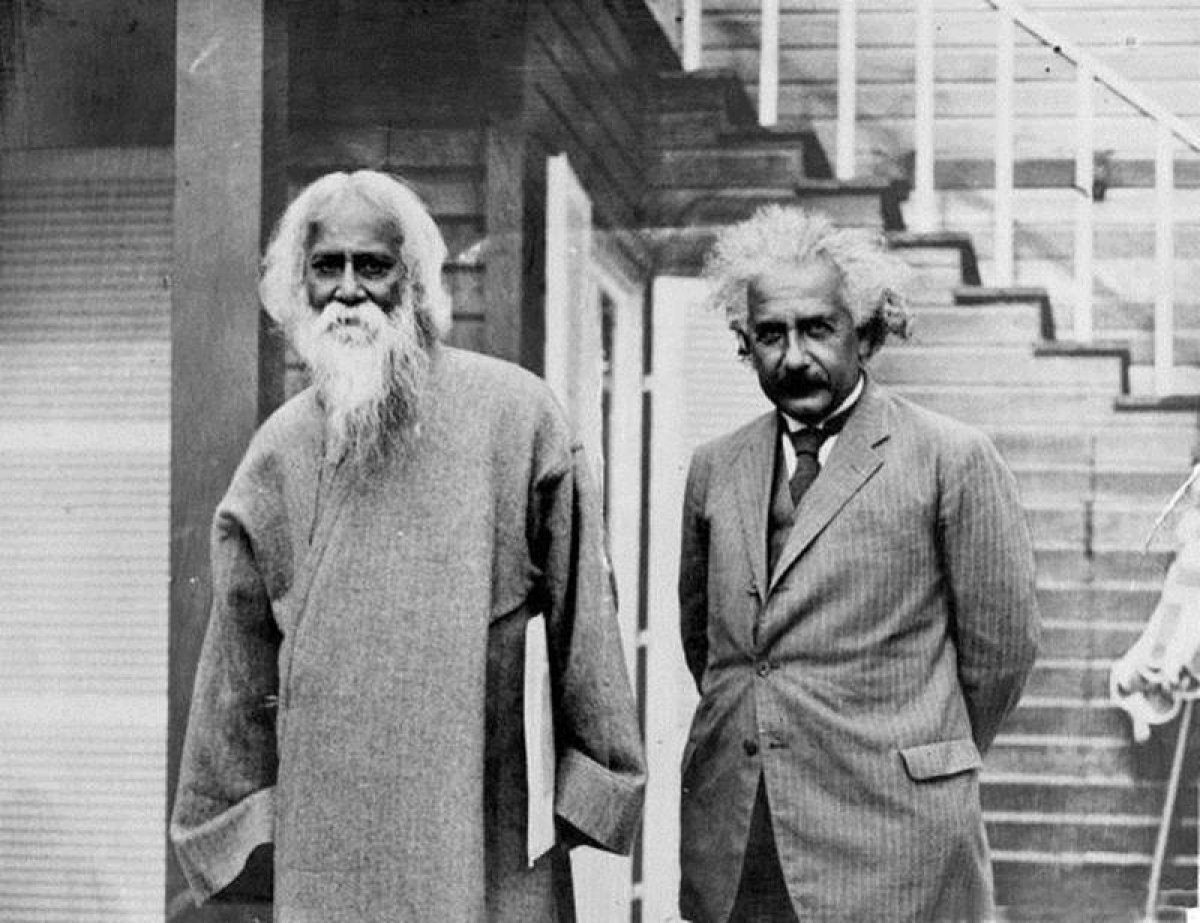
    Tagore with Einstein

    A polymath

    Rabindranath Tagore did not limit himself to one form of creative expression. Apart from writing poetry, short stories and novels, he was a great essayist, dramatist, song writer, composer and painter. When gramophone was introduced in India, he recorded his songs. He was an exceptionally curious man who wanted to learn as much as was humanly possible in one life. Some of his very popular short stories include Kabuliwalla, Khudita pashan, and Bhikarini.

    Apart from his short stories, his novels Ghare Baire (At Home and Outside) and Nastanirh (Broken Nest) were made into fantastic films by none other than Satyajit Ray, the latter was called Charulata. Both had strong female protagonists. It is said that no one understood women as beautifully as Tagore did. In 1913, he became the first non-European to win a Nobel Prize for Geetanjali—a collection of poems that was originally written in Bengali and were translated to English by Tagore. He never stopped exploring new avenues of self-expression. Tagore was in his sixties when he started painting. He was not formally trained in fine art, but that did not stop him from pursuing painting and he used his sensibilities and visual vocabulary to develop a distinct style of his own.

    A global phenomenon

    Tagore was inspired by both Eastern and Western philosophies. As an avid traveler, he had a keen understanding of different cultures and till his last days even with his failing health, he continued with his travels. He had visited around thirty countries in his lifetime, including Japan, Mexico, United States, and England to name a few. He wanted to spread his idea of ‘One World’ and gave lectures in universities in different countries. He was on a constant quest to facilitate a dialogue between the East and the West based on concepts of humanity, freedom and creative expression. He met some of the world’s greatest minds including Albert Einstein and shared ideas with them.

    An educationist

    Tagore’s pursuit to impart knowledge without the barriers of nation, geography, race or religion continued as he went on to set up a school at Santiniketan with the aim to focus on humanity and its creative expressions based on a Guru-Shishya method of schooling system. His father had bought a large stretch of land around 136 km from Kolkata and had established an ashram with a temple. Tagore shifted there in 1901 and set up an educational institution that was experimental. The classes were held under trees, close to nature. Later on, he turned it into the Visva Bharati University.

    The personal tragedies

    In Tagore’s life he had to confront several deaths of his near and loved ones. He lost his mother when he was very young and he found comfort when he identified his mother’s love in nature. But then the untimely death of his sister-in-law, Kadambari Devi, left him devastated. She was his muse and an anchor for the budding writer that he was, then. The loss was reflected in many of his stories, songs and poetry.  Between 1902 and 1918 he lost his wife, father, son and two daughters. Despite facing these personal tragedies in his life, Tagore never lost the optimism that life had to offer. Instead of drowning into the sea of sorrows he channeled his energy towards creative pursuits.

    It was on 7th August 1941, that Tagore breathed his last. He died in Jorasanko Thakur Bari, the place where he was born and had his first tryst with writing. Tagore wrote a poem Aaji hote shoto borsho pore (100 years from now), wherein, he was curious to know who would be his readers after 100 years. Perhaps, when he wrote that poem, he didn’t know that even after 76 years since Tagore’s demise, he continues to live through his writing, music and ideas in the collective consciousness of people from around the world.

  • Printmaking in Bengal

    Printmaking in Bengal

    The ongoing exhibition at Project 88 on Prints from Bengal: Modernism in Colonial India explores the process of printmaking in Bengal and its role in understanding the socio-political climate in British India of the early to mid-20th century. Kalyani Majumdar brings the story.

    Published in Free Press Journal; Date: 10.06.2018

    Ramkinkar Baij, Untitled, Woodcut on Paper, 5 x 7.5 inch

    An active art space now, Project 88 was once a century-old metal printing press, situated in Colaba, Mumbai. So, when the art gallery decided to organise an art show on prints from Bengal, it came full circle with its own history. The exhibition explores the nuances involved in printmaking as an art form, by some of the stalwarts from the art world who changed the modern Indian art scene of the twentieth century.

    Art as an expression

    Artists have often used art to express their observations especially during the time of unrest, human suffering and oppression. Hence, when one looks at the series of prints exhibited at Project 88, it provides a keen understanding of the social life of Bengal and also the political scene in colonial India. The artists whose prints are exhibited at the gallery are, Gaganendranath Tagore (1867 – 1938), Mukul Chandra Dey (1895 – 1989), Ramendranath Chakravorty (1902-1955), Ramkinkar Baij (1906 – 1980) and Rani (Dey) Chanda (1912 – 1997). They were all born in the undivided Bengal in British India and were all associated to Santiniketan.

    Ramendranath Chakravarty, Untitled, 1935, Woodcut

    They grew up during a period when Bengal was going through a lot of political and social upheavals. These artists saw the unrest caused due to partition of Bengal in 1905 on communal lines. Followed by the shifting of the capital from Calcutta to Delhi and its repercussions, they played their part in the Swadeshi movement and attempted to find an Indian identity in colonial India. Apart from Gaganendranath Tagore, who died in 1938, the other artists also saw the, Bengal famine, communal violence followed by the partition of Bengal and the Indian independence. These events had great impact on the artists’ works. Also, all the five artists were highly inspired by the 19th century Bengal Renaissance and that too played an important role in how they communicated through their art.

    From Bichitra Club to Kala Bhavan

    Founded in 1915 by the Tagores in their Jorasankho house in North Kolkata, the primary aim of Bichitra Club was to explore different styles of printmaking and painting. Bichitra, which means, variety, was spearheaded by the three nephews of Rabindranath Tagore — Gaganendranath, Samarendranath and Abanindranath. They had turned the south veranda of the Jorasankho house into a club, fashioned on the concept of an art salon. The club offered classes on printmaking, painting, music, pottery, carpentry and so on. Rabindranath Tagore defined it as the model school and its members and students also had Pratima Devi and Sunayani Devi from the Tagore family as students. It was here that the printmaking techniques were explored in a manner that saw the emergence of woodcuts and lithographs as art forms.

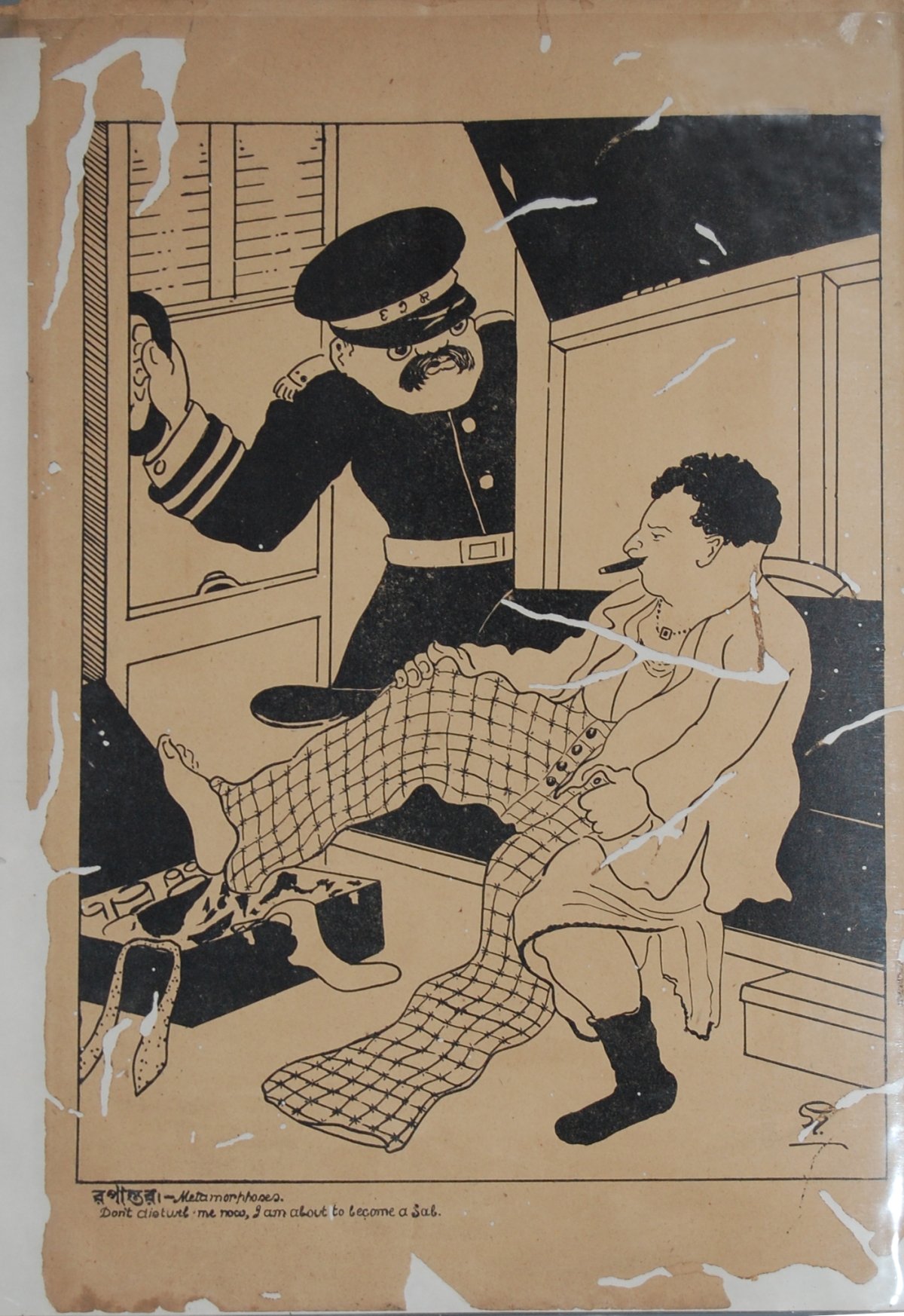
    Gaganendranath Tagore, Metamorphoses, 1917, Lithograph on Paper, 17 x 11 inch

    The practice of printmaking as a fine art medium became extremely popular with the establishment of Kala Bhavan in 1919. It is the fine arts faculty of the Visva Bharati University, Santiniketan. And, it was none other than Nandalal Bose, a student of Abanindranath Tagore, and also the creator of the logo for Bichitra Club, who made printmaking a popular art form in Kala Bhavana. Ramendranath Chakravorty, Mukul Chandra Dey, Rani Dey (Chanda), Ramkinkar Baij were all trained at Santiniketan.

    Tagore’s satirical depiction of urban life

    Artist Gaganendranath Tagore had special interest in lithography, and even went on to set up his own lithographic press in 1917.  He was anti-colonial and had no qualms to express it openly through his art. His prints exhibited at the gallery shows, caricatures that made satiric commentaries on colonial Indian urban life. One of his works on display, titled, Metamorphosis: Don’t disturb me now, I am about to become a sab show a Bengali babu pretending to be a European, as he is shown wearing a trouser on top of his dhuti. Through his humour, he would often take on the corrupt politicians and showcase the hypocrisy that existed in the Indian society. Even today, Tagore is considered one of the finest and influential modernist printmakers, India ever had.

    Depiction of rural and tribal life

    The prints by Chakravorty, Dey, Baij and Chanda at the exhibition, depicts the rural and tribal (santhal) life.  Ramendranath Chakravorty began his formal art education in Government School of Art, Calcutta/Kolkata in 1919, but in two years he left for Santiniketan for the newly established Kala Bhavan. It was here that he found his mentor, Nandalal Bose. Chakravorty’s ability to capture the rural Bengal life can be seen clearly in his wood engravings. His work, Untitled, woodcut from 1935 is one such example. His works often expressed a duality, wherein, it finds influences from both the revivalist movement in Bengal and the Swadeshi Movement that was rising during that period. However, he was always keen on exploring techniques prevalent in Japan and Europe.

    Mukul Dey, Filling the Pitchers, Hand Coloured Dry point Etching on Paper, 6 x 8 inch

    Mukul Chandra Dey, was one of the prominent member of the Bichitra Club. In 1916, he went to US to learn the technique of dry-point etching. He came back to Santiniketan in the 1920s. His exhibit at the gallery titled, Filling the Pitcher looks hand-painted as the artist has used a variety of tints and smudges to define his subjects.

    Ramkinkar Baij went to Santiniketan to become a sculptor and painter, however he also found interest in the process of printmaking. He connected easily with the tribal lifestyle and throughout his lifetime his works revolved around his tribal subjects. In one of his prints at the show, the Vande Mataram chant is inscribed on the top along with a partially visible face of a man and on the foreground the print has jagged uneven broken shapes. His monochromatic woodcuts has dynamic characteristics, combined with a certain ruggedness that makes his prints stand out from the rest.

    Rani (Dey) Chanda, was Mukul Dey’s sister. It was Rabindranath Tagore who encouraged her to pursue art. She went to Santiniketan and studied painting, music and dancing. She was imprisoned for anti-British activities for a while. In 1932, Mukul Dey published a portfolio of 25 linocuts by his sister. Her prints are a beautiful contrast of black-and-white compositions creating a dreamlike effect of rural Bengal. Whether it’s the huts in moonlit night or a boat riding the waves, she created magic with her perfect lines and balance of black and white.

    Event Detail:

    When: On till June 16

    Timings: 11 AM to 7 PM

    Venue: Project 88, Ground Floor, B.M.P. Building, Narayan A Sawant Rd, Azad Nagar, Colaba, Mumbai

    (Image credit courtesy: The artist, Galerie 88 & Project 88, Mumbai)