Tag: city

  • Art Deco: The Mumbai connection

    Art Deco: The Mumbai connection

    freepressjournal_import_2017_09_regal

    When a design movement called Art Deco flourished between the two World Wars in Europe, it made its way to Mumbai around the same time and found many takers in the city. Kalyani Majumdar delves into the story.

    Published in Free Press Journal; Date: 03.09.2017

    freepressjournal_import_2017_09_taxi-1-2

    Did you know that Mumbai has the second largest number of Art Deco buildings in the world right after Miami? For most people, it comes as a surprise. Possibly the reason could be that Mumbai is mostly synonymous with the Gateway of India that is an Indo-Saracenic architecture or the famous CST (formerly the Victoria Terminus), a neo-Gothic architecture. So, where are the Art Deco buildings? There is no doubt that Mumbai cityscape is dotted with iconic architectural masterpieces from the colonial period, and walking around South Mumbai is like visiting a museum displaying different architectural styles. However, if you pay attention on the built structures while walking around the Oval Maidan, Marine Drive and Colaba it is not difficult to spot these Art Deco buildings with their signature design elements such as symmetry, geometric designs and decorative motifs on the façade.  Curiously, one might even wonder what it was about Art Deco-style that it found so many connoisseurs in the city. To understand that we need to dive into the history of Art Deco.

    A movement that started in France

    Art Deco derived its name from the French words “Arts Décoratifs”. It was an exhibition that was held in Paris in 1925 called the Exposition Internationale des Arts Décoratifs et Industriels Modernes (International Exposition of Modern Decorative and Industrial Arts). To get selected for the exhibition the works had to be modern that was without the influence of past design-styles.

    Originally, the exposition was to take place in 1915, but was postponed due to the First World War. To a great extent the War had a strong influence on Art Deco’s popularity. The devastation and loss due to the war had left everyone disillusioned of the future. The horrors of war were being expressed through many new art movements that came up around the 1920s such as Cubism, Surrealism and Fauvism. Literary works by Ernest Hemingway and Scott Fitzgerald give us a fair idea of the society of that time.

    With socio-political changes taking place in Europe and around the world, the exposition was a success. Art Deco found many takers as there was something very appealing about this style that was modern and had moved away from the formal design styles that was prevalent till then. Post World War, the world was looking for optimism and that was exactly what Art Deco represented with its simple geometric lines, decorative motifs that brought in inspirations from around the world, and the use of vibrant colours. It was heralding the machine age with the use of technology.

    The designs could be replicated easily, thus bringing down the manufacturing costs along with the introduction of stainless steel, plastics and other unconventional materials. Apart from architecture, this design movement influenced jewellery, automobiles, and furniture designs as well. In the world of architecture Art Deco was fast becoming popular all around the world with the US giving the world the two iconic Art Deco buildings of that era, the Chrysler Building and the Empire State Building. As Art Deco rose in popularity the world over, it had surely become an international movement from its French origins.

    Art Deco found its way to Mumbai

    The time when Art Deco was taking over America, especially Miami, another city across the globewas fast becoming the second home for Art Deco to flourish in. It was none other than Mumbai. It was on the world map as an important port city for British India. Every new trend that was prevalent in the West found a home in Mumbai. In the 1920s the well-heeled and educated Indians from the city that were making frequent trips to Europe brought back the Art Deco style with them back home.

    freepressjournal_import_2017_09_TAXI

    Between 1920s and 1940s Art Deco graced the South Mumbai landscape, especially the residential buildings on Marine Drive that came up on the newly reclaimed land around the same time, thanks to the Backbay Land Reclamation Scheme.  With its optimistic and modern designs that had moved away from the imprint of colonial design-styles such as the Gothic and the Victorian, the Mumbai home owners wanted to do up their properties in the Art Deco style. Art Deco was vibrant and had a global appeal. It was the trend everyone wanted to be part of. Thus, in India just like in the rest of the world, Art Deco made its presence in a big way.

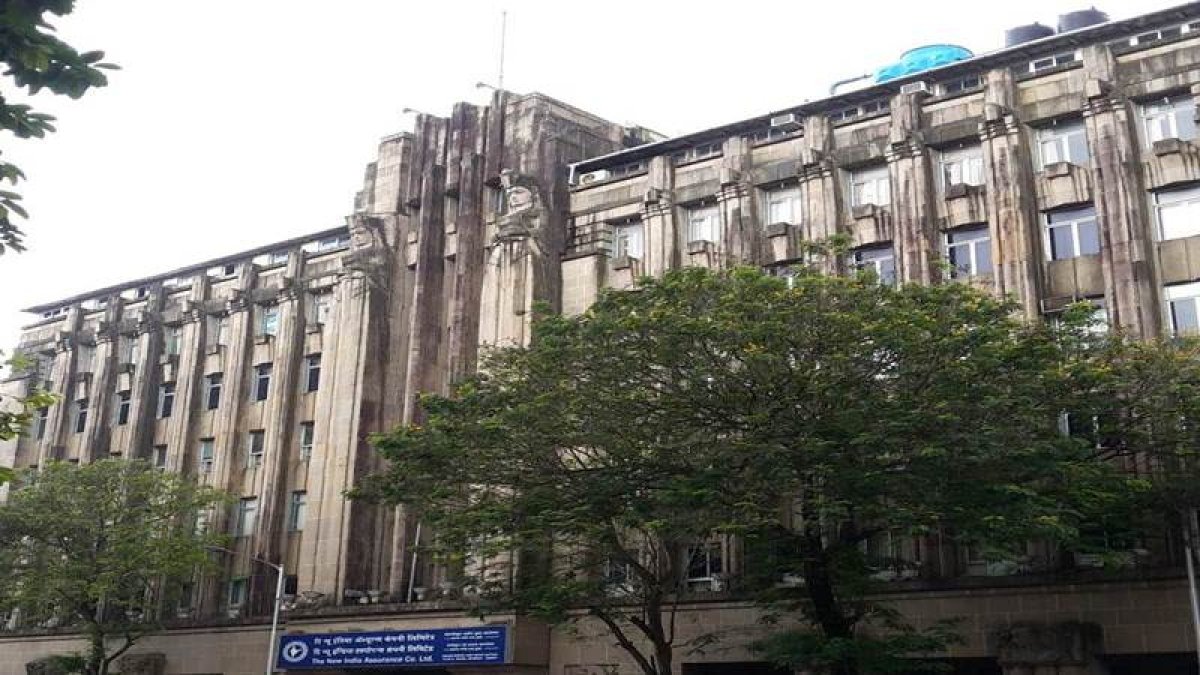
    Apart from the geometric patterns and the need for symmetry, one also observes nautical elements being part of the Art Deco buildings in Mumbai. One can see the new age design elements on buildings such as the Eros Cinema right across Churchgate station that was completed in 1937, or the decorative motifs on the façade of the iconic Regal Cinema in Colaba that was opened to public in 1933. Another notable Art Deco building is on the Mahatma Gandhi Road in Fort — The New India Assurance Building. It has bas reliefs depicting rural life in India, but what catches your attention first are the two huge statues on the façade that appears of Egyptian origin. It is indeed a long list of beautiful Art Deco buildings that exist in the city.

    So, next time when walking on the streets of Mumbai do pay attention to the buildings that you pass by, you might stumble upon an Art Deco hidden somewhere in the urban cluster of high rises that stands as a testimony of the era that was popularly known as the roaring 20s or the Jazz Age.

  • Haunting Notes from Mumbai

    KALYANI MAJUMDAR explores Sarnath Banerjee’s ongoing exhibition, which brings a trove of stories from the supernatural realm that engages with the city of Mumbai. 

    (Published in Free Press Journal; Date: 26.05.2019)

    freepressjournal_import_2019_05_W_end_May26_pg4_anchor-left-1

    Every city has its fair share of ghost stories. I remember when I first arrived in Mumbai, I was told stories by people coming from various walks of life about certain buildings and roads in the city that are associated with apparitions. The Spectral Times is an exhibition of works by the Berlin-based renowned artist and graphic novelist, Sarnath Banerjee at Dr Bhau Daji Lad Museum (BDL). The exhibition brings forth stories that take the visitors through a wonderful journey into the temporality of haunting, wherein, the past and the present seems to overlap. The exhibition is curated by Tasneem Zakaria Mehta, Managing Trustee of BDL, and co-curated by Himanshu Kadam. This is part of the museum’s decade-long series, Engaging Traditions, which invites contemporary artists to engage with its archives and history.

    The exhibition space

    From the entrance of the BDL Museum, and through the hallway on the ground floor you make your way up a flight of stairs onto a hall that leads you to a room with an interesting choice of lighting that creates a strong contrast of dark and light, very different from the rest of the museum space, lending it a feel of an old painting or a photograph with chiaroscuro lighting. It has a cabinet filled with a collection of objects such as a man’s head, a book on Arabic surgeries and so on. There are few chairs arranged in a circle for the visitors to sit. The exhibition area is divided into three sections. The next section of the room showcases Banerjee’s artworks. The illustrations combined with sound installations narrating fictional tales that mostly have an eerie ending, creates an engaging environment. The exhibition commands full engagement of all your senses as it is recommended that once you listen to the narratives, you must revisit the artworks, and see the characters come alive and you as an onlooker become a part of the process of storytelling. The third section of the room is separated with a black curtain, you step in the section and sit on one of the chairs arranged facing an old radio. While you sit and listen to another story with an anticlimactic ending with the storyteller being a woman with the severed head, you can’t help but take in the surrounding of the room with a derelict spiral staircase at the corner that has lost its functionality with time and you wonder how the theme of the exhibition fits the museum space as the past keeps reasserting itself through the stories. Narrated in the form of a magazine interview, Birjis Bari, a fictional reporter continues to provide us scintillating tales through the news periodical, The Spectral Times.

    Magic of storytelling

    The exhibition uses the radio component and takes us back in time when the only source of news, entertainment and information was radio. Now, we have videos for everything, however listening to a story in a radio provides us the freedom to imagine the characters of the story, the atmosphere and everything else. It has its own magic.

    Illustrations and narratives

    Although almost all the stories have eerie endings each story also depicts city life and its people. For instance, there is a couple that meets at Dom’s Guesthouse. Even though they belong to the city and yet they ritualistically make it a point to spend few days at the guesthouse and experience the city as two strangers. Of course, there is a spectral angle to this narrative as well. Then there is Shehri Adamkhor that recounts the story of a man, who has shifted cities and is trying to quit smoking and talks about his cannibalistic behaviours. The narration is laced with dark humour. Then there is an artwork titled, Milk Colony, that has a narration revolving around the Aarey forest wherein several auto-rickshaw wallas share their experience of spotting a ghostly figure that appears out of nowhere and sings a very famous Hindi movie song. However, there are some stories that are more unsettling than the others, like the Fidaly Mansion.

    After spending a good amount of time soaking in the dramatic atmosphere accompanied with the narratives, when you step out of the room into the hall with its bright light and merge into the sea of visitors to the museum, there is a sort of longing for that atmosphere that you just left behind in the room with its spectres and their tales. You are forced to wonder about this inherent fascination that we have for apparitions and the unexplained phenomenon. Is it the ghost narratives that are merely reasserting itself in our stable present that makes it unsettling for our logical understanding of concepts that are linear? Or, are we just fascinated by the idea of temporality of haunting, through which events and people return from the limits of time and mortality? Perhaps, both!

    Event details:

    On till May 26, 2019

    Timings: 10 am– 6 pm (Wednesday closed)

    Venue: Dr Bhau Daji Lad Museum, Ranibaug, Byculla East, Mumbai