Tag: culture

  • The unaged liquor in a bottle

    The unaged liquor in a bottle

    The unaged liquor Vodka-making is a legacy of the Russians and with the launch of two new vodkas in the Indian market—Russian Spirit and Kruto—MIR Spirits is aiming to change the way the world sees, drinks and experiences vodka.

    By Kalyani Majumdar; Published in Liquid magazine; March-April 2014

    These days anyone engaged in charged-up conversation uttering either “Ukraine” or “Russia” is most certainly talking about the current political crisis that has engulfed the two countries. But at Liquid we are referring to these two countries from a very different context, and however “volatile” our discussion may be it is merely incidental to the alchemical nature of our subject. One could guess by now that we are talking about none other than the post-modern drink—vodka.

    The Indian consumers are well aware of their vodkas and India is already a lucrative market for some of the leading and well known vodka brands such as Absolut, Grey Goose to name a few on the list. And to keep up with the Russian adage There cannot be too much vodka, there can only be not enough vodka the Indian vodka drinker is always happy to get more brands to choose from. This year with the launch of Russian Spirit and Kruto, Indian vodka drinkers have every reason to rejoice. During the launch of the two vodka brands Roman Tallis, President of Russian Spirit Inc. said, “India is an exciting market in the global scheme of things. With its pre dominantly young population, we thought what greater tribute to this wonderful country than to globally launch Russian Spirit and Kruto here. Both our brands set new product benchmarks in their respective categories. It is not a surprise that the response so far has been nothing less than fantastic.” MIR Spirits, importer of Russian Spirit Inc. in India has brought these two vodkas that are created from 300-year-old Russian recipes combined with the finest wheat grains from the ecologically pure region in Ukraine.

    The distillation process involves and activates carbon filtration practice which ensures the highest level of purity, desired pH balance and clarity of taste. These grains are then used to create rectified ethyl alcohol. This is meticulously distilled before being combined with untouched water sourced from an aquifer 800 metres underground. Next, the spirit undergoes filtration through activated birch charcoal—as early as the eighteenth century the Russians have been filtering and purifying the alcohol with charcoal—Ural mountain quartz and polypropylene filter that is only one-micron wide. And finally, the alcohol is run through a pure gold membrane filter. This important step enriches the vodka with gold ions. After this absolute fanciful and delicate vodka-making ritual it would be a travesty if this creation is not drunk in the good old Russian fashion—neat. Na Zdoroyve!

    Russian Spirit

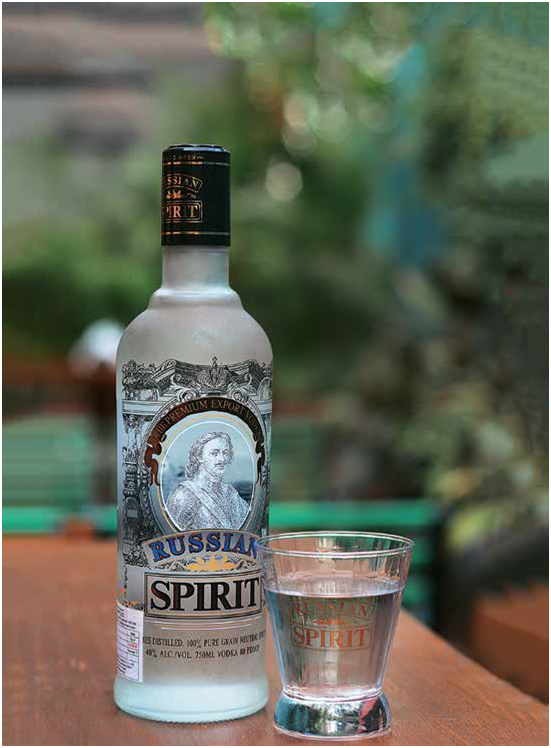
    For anyone who is aware of vodka, one must know how difficult it is to express this limpid liquid that is devoid of colour, bouquet, aroma and other high-nosed characteristics that one experiences while drinking its darker-oaken cousins. At the blind vodka tasting session it helps if one follows the rules of what other alcoholic tasting sessions demands, but in reverse in order to figure out the superior or premium vodka, reason being in case of vodka the purer the vodka the more colourless, odourless and tasteless it would be. Hence it is recommended that one must drink Russian Spirit neat and non-chilled so that it is a revelation when, as it makes its way through the mouth till it hits the throat, one is surprised by its smooth finish and warm and silky entry with an almost non-existent bite (it does not burn) which is a rare trait in vodkas that are available in India. The bottle that encapsulates this 15 times distilled vodka is of frosted glass with a portrait of Peter the Great himself on one side and St Petersburg on the other side. It is believed that during the times of Peter the Great drinking in Russia had reached unprecedented levels which was probably because the great reformer needed considerable financing for the development of his country and since alcohol drinking was legalised money by way of tax was rolling in through vodka sales. Unlike other popular brands from the West providing flavoured vodkas, Russian Spirit does not align to that idea as it is not how the Russians drink their vodka. And, keeping alive that tradition Russian Spirit is available in its pure nonflavoured state. With a price tag of only `3,500 for a 750ml bottle—available only in Mumbai for now, but soon it will be available in Delhi and other major cities—it is a liquid that you might like to introduce yourself to.

    Kruto

    In Russian the word Kruto means cool and the packaging of Kruto vodka exemplifies youthful vibrancy—the frost glass bottle with fiery red band mentioning Kruto signifies the self-indulgent generation. The Kruto Original Vodka is distilled nine times for a smooth, delicate spirit that has a touch of floral and toasted honey notes from the wheat, great to be used as a base in cocktails. Priced at Rs 1,850 for a 750 ml bottle, it is available presently only at select retail outlets in Mumbai. To celebrate the advent of Kruto we have some refreshing summer cocktails to try out and beat the heat with a contemporary twist.

    Kruto Summer Cocktails

    Sour Apple Martini

    Ingredients:

    • 50 ml Kruto vodka
    • 15 ml Monin green apple
    • 60 ml Apple juice
    • 10 ml Lime juice
    • 8 nos Fresh mint leaves
    • 1 no Fresh green apple (Garnish)

    Method: Add all ingredients along with punctured mint leaves into a Boston shaker over ice. Shake and double strain into a chilled Martini glass. Garnish with thin slices of sour green apple.

    Apple Currant

    Ingredients:

    • 50 ml Kruto vodka
    • 15 ml Crème de Cassis/
    • Monin currant
    • 60 ml Apple juice
    • 10 ml Lime juice
    • 10 nos Fresh mint leaves
    • 6 nos Black grapes

    Method: Combine all ingredients in a Boston shaker with muddled mint. Shake and double strain into a studio rock glass over ice. Add black grapes and a lime wedge as garnish.

    Watermelon Martini

    Ingredients:

    • 50 ml Kruto vodka
    • 1 slice Fresh watermelon
    • 1 no Lemon
    • 8 nos Fresh mint leaves
    • 10 ml Monin watermelon

    Method: Muddle fresh watermelon, mint and lemon wedges in a Boston shaker. Add Monin and Kruto. Shake well with ice and double strain into a chilled Martini Glass. Garnish with a thin slice of watermelon.

  • Art Deco: The Mumbai connection

    Art Deco: The Mumbai connection

    freepressjournal_import_2017_09_regal

    When a design movement called Art Deco flourished between the two World Wars in Europe, it made its way to Mumbai around the same time and found many takers in the city. Kalyani Majumdar delves into the story.

    Published in Free Press Journal; Date: 03.09.2017

    freepressjournal_import_2017_09_taxi-1-2

    Did you know that Mumbai has the second largest number of Art Deco buildings in the world right after Miami? For most people, it comes as a surprise. Possibly the reason could be that Mumbai is mostly synonymous with the Gateway of India that is an Indo-Saracenic architecture or the famous CST (formerly the Victoria Terminus), a neo-Gothic architecture. So, where are the Art Deco buildings? There is no doubt that Mumbai cityscape is dotted with iconic architectural masterpieces from the colonial period, and walking around South Mumbai is like visiting a museum displaying different architectural styles. However, if you pay attention on the built structures while walking around the Oval Maidan, Marine Drive and Colaba it is not difficult to spot these Art Deco buildings with their signature design elements such as symmetry, geometric designs and decorative motifs on the façade.  Curiously, one might even wonder what it was about Art Deco-style that it found so many connoisseurs in the city. To understand that we need to dive into the history of Art Deco.

    A movement that started in France

    Art Deco derived its name from the French words “Arts Décoratifs”. It was an exhibition that was held in Paris in 1925 called the Exposition Internationale des Arts Décoratifs et Industriels Modernes (International Exposition of Modern Decorative and Industrial Arts). To get selected for the exhibition the works had to be modern that was without the influence of past design-styles.

    Originally, the exposition was to take place in 1915, but was postponed due to the First World War. To a great extent the War had a strong influence on Art Deco’s popularity. The devastation and loss due to the war had left everyone disillusioned of the future. The horrors of war were being expressed through many new art movements that came up around the 1920s such as Cubism, Surrealism and Fauvism. Literary works by Ernest Hemingway and Scott Fitzgerald give us a fair idea of the society of that time.

    With socio-political changes taking place in Europe and around the world, the exposition was a success. Art Deco found many takers as there was something very appealing about this style that was modern and had moved away from the formal design styles that was prevalent till then. Post World War, the world was looking for optimism and that was exactly what Art Deco represented with its simple geometric lines, decorative motifs that brought in inspirations from around the world, and the use of vibrant colours. It was heralding the machine age with the use of technology.

    The designs could be replicated easily, thus bringing down the manufacturing costs along with the introduction of stainless steel, plastics and other unconventional materials. Apart from architecture, this design movement influenced jewellery, automobiles, and furniture designs as well. In the world of architecture Art Deco was fast becoming popular all around the world with the US giving the world the two iconic Art Deco buildings of that era, the Chrysler Building and the Empire State Building. As Art Deco rose in popularity the world over, it had surely become an international movement from its French origins.

    Art Deco found its way to Mumbai

    The time when Art Deco was taking over America, especially Miami, another city across the globewas fast becoming the second home for Art Deco to flourish in. It was none other than Mumbai. It was on the world map as an important port city for British India. Every new trend that was prevalent in the West found a home in Mumbai. In the 1920s the well-heeled and educated Indians from the city that were making frequent trips to Europe brought back the Art Deco style with them back home.

    freepressjournal_import_2017_09_TAXI

    Between 1920s and 1940s Art Deco graced the South Mumbai landscape, especially the residential buildings on Marine Drive that came up on the newly reclaimed land around the same time, thanks to the Backbay Land Reclamation Scheme.  With its optimistic and modern designs that had moved away from the imprint of colonial design-styles such as the Gothic and the Victorian, the Mumbai home owners wanted to do up their properties in the Art Deco style. Art Deco was vibrant and had a global appeal. It was the trend everyone wanted to be part of. Thus, in India just like in the rest of the world, Art Deco made its presence in a big way.

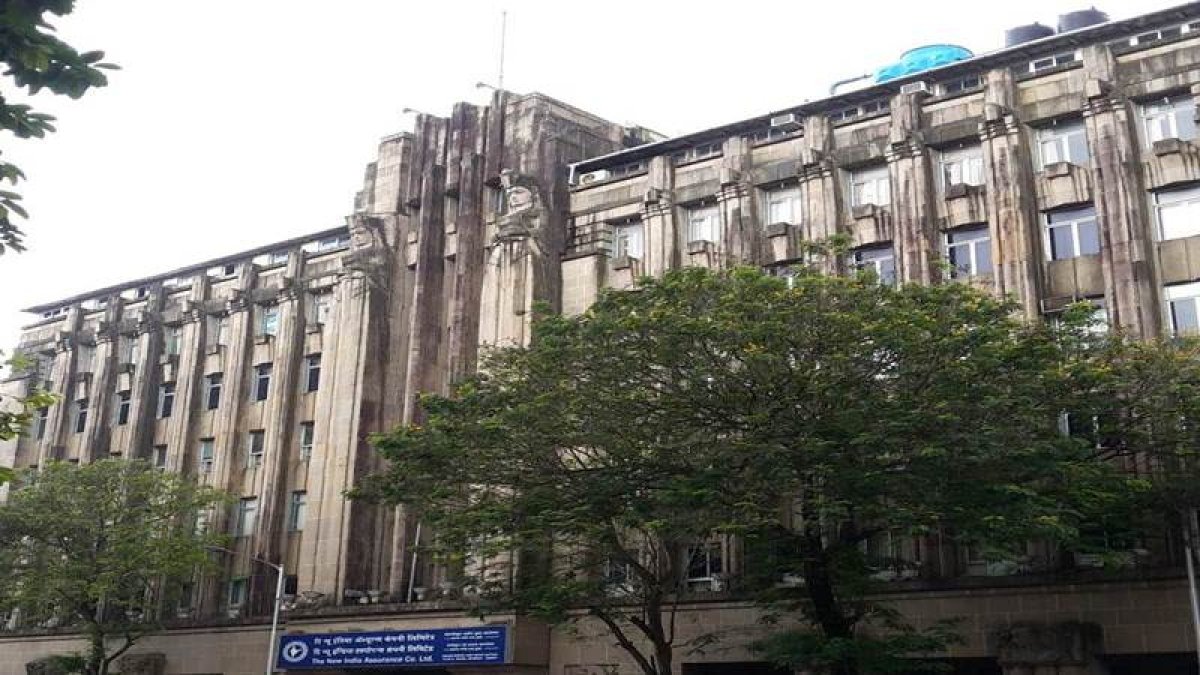
    Apart from the geometric patterns and the need for symmetry, one also observes nautical elements being part of the Art Deco buildings in Mumbai. One can see the new age design elements on buildings such as the Eros Cinema right across Churchgate station that was completed in 1937, or the decorative motifs on the façade of the iconic Regal Cinema in Colaba that was opened to public in 1933. Another notable Art Deco building is on the Mahatma Gandhi Road in Fort — The New India Assurance Building. It has bas reliefs depicting rural life in India, but what catches your attention first are the two huge statues on the façade that appears of Egyptian origin. It is indeed a long list of beautiful Art Deco buildings that exist in the city.

    So, next time when walking on the streets of Mumbai do pay attention to the buildings that you pass by, you might stumble upon an Art Deco hidden somewhere in the urban cluster of high rises that stands as a testimony of the era that was popularly known as the roaring 20s or the Jazz Age.

  • Haunting Notes from Mumbai

    KALYANI MAJUMDAR explores Sarnath Banerjee’s ongoing exhibition, which brings a trove of stories from the supernatural realm that engages with the city of Mumbai. 

    (Published in Free Press Journal; Date: 26.05.2019)

    freepressjournal_import_2019_05_W_end_May26_pg4_anchor-left-1

    Every city has its fair share of ghost stories. I remember when I first arrived in Mumbai, I was told stories by people coming from various walks of life about certain buildings and roads in the city that are associated with apparitions. The Spectral Times is an exhibition of works by the Berlin-based renowned artist and graphic novelist, Sarnath Banerjee at Dr Bhau Daji Lad Museum (BDL). The exhibition brings forth stories that take the visitors through a wonderful journey into the temporality of haunting, wherein, the past and the present seems to overlap. The exhibition is curated by Tasneem Zakaria Mehta, Managing Trustee of BDL, and co-curated by Himanshu Kadam. This is part of the museum’s decade-long series, Engaging Traditions, which invites contemporary artists to engage with its archives and history.

    The exhibition space

    From the entrance of the BDL Museum, and through the hallway on the ground floor you make your way up a flight of stairs onto a hall that leads you to a room with an interesting choice of lighting that creates a strong contrast of dark and light, very different from the rest of the museum space, lending it a feel of an old painting or a photograph with chiaroscuro lighting. It has a cabinet filled with a collection of objects such as a man’s head, a book on Arabic surgeries and so on. There are few chairs arranged in a circle for the visitors to sit. The exhibition area is divided into three sections. The next section of the room showcases Banerjee’s artworks. The illustrations combined with sound installations narrating fictional tales that mostly have an eerie ending, creates an engaging environment. The exhibition commands full engagement of all your senses as it is recommended that once you listen to the narratives, you must revisit the artworks, and see the characters come alive and you as an onlooker become a part of the process of storytelling. The third section of the room is separated with a black curtain, you step in the section and sit on one of the chairs arranged facing an old radio. While you sit and listen to another story with an anticlimactic ending with the storyteller being a woman with the severed head, you can’t help but take in the surrounding of the room with a derelict spiral staircase at the corner that has lost its functionality with time and you wonder how the theme of the exhibition fits the museum space as the past keeps reasserting itself through the stories. Narrated in the form of a magazine interview, Birjis Bari, a fictional reporter continues to provide us scintillating tales through the news periodical, The Spectral Times.

    Magic of storytelling

    The exhibition uses the radio component and takes us back in time when the only source of news, entertainment and information was radio. Now, we have videos for everything, however listening to a story in a radio provides us the freedom to imagine the characters of the story, the atmosphere and everything else. It has its own magic.

    Illustrations and narratives

    Although almost all the stories have eerie endings each story also depicts city life and its people. For instance, there is a couple that meets at Dom’s Guesthouse. Even though they belong to the city and yet they ritualistically make it a point to spend few days at the guesthouse and experience the city as two strangers. Of course, there is a spectral angle to this narrative as well. Then there is Shehri Adamkhor that recounts the story of a man, who has shifted cities and is trying to quit smoking and talks about his cannibalistic behaviours. The narration is laced with dark humour. Then there is an artwork titled, Milk Colony, that has a narration revolving around the Aarey forest wherein several auto-rickshaw wallas share their experience of spotting a ghostly figure that appears out of nowhere and sings a very famous Hindi movie song. However, there are some stories that are more unsettling than the others, like the Fidaly Mansion.

    After spending a good amount of time soaking in the dramatic atmosphere accompanied with the narratives, when you step out of the room into the hall with its bright light and merge into the sea of visitors to the museum, there is a sort of longing for that atmosphere that you just left behind in the room with its spectres and their tales. You are forced to wonder about this inherent fascination that we have for apparitions and the unexplained phenomenon. Is it the ghost narratives that are merely reasserting itself in our stable present that makes it unsettling for our logical understanding of concepts that are linear? Or, are we just fascinated by the idea of temporality of haunting, through which events and people return from the limits of time and mortality? Perhaps, both!

    Event details:

    On till May 26, 2019

    Timings: 10 am– 6 pm (Wednesday closed)

    Venue: Dr Bhau Daji Lad Museum, Ranibaug, Byculla East, Mumbai