Tag: drinks

  • The unaged liquor in a bottle

    The unaged liquor in a bottle

    The unaged liquor Vodka-making is a legacy of the Russians and with the launch of two new vodkas in the Indian market—Russian Spirit and Kruto—MIR Spirits is aiming to change the way the world sees, drinks and experiences vodka.

    By Kalyani Majumdar; Published in Liquid magazine; March-April 2014

    These days anyone engaged in charged-up conversation uttering either “Ukraine” or “Russia” is most certainly talking about the current political crisis that has engulfed the two countries. But at Liquid we are referring to these two countries from a very different context, and however “volatile” our discussion may be it is merely incidental to the alchemical nature of our subject. One could guess by now that we are talking about none other than the post-modern drink—vodka.

    The Indian consumers are well aware of their vodkas and India is already a lucrative market for some of the leading and well known vodka brands such as Absolut, Grey Goose to name a few on the list. And to keep up with the Russian adage There cannot be too much vodka, there can only be not enough vodka the Indian vodka drinker is always happy to get more brands to choose from. This year with the launch of Russian Spirit and Kruto, Indian vodka drinkers have every reason to rejoice. During the launch of the two vodka brands Roman Tallis, President of Russian Spirit Inc. said, “India is an exciting market in the global scheme of things. With its pre dominantly young population, we thought what greater tribute to this wonderful country than to globally launch Russian Spirit and Kruto here. Both our brands set new product benchmarks in their respective categories. It is not a surprise that the response so far has been nothing less than fantastic.” MIR Spirits, importer of Russian Spirit Inc. in India has brought these two vodkas that are created from 300-year-old Russian recipes combined with the finest wheat grains from the ecologically pure region in Ukraine.

    The distillation process involves and activates carbon filtration practice which ensures the highest level of purity, desired pH balance and clarity of taste. These grains are then used to create rectified ethyl alcohol. This is meticulously distilled before being combined with untouched water sourced from an aquifer 800 metres underground. Next, the spirit undergoes filtration through activated birch charcoal—as early as the eighteenth century the Russians have been filtering and purifying the alcohol with charcoal—Ural mountain quartz and polypropylene filter that is only one-micron wide. And finally, the alcohol is run through a pure gold membrane filter. This important step enriches the vodka with gold ions. After this absolute fanciful and delicate vodka-making ritual it would be a travesty if this creation is not drunk in the good old Russian fashion—neat. Na Zdoroyve!

    Russian Spirit

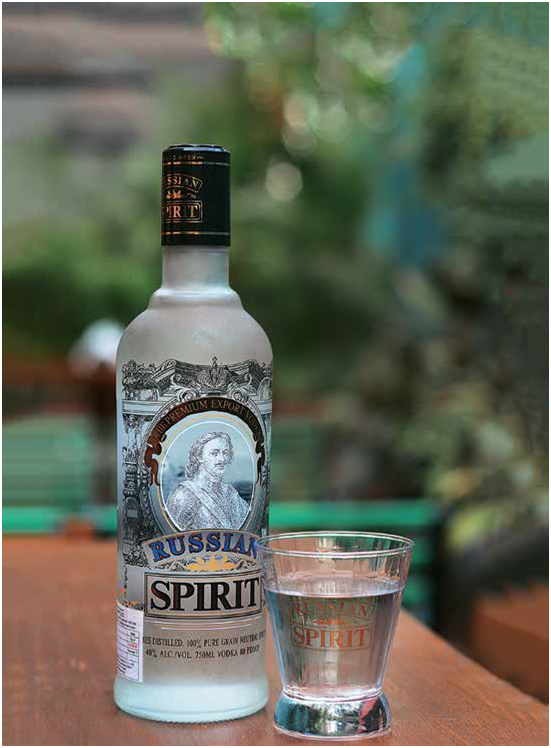
    For anyone who is aware of vodka, one must know how difficult it is to express this limpid liquid that is devoid of colour, bouquet, aroma and other high-nosed characteristics that one experiences while drinking its darker-oaken cousins. At the blind vodka tasting session it helps if one follows the rules of what other alcoholic tasting sessions demands, but in reverse in order to figure out the superior or premium vodka, reason being in case of vodka the purer the vodka the more colourless, odourless and tasteless it would be. Hence it is recommended that one must drink Russian Spirit neat and non-chilled so that it is a revelation when, as it makes its way through the mouth till it hits the throat, one is surprised by its smooth finish and warm and silky entry with an almost non-existent bite (it does not burn) which is a rare trait in vodkas that are available in India. The bottle that encapsulates this 15 times distilled vodka is of frosted glass with a portrait of Peter the Great himself on one side and St Petersburg on the other side. It is believed that during the times of Peter the Great drinking in Russia had reached unprecedented levels which was probably because the great reformer needed considerable financing for the development of his country and since alcohol drinking was legalised money by way of tax was rolling in through vodka sales. Unlike other popular brands from the West providing flavoured vodkas, Russian Spirit does not align to that idea as it is not how the Russians drink their vodka. And, keeping alive that tradition Russian Spirit is available in its pure nonflavoured state. With a price tag of only `3,500 for a 750ml bottle—available only in Mumbai for now, but soon it will be available in Delhi and other major cities—it is a liquid that you might like to introduce yourself to.

    Kruto

    In Russian the word Kruto means cool and the packaging of Kruto vodka exemplifies youthful vibrancy—the frost glass bottle with fiery red band mentioning Kruto signifies the self-indulgent generation. The Kruto Original Vodka is distilled nine times for a smooth, delicate spirit that has a touch of floral and toasted honey notes from the wheat, great to be used as a base in cocktails. Priced at Rs 1,850 for a 750 ml bottle, it is available presently only at select retail outlets in Mumbai. To celebrate the advent of Kruto we have some refreshing summer cocktails to try out and beat the heat with a contemporary twist.

    Kruto Summer Cocktails

    Sour Apple Martini

    Ingredients:

    • 50 ml Kruto vodka
    • 15 ml Monin green apple
    • 60 ml Apple juice
    • 10 ml Lime juice
    • 8 nos Fresh mint leaves
    • 1 no Fresh green apple (Garnish)

    Method: Add all ingredients along with punctured mint leaves into a Boston shaker over ice. Shake and double strain into a chilled Martini glass. Garnish with thin slices of sour green apple.

    Apple Currant

    Ingredients:

    • 50 ml Kruto vodka
    • 15 ml Crème de Cassis/
    • Monin currant
    • 60 ml Apple juice
    • 10 ml Lime juice
    • 10 nos Fresh mint leaves
    • 6 nos Black grapes

    Method: Combine all ingredients in a Boston shaker with muddled mint. Shake and double strain into a studio rock glass over ice. Add black grapes and a lime wedge as garnish.

    Watermelon Martini

    Ingredients:

    • 50 ml Kruto vodka
    • 1 slice Fresh watermelon
    • 1 no Lemon
    • 8 nos Fresh mint leaves
    • 10 ml Monin watermelon

    Method: Muddle fresh watermelon, mint and lemon wedges in a Boston shaker. Add Monin and Kruto. Shake well with ice and double strain into a chilled Martini Glass. Garnish with a thin slice of watermelon.

  • The ‘spirit’ of America

    The ‘spirit’ of America

    From its humble beginnings to becoming a magnificent spirit, we embark on a quest to understand and celebrate the true ‘spirit’ of bourbon.

    Text: Kalyani Majumdar

    Published in Liquid (a bi-monthly magazine) pdf file of the pages ; Date: Nov-Dec 2013

    Maker’s Mark, Kentucky straight Bourbon; Picture credit: Maker’s Mark

    Mark Twain’s famous quote, “If I cannot drink bourbon and smoke cigars in heaven then I shall not go”, speaks volume about the all American spirit—bourbon. So, why is bourbon considered the native spirit of America? The answer lies in the American history itself, as bourbon is closely entangled with the story of United States of America, and has been an active catalyst in the political and economic struggle that created the nation. And, it is a fact that very few whisky drinkers outside the United States of America know the process of how Bourbon is made, and its difference from other whiskies of the world—in terms of its taste, colour and ingredients. It all began with the early settlers who travelled from England, Ireland, Scotland, Germany, France and Spain in the hope of making it big in the promising land. Along with them came their many skills, and distilling was one of them. The primary grain that farmers in the new land were growing was corn, and it was transported from the west of the Allegheny Mountains to the east for trading purposes. The horses could carry only a limited amount of grain on the mountainous and difficult terrain, so, converting the grain into whiskey was more profitable for these local farmers. But, in 1791, Congress levied excise taxes on all distilled spirits. And, the taxes levied by the central government escalated a feeling of injustice amongst the farmers of the west and led to a revolution that is known as the Whiskey Rebellion of 1794. Protests continued and many small-time distillers from the British colonies moved towards Kentucky, as the land was fertile to grow corn, and it was not until 1803 that the tax was repealed by Thomas Jefferson—the third president of USA. And, in 1964 the U.S. Congress recognised bourbon as America’s Native Spirit.

    The spirit Bourbon when poured in a glass has the colour of the sunset, and has distinctly oaky, woody notes coupled with a sweet and smooth taste, with flavours of vanilla and caramel, and is savoured perfectly on the rocks or with water. Unlike other whiskies, bourbon is aged in barrels that are for one-time use only, and the oak is charred, giving the liquor richness, spice and its brownness. As a result of its strong oak flavour, bourbon makes a great cocktail because it is not muted by any number of mixes. When making bourbon, the only thing that can be added is water and that too to bring down the proof, whereas other whisky makers can add colours and flavours. Interestingly, there are strict guidelines laid by the Federal Government, as to what could be called ‘bourbon’. For instance, the label cannot say ‘Kentucky Bourbon’ if it is not distilled in Kentucky, and it cannot be called ‘bourbon’ if it is not distilled in the United States. Also, it must contain at least 51 per cent corn in the fermented grain mash, and it must be aged for a minimum of two years, in new American white oak barrels that have been charred on the inside. It is believed that around 80 per cent of the flavour of bourbon whiskey comes from the oak barrels used to store them in, and temperature plays an important

    role in the final product. The premium bourbon whiskey labels are usually distilled in small batches and the main ingredients in making bourbon traditionally are corn, rye and barley. But, there are bourbons that replace rye with wheat. While talking about the true American spirit, it would be a travesty if we don’t mention the Maker’s Mark Distillery that has been recognised as ‘the world’s oldest operating bourbon whisky distillery’ by Guinness World Records. And, Maker’s Mark is the only bourbon that spells ‘whisky’ without an ‘e’ on their bottles, clearly, displaying the Scottish lineage of the family. Robert Samuels was a farmer by trade, and made Kentucky whisky only for personal use and close friends. He had arrived in Kentucky in the year 1780 and insisted on spelling whisky the Scottish way. Till 1840, the Samuels family was not commercial producers of bourbon. It was only when his grandson T. W. Samuels constructed a distillery at Samuels Depot, Kentucky that they started to produce bourbon commercially. But, the Maker’s Mark (warehouse image) that we know of today was created by Bill Samuels Sr., as he wanted to produce a bourbon without the bitterness, and so he did. In 1954, he made the first 19 barrels of whisk(e)y, using limestone water from the distillery’s spring-fed lake and a mash consisting of corn, barley and soft, red, gentle winter wheat. And, bourbon was rediscovered. Fifty years later, his son Bill Samuels, Jr. introduced Maker’s 46, a handcrafted, full-bodied bourbon without any bitterness, and it begins when fully matured Maker’s Mark is emptied from the barrel so that 10 seared French oak staves can be affixed to the sides. Then, Maker’s Mark, which is made with red winter wheat for a smooth taste, is put back in the barrel and aged for several more months, allowing the natural caramel, vanilla and spice flavours released by the staves to enhance the end product. Maker’s Mark bottles are easily known for their wax seal and each bottle is individually sealed to this day. Most bourbon whiskies are named after familial legends and every bottle narrates a story of the iconic bourbon that it is. Jim Beam has its own share of legends, and this bourbon was started by Jacob Beam in 1795. The Boehm family from Germany landed in America in 1740, and would later change their name to Beam and the rest as we know is history. The Beam family created one of the world’s finest and best-selling bourbons, and also a brand that has come to be a prominent presence all over the world including India. Jim Beam

    also creates small-batch bourbons for example, Knob Creek®, Basil Hayden’s®, Booker’s® and Baker’s® that are each handcrafted from their own special, time-honoured recipes in limited quantities, and is aged somewhere between six to eight years. In 2011, Fred Noe’s personal addition to the Beam collection, the Jim Beam® Devil’s Cut®, is made from the rich whiskey trapped inside the barrel wood after they’re emptied. This barrel-treated extract is blended with 6 YO Jim Beam® bourbon and bottled at 90 proof. The result is a robust, premium bourbon with deep colour, aroma and character. As aforementioned, bourbon because of its distinct taste can be a great mixer for cocktails, the brand that comes to mind is Wild Turkey. Although the Ripy Brothers’ distillery was already
    making bourbon whiskey for a long time, it was only in 1940 that Wild Turkey Bourbon got its name from a distillery executive during an annual Wild Turkey hunting trip. Try cocktails such as the 56 Julep that contains Wild Turkey® 101 Bourbon, or the Black Demure made with Wild Turkey® 81 Bourbon for a sweet palate, or enjoy a spicy cocktail with 1873 Manhattan—a wonderful concoction of Wild Turkey® 101 Bourbon with Carpano Antica Vermouth and Orange Curaçao. Buffalo Trace Bourbon Whiskey is another one to look out for, and one should consider themselves lucky if they can get their hands on a 15 YO Pappy Van Winkle, another Kentucky classic. So, next time you go for a drink, try this brilliant amber-coloured whiskey, and roll it in your mouth and enjoy the myriad flavours in every sip. Cheers!