Text by Kalyani Majumdar | Photos by Bhati N. & Mansukh Prajapati |
Published in Domus India & Italian edition | Nov 2011
Despite the challenges of moulding clay products in a world populated with plastics and electronics, Mansukh Prajapati continues to harness green technology from clay for the village and the city

Those in town, city and suburb who alike have experienced the nightmare of relocating to a new house and finding out that one needs more electrical sockets than the place provides, surely remember the wish for certain appliances that could function without electricity. Even as the urban world throws such challenges at us, a humble potter in Gujarat decided to further develop the art and science of moulding clay with his innovative applications and designs to answer a fundamental problem related to household gadgets.
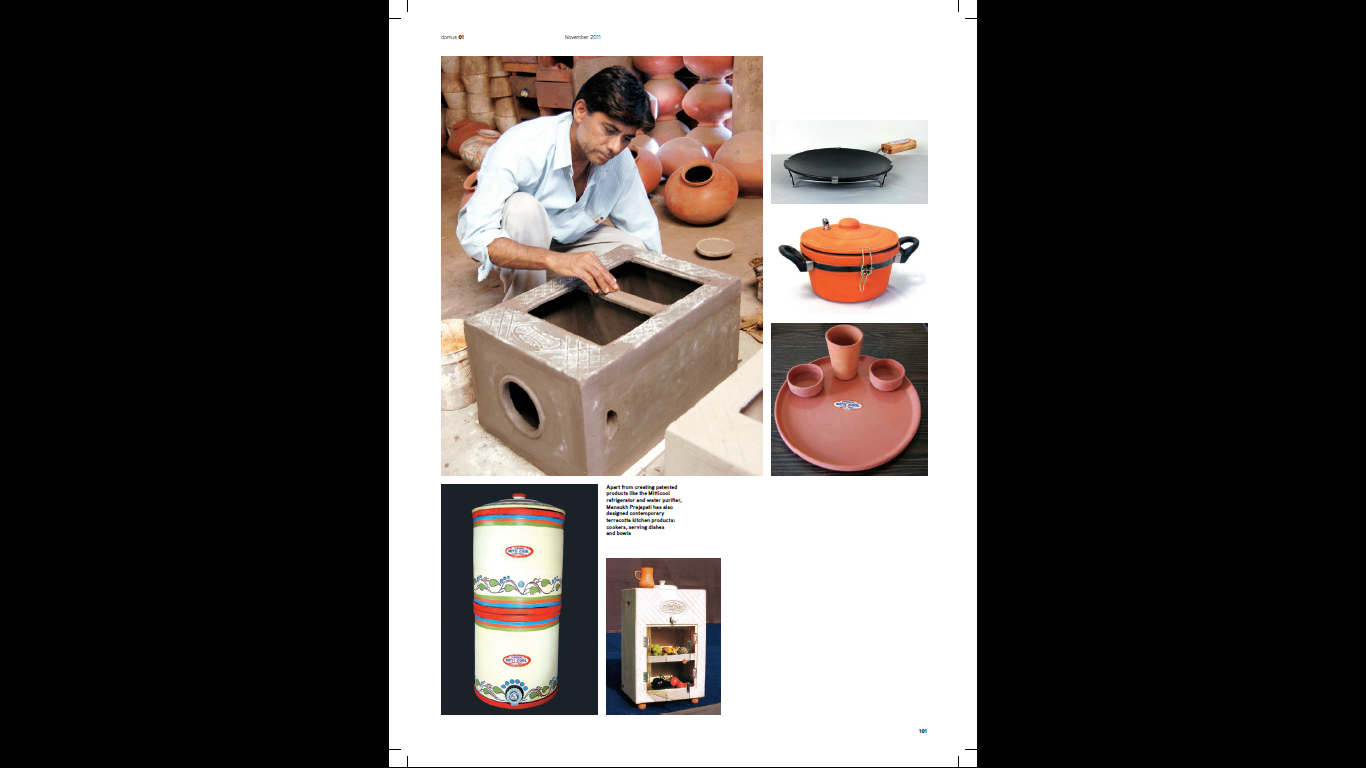
Mansukhbhai Prajapati is an ordinary potter with extra-ordinary ideas and has proven the truth of that famous adage—necessity is the mother of all invention. Hailing from Rajkot, Gujarat, Mansukhbhai belongs to a traditional potter family. While working in a tile-making factory he learnt how the big terracotta-manufacturing units worked. Then in 1988, securing a loan of r30,000 from a local lender, he started out on his own. For the next three years he improved on the design and material for the manufacture of clay tavas and in 1992 he came up with a tava that was far more durable than the ones then being made. Since his constant inspiration has been the needs of common people, and knowing the perils of not having access to clean drinking water, he began designing water purifiers made of clay with the dual-function of purifying and cooling at the same time. Durable and reasonably priced, the product was an instant success with the local rural population.

But, the real innovation was yet to come. In the aftermath of the 2001 earthquake epicentered at Bhuj, which shook the entire region of Gujarat bringing heavy loss of life and material, mostvillagers lost the clay pots they used to store and cool water in. The plight they faced motivated Mansukhbhai to engineer a refrigerator made out of clay—cheap and free of the need for an electrical outlet. It took four years of work on a suitable moulding technique and to develop a machine that could separate clay from sand to make a purer form of clay, and then work on the technique of firing it at a controlled temperature of 1250 degree Celsius—this process is used to increase the porosity of clay, to successfully prototype the idea. The handmade Mitticool refrigerator which emerged from this research can store 10 litres of water and vegetables for eight days, and dairy products for one day with a total storagecapacity of five kilograms of vegetables; this technology also helps preserve the original freshness of vegetables. This clay product works without electricity and uses the same principle of cooling as traditional terracotta pots. It takes about eight days to produce one and is priced at r2,500. Facilitators like the Gujarat Grassroots Innovation Augmentation Network (GIAN) have helped him for the past six years with patents, market visibility and technical inputs for his products, while design assistance has been provided by the National Institute of Design (NID). Interestingly, the Mitticool range of products is slowly gaining popularity among city dwellers. Today, in addition to Ahmedabad he supplies to vendors in Pune, Mumbai, Gujarat, Hyderabad and Chennai.


In a world populated with cheap plastics and electronics, the unassuming Mansukhbhai is considering the marketing of these products internationally, while continuing to focus on building as many Mitticool products for village-dwellers and city-folk as he can practically produce. One of his ambitions, at a very different scale, is to build eco-friendly houses from organic materials which consume negligible electricity and are earthquake-proof.

and bowls
It is a modern paradox that even as the world begins to slowly crave for sustainable everyday products, a small town potter like Mansukhbhai, with creations which are a proven precursor to deeper innovation in clean technologies at the mass level of everyday products, still struggles to achieve a firm grasp on the market which began foremost as a market built on a bank of traditional intelligence.