Tag: storytelling

  • The French connection in Bengal

    The French connection in Bengal

    Nestled along the Hooghly River is a tiny town just 35 kilometres from Kolkata that is steeped in history and is definitely worth exploring, writes KALYANI MAJUMDAR.

    Published in Free Press Journal; Date 21.05.2017

    Clock Tower; Image credit: Kalyani Majumdar

    A gentle breeze welcomes you as you step on the Strand. The beautiful promenade along the Hooghly River is a lovely stretch and across it stands a row of beautiful French colonial buildings.  Wait, French? Yes, you read it right! It is a general perception for most that in India the French existed only in Pondicherry. In fact this quaint place called Chandernagore was and still is, the La petit French—the little France—in West Bengal and is only 19 square kilometres in total area. Chandernagore might be a small town but its historical significance cannot be trifled with.

    A town with many names
    The name of the town itself has many derivatives. Some say that the bank of the river forms the shape of the moon—chandra—inBengali; others say it is named after the oldest temple of Goddess Chandi. According to some it was believed to be a centre for selling sandal (chandan). The best way to explore this lovely town is to walk it.

    The advent of the French
    Chandernagore became a French colony in 1673, wherein they established their trading banks, and it became a permanent French settlement by 1688. After the 1757 war with the British the town changed hands a couple of times between the British and the French. However, from 1816 it remained with France till 1950. Although Chandernagore was a French colony, it had a strong convergence of the French and Bengali cultures as many Bengali merchants flourished and played an important role in development of the town.

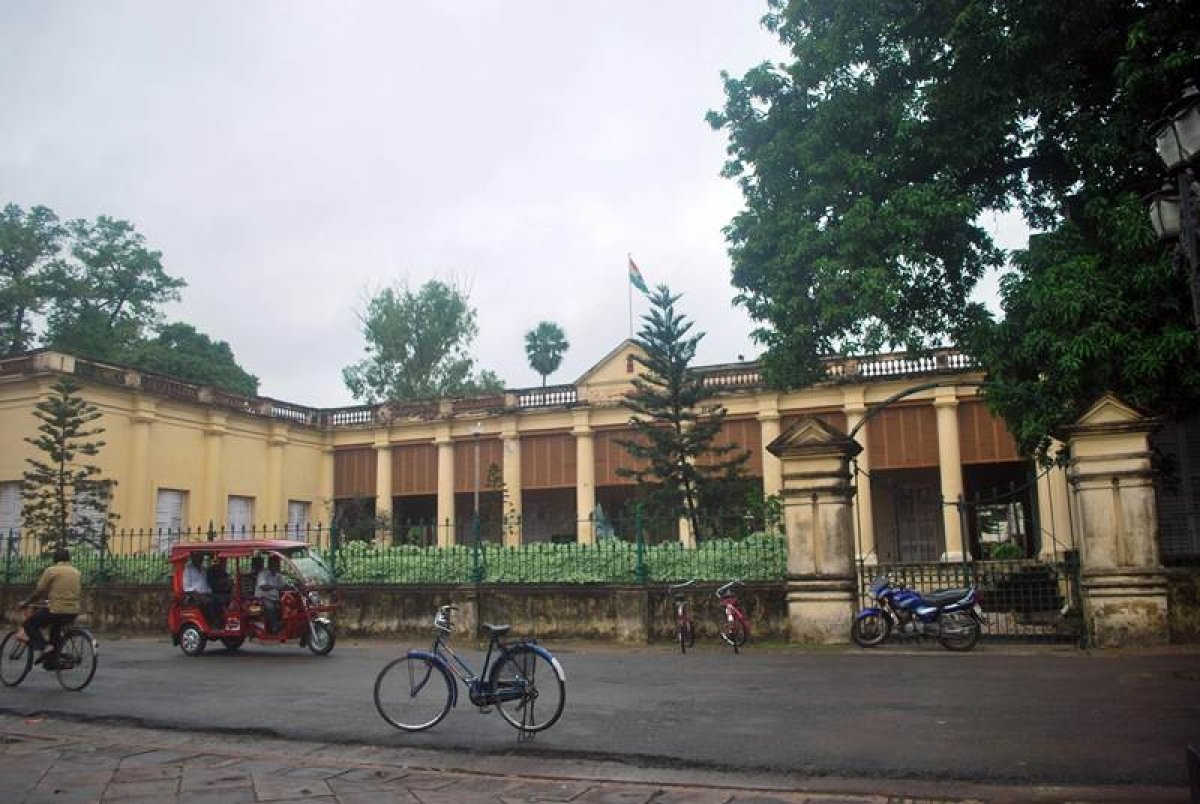
    Institute de Chandernagore – Dupleix Palace ; Photo credit: Kalyani Majumdar

    Institute de Chandernagore – Dupleix Palace
    In 1730, Joseph François Dupleix was appointed governor of Chandernagore. It was during his time that the town became the main center of commerce in Bengal. The Fort d’Orléans, was also built during his time. Today the reminiscence of Dupleix’s glorious years in Chandernagore is housed in the Institute de Chandernagore that stands in a grand manner located on the Strand commanding a view of the Hooghly River. It is a French colonial building with spacious verandahs enveloping the entire building supported by columns. A flight of steps take you to the entrance to the museum that showcases artefacts, old photographs and Dupleix’s personal belongings. You can spend a good few hours strolling in the garden or sit in the verandah and enjoy the scenic view.

    Every building has a story
    Built in 1904, the Patal Bari (underground house) on the Strand is worth a visit as its lowest floor is submerged in the river. Some very prominent personalities have resided in this house during their visit to the town including Rabindranath Tagore. A clock given by Joseph Daumain sits on the tower facing the promenade reminding everyone of the times that this town has seen. The other grand building on this stretch is the sub-divisional court of Chandernagore. However, it was not always a court. It was the Hotel de Paris. You could very well imagine the spacious verandahs and gardenslit up for the typical Parisian evening soirees. The road off the Strand takes you to Sacred Heart Church. This Roman Catholic Church was built around 1875 and has beautiful stained glass paintings. As you continue walking past the church you come across shops, and old houses competing with new buildings.

    Nandodulal temple ; Photo credit: Kalyani Majumdar

    The temple that withstood cannon fire
    This town played a pivotal role in the famous Battle of Plassey in 1757 when Robert Clive destroyed the Fort de Orleans along with houses and places of worship. There are few buildings that still stand as mute witnesses to Clive’s cannon balls. The temple that still exists from that time is the Nandodulal temple. Built in 1740, it is believed to be the largest dui chala (double-sloped roof) temple in Bengal. Located on a picturesque landscape with a little pond on the rear, the wall still carries theimprint of Clive’s cannon balls.

    Refuge for Indian freedom fighters
    As you peel one layer of history of this town you unravel another layer beneath.  Since Chandernagore was a French colony during the same time when Calcutta was under the British, many freedom fighters from British Bengaltook refuge in French Bengal. The most famous name is of Sri Aurobindo Ghosh. The house where Sri Aurobindo went into hiding and used the space to make bombs still stands. In fact many brave hearts such as Kanailala Dutt and Rajbihari Ghosh that fought for the Indian freedom against the British hailed from this town. You can visit the Prabartak Ashram that was established by Motilal Roy. It used to be a safe haven for freedom fighters.One should not miss the Laldighi on the Grand Trunk road, the cemetery across it, and the old library building not very far from there.

    Local flavour
    Although most of Chandernagore’s identity comes from its French association, but one that continues to have the local Bengali flavour is the Jagaddharti Puja. It is celebrated with much fervor. After a heavy duty history tour one should not miss the lovely evenings at Strand. It looks like the entire town is on the promenade. With shopping carts and ferries on either side of the Strand selling trinkets, street food, icecream carts. Music floating from the Rabindra Bhawan across the street and the sight of old people discussing politics and Tagore on the same breath is quiet a sight, not to be missed by anyone. Albeit, officially Chandernagore merged with West Bengal and became part of India in 1951, the vestiges of the Liberty gate on the south of the town acts as a reminder of the French connection with the inscription sayingLiberté, égalité, fraternité—Liberty, equality, fraternity—the three pillars of the French revolution. We tip the hat for those lovely words that continue to give us hope.

  • The French connection in Bengal

    The French connection in Bengal

    Nestled along the Hooghly River is a tiny town just 35 kilometres from Kolkata that is steeped in history and is definitely worth exploring, writes KALYANI MAJUMDAR.

    Published in Free Press Journal; Date 21.05.2017

    Clock Tower; Image credit: Kalyani Majumdar

    A gentle breeze welcomes you as you step on the Strand. The beautiful promenade along the Hooghly River is a lovely stretch and across it stands a row of beautiful French colonial buildings.  Wait, French? Yes, you read it right! It is a general perception for most that in India the French existed only in Pondicherry. In fact this quaint place called Chandernagore was and still is, the La petit French—the little France—in West Bengal and is only 19 square kilometres in total area. Chandernagore might be a small town but its historical significance cannot be trifled with.

    A town with many names
    The name of the town itself has many derivatives. Some say that the bank of the river forms the shape of the moon—chandra—inBengali; others say it is named after the oldest temple of Goddess Chandi. According to some it was believed to be a centre for selling sandal (chandan). The best way to explore this lovely town is to walk it.

    The advent of the French
    Chandernagore became a French colony in 1673, wherein they established their trading banks, and it became a permanent French settlement by 1688. After the 1757 war with the British the town changed hands a couple of times between the British and the French. However, from 1816 it remained with France till 1950. Although Chandernagore was a French colony, it had a strong convergence of the French and Bengali cultures as many Bengali merchants flourished and played an important role in development of the town.

    Institute de Chandernagore – Dupleix Palace ; Photo credit: Kalyani Majumdar

    Institute de Chandernagore – Dupleix Palace
    In 1730, Joseph François Dupleix was appointed governor of Chandernagore. It was during his time that the town became the main center of commerce in Bengal. The Fort d’Orléans, was also built during his time. Today the reminiscence of Dupleix’s glorious years in Chandernagore is housed in the Institute de Chandernagore that stands in a grand manner located on the Strand commanding a view of the Hooghly River. It is a French colonial building with spacious verandahs enveloping the entire building supported by columns. A flight of steps take you to the entrance to the museum that showcases artefacts, old photographs and Dupleix’s personal belongings. You can spend a good few hours strolling in the garden or sit in the verandah and enjoy the scenic view.

    Every building has a story
    Built in 1904, the Patal Bari (underground house) on the Strand is worth a visit as its lowest floor is submerged in the river. Some very prominent personalities have resided in this house during their visit to the town including Rabindranath Tagore. A clock given by Joseph Daumain sits on the tower facing the promenade reminding everyone of the times that this town has seen. The other grand building on this stretch is the sub-divisional court of Chandernagore. However, it was not always a court. It was the Hotel de Paris. You could very well imagine the spacious verandahs and gardenslit up for the typical Parisian evening soirees. The road off the Strand takes you to Sacred Heart Church. This Roman Catholic Church was built around 1875 and has beautiful stained glass paintings. As you continue walking past the church you come across shops, and old houses competing with new buildings.

    Nandodulal temple ; Photo credit: Kalyani Majumdar

    The temple that withstood cannon fire
    This town played a pivotal role in the famous Battle of Plassey in 1757 when Robert Clive destroyed the Fort de Orleans along with houses and places of worship. There are few buildings that still stand as mute witnesses to Clive’s cannon balls. The temple that still exists from that time is the Nandodulal temple. Built in 1740, it is believed to be the largest dui chala (double-sloped roof) temple in Bengal. Located on a picturesque landscape with a little pond on the rear, the wall still carries theimprint of Clive’s cannon balls.

    Refuge for Indian freedom fighters
    As you peel one layer of history of this town you unravel another layer beneath.  Since Chandernagore was a French colony during the same time when Calcutta was under the British, many freedom fighters from British Bengaltook refuge in French Bengal. The most famous name is of Sri Aurobindo Ghosh. The house where Sri Aurobindo went into hiding and used the space to make bombs still stands. In fact many brave hearts such as Kanailala Dutt and Rajbihari Ghosh that fought for the Indian freedom against the British hailed from this town. You can visit the Prabartak Ashram that was established by Motilal Roy. It used to be a safe haven for freedom fighters.One should not miss the Laldighi on the Grand Trunk road, the cemetery across it, and the old library building not very far from there.

    Local flavour
    Although most of Chandernagore’s identity comes from its French association, but one that continues to have the local Bengali flavour is the Jagaddharti Puja. It is celebrated with much fervor. After a heavy duty history tour one should not miss the lovely evenings at Strand. It looks like the entire town is on the promenade. With shopping carts and ferries on either side of the Strand selling trinkets, street food, icecream carts. Music floating from the Rabindra Bhawan across the street and the sight of old people discussing politics and Tagore on the same breath is quiet a sight, not to be missed by anyone. Albeit, officially Chandernagore merged with West Bengal and became part of India in 1951, the vestiges of the Liberty gate on the south of the town acts as a reminder of the French connection with the inscription sayingLiberté, égalité, fraternité—Liberty, equality, fraternity—the three pillars of the French revolution. We tip the hat for those lovely words that continue to give us hope.

  • Bangalore: Exploring the multi-layered history of the city

    Published in Free Press Journal; Date: 14.02.2018

    If the soul of a city is uncovered by walking the streets, then definitely it holds true for Bangalore as it reveals itself beyond its IT hub and impersonal glass buildings. Kalyani Majumdar explores the multi-layered history of the city.

    As you look past the traffic and catch sight of rows of pink and yellow flowers against the clear blue sky, for a second you forget the traffic, and savour the moment. Welcome to Bangalore/Bengaluru.

    Rise of a modern city

    Bangalore came into significance in 1537 AD, when Kempe Gowda I, a feudatory of Vijaynagar Empire laid the foundation of the city by building a mud Fort, wherein people of different vocation had their settlements. After him, it changed many hands from the Marathas to the Mughals, followed by Hyder Ali and then his son Tipu Sultan and finally, the British Empire. They have all left their imprints on Bangalore. However, Bangalore flourished as a city once the British took over. It started with the shifting of British Headquarters from Mysore to Bangalore in 1837. Gradually, the city witnessed a steady development of wider roads, boulevards, railway lines, improved post and telegraph facilities, and buildings.

    A royal experience

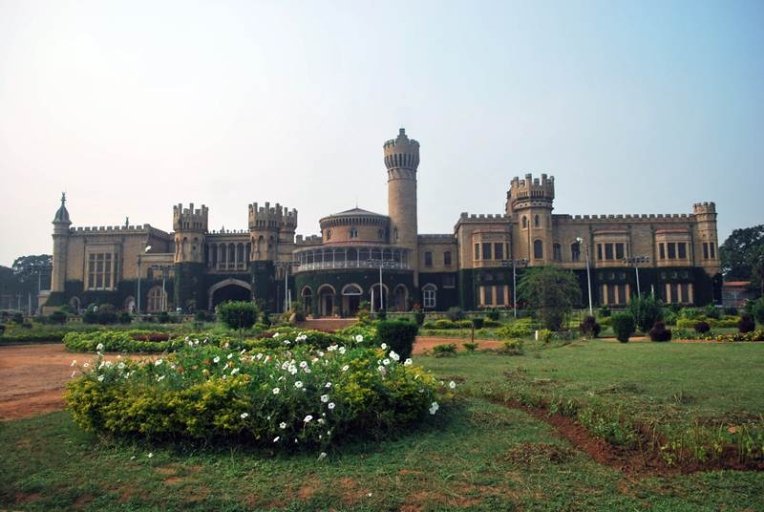
    A grand view of the Bangalore Palace; Photo credit: Kalyani Majumdar

    As you approach the Bangalore Palace, it is hard to miss the close resemblance of the exterior with the Windsor Palace in England. It is a magnificent Tudor-style structure facing a beautiful garden and has royalty written all over its façade. The plot was bought by King Chamaraja Wadiyar’s guardians in 1873. The palace was built in 1887. Once inside it is hard to miss the bright yellow-coloured ballroom with its decorated columns, ceiling and arches. After taking in the splendour of the ball room walk up a wooden staircase to the Durbar Hall. The huge room with its embellished interiors, huge chandeliers and a beautiful collection of art is indeed a rich experience. The corridors have exhibits from Maharajas hunting escapades. One of the courtyards has a beautiful coloured-tile bench gifted by an erstwhile Spanish royal. It is highly recommended that you walk the lane lined up with trees on your way to the exit.

    From South Parade to M.G Road

    It is not just now that M.G Road in Bangalore is famous for being the centre of social life. Even during the British era, it had a similar character and was known as South Parade. The building that now has the office of Deccan Herald was once where the popular Funnel’s Restaurant stood. Next to it, is the iconic Higginbotham book store. It has been there since 1905. Recently, it revamped its interiors and now it has reopened with a colourful interior and the façade looks bright as well. The book store has a fantastic collection. There is certainly a sentimental factor attached to this bookshop that has catered to generations of booklovers and still continues to do so. It is lovely to see how the old and the new has blended effectively on this particular stretch. Across the road, alongside the metro station there is a lovely boulevard. The walkway is almost half a kilometer and is lined up with white and pink bougainvillea. It is so refreshing even though it is right next to a busy road.

    The roads from the past 

    Book Society on St. Marks Road; Photo credit: Kalyani Majumdar

    At the intersection where M.G Road meets St. Marks Road, you can see a gothic building with etching in bold letters that say, ‘Book Society’. It was built in 1912. Part of the building is now the Hard Rock Café and apparently, sometime back it also had a HMV record store. As you continue further on St Mark Road the prestigious Bowring Institute is on view. From there you can easily negotiate through wide streets to reach the Museum Road, lest you are not wearing comfortable shoes. In 1865, part of the Cantonment Jail building on this road, now Good Shepherd Convent, served as the Government Museum, before it was shifted to its present location on a beautiful neoclassical structure in Kasturba Road, in 1878. Nevertheless, the road retained its name, thus keeping alive a part of history. Also, on the same road right next to the Post Office stands a 150-year-old tiled-roof building that serve as the office of the senior superintendent of post office.

    Cubbon Park 

    A statue of Queen Victoria stands at one corner of the Cubbon Park; Photo credit: Kalyani Majumdar

    If you approach Cubbon Park from Kasturba Road then you will come across a statue of Queen Victoria standing at the corner of the Park, facing the busy street, perhaps wondering how much the city has changed since 1906. The Cubbon Park was established in 1870 by John Meade and the landscaping was done by Richard Sankey. It is a lovely place to park yourself under a tree with a book.

    Imprints from the past 

    The Glass House at Lalbagh Botanical Garden; Photo credit: Kalyani Majumdar

    At the entrance of the Lalbagh Botanical Garden there is a peninsular gneissic rock, dated to about 3,000 million years, making it one of the oldest rock formations on the planet. And atop the rock is the Kempe Gowda tower. Hyder Ali laid its foundation in 1760. It was a pleasure garden till William New, a gardener from Kew in London came to Lalbagh in 1858 and turned the place into a scientific research centre and maintained a regular inventory of the trees. He lived in a small cottage inside Lalbagh which is now the Lalbagh library. In 1874, John Cameron took over as superintendent of Lalbagh. He too did many experimental cultivations within the garden. He proposed the idea of a Glass House. It was built in 1889 inspired by the famous Crystal Palace of London. It houses many flower shows and is a must-see.

    Outside the Lalbagh gate, there are stalls selling fresh fruit juice in the morning. One might wonder, if this was perhaps the spot where Cameron enthusiastically distributed seeds of new vegetables that he grew, to the passing farmers. We do owe him Chayote, a popular vegetable in Karnataka. Stories such as these crop up when one steps out on the streets of this city to listen to the echoes from the past and weave them into an urban narrative.

  • Why Oise in Northern France is a revelation

    Why Oise in Northern France is a revelation

    Even though Oise in Northern France, not far from Paris is usually missing from most travel itinerary, it is a revelation as KALYANI MAJUMDAR found out after visiting this picturesque place with its landscape, people and history.

    Published in Free Press Journal; Date: 01.04.2018; My article has been translated by a French Magazine Courier International. Click here to read it in French

    The serene beauty of Sacy-le-Petit in Oise; Image credit: Kalyani Majumdar

    As I bicycled my way through the expansive undulating green flatland on both sides of the road that met the blue sky, it seemed like an endless horizon. When I decided to undertake immersive travelling through volunteering on sustainable and organic farms across France, I had no idea what was in store for me here in Oise.

    Digging into the history

    The geographic location of Oise in Picardy region is strategic to many important events in history as it has always been the passage to Paris and thus played an important role in communication during the two World Wars. Occupied from September 1914 to March 1917, ravaged by the battles of 1918, this peaceful region has had its share of bloodshed and war.

     It was also the first French department to be liberated, and even the signing of the Armistice took place in Compiègne Forest in Oise on 11 November 1918. Moreover, this region is also associated with the sugar embargo of the 19th century. During the Napoleonic war in the 1800s, the British had blocked the French trade routes with the Caribbean Islands which led to massive shortage of sugar in France. As a solution, Napoleon I introduced sugar beet to counter the sugar embargo. The fertile lands of Oise grew it in abundance and the region grew rich. Whether you are a history enthusiast or a nature lover, there is something here for everyone.

    Unmissable dungeon 

    Donjon de Vez; Image credit: Kalyani Majumdar

    Located in the middle of Oise, Donjon de Vez is hard to miss with its imposing grey structure that is surrounded by lush green landscape. It is a medieval dungeon dating back to Gallo-Roman period. Initially, it was a structure mainly made of wood and stone that was built to protect the Gauls against the invasions by the Barbarians, of which nothing is left today. In 1214, Raoul Ducheim, who later Latinised his name and came to be known as d’ Estrees, re-planned, fortified and restored the structure.

    He added the three-storied living quarters, some of which still remains. In 1360, his great-grandson Jehan de Vez added the pentagonal-shaped tower. The terrace consists of machicolations and perhaps it was the primary defense system. At its present state, it is maintained by Caroline and Francis Briest. Because of their efforts they have given a new lease of life to the structure. It showcases permanent art installations—sculptures, paintings and stained glass artworks. Especially on a nice sunny day one could easily spend few hours at the Vez.

    Sacy-le-Petit 

    The expansive flatland in Sacy-le-Petit; Image credit: Kalyani Majumdar

    Sacy-le-Petit is a commune in Oise and dates back to pre-historic and Roman period. One can either drive down from Paris or board a train from Paris to Pont-Sainte-Maxence. There are taxis available at the station. The winding roads are dotted with houses made of red bricks mostly. The villages of Picardy region has a distinct culture and architectural style that can be seen in this commune as well. Before visiting this place while looking through images I had come across a photograph from 1940, of an abandoned French tank sitting on a farmland in Sacy-le-Petit, being inspected by the Germans.

    It is the same commune, yet its serene beauty belies the gruesome bloodshed that this region has seen. From May to July would be the best time to visit this region when the flowers are in full bloom in the gardens, and farm lands are green. Sacy-le-Petit is majorly an agricultural area. There are inns and hotels available here for a comfortable stay. The popular places to visit nearby includes Compiègne.

    Chateau de Sacy 

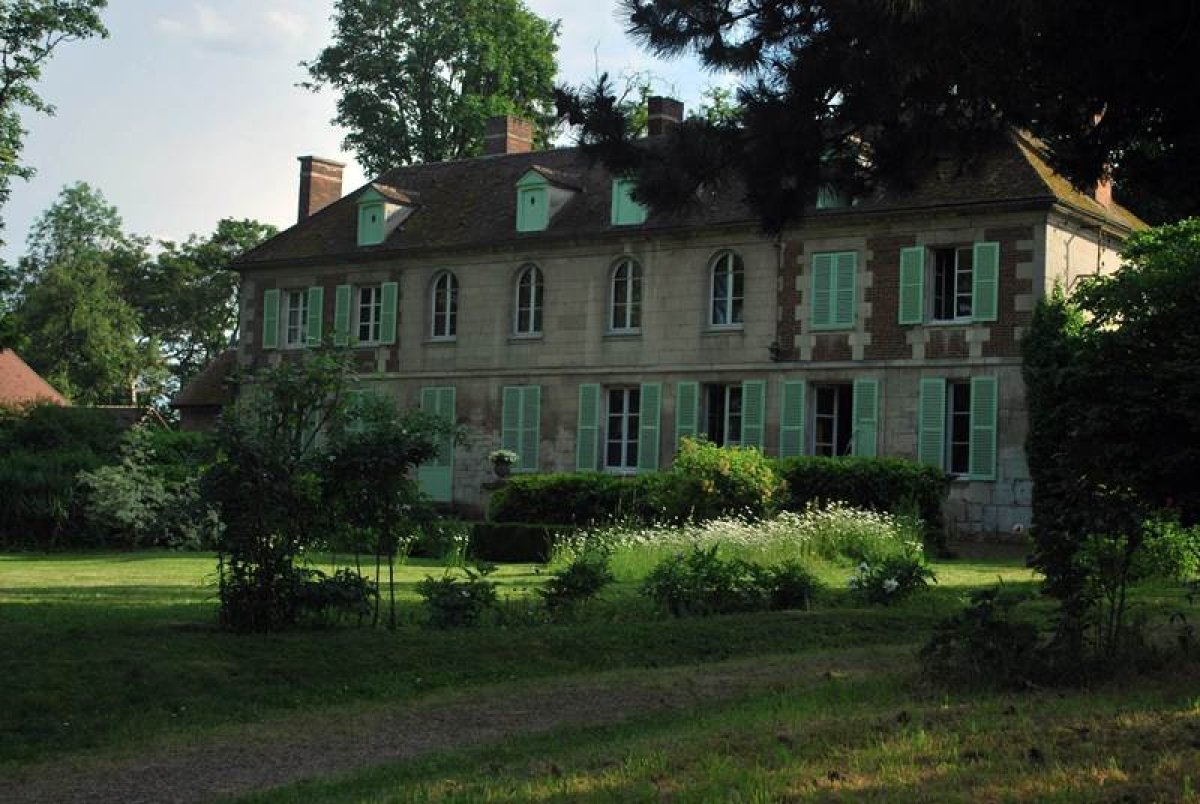
    Chateau de Sacy; Image credit: Kalyani Majumdar

    I was fortunate to volunteer at the Chateau de Sacy in Sacy-le-Petit during the same week as the festival of L’Oise Verte et Bleu, L’événement Grandeur. It is a festival to celebrate and discover the culture of Oise that includes outdoor activities, local culinary feasts and so on. Chateau de Sacy is situated in the middle of a large organic garden and is surrounded by a lovely collection of tall trees. The chateau is steeped in history and is closely linked to the history of Sacy-le-Petit. In the 19th century, Claude-François and Madeleine-Félicité Dupressoir had decided to take over this house and brought along things that were dear to them from their old castle, items such as, woodwork, trumeau, fireplaces and plates, the balustrade Louis XIV.

    Later on, as the region became rich by growing sugar beet during the sugar embargo they turned the two farms and a garden into a chateau. The current occupant is Hermine Williams, who inherited the house and is a descendant of Madeleine-Félicité and Claude-François Dupressoir.  There are organised tours of the Chateau de Sacy that should not be missed. Cycling and walking are the best way to see the sights and mingle with the friendly locals. Every weekend there is a flea market nearby, and is a great opportunity to immerse into the local culture.

    Perhaps the fact that this region of France has remained free from tourist traps, that it is still in its pristine form. For me, even now, Oise is embedded in my memory. It still continues to stir my imagination as I can still feel the wind in my hair and remember the intriguing stories that I have heard, some of which are now part of my story.

  • Art Deco: The Mumbai connection

    Art Deco: The Mumbai connection

    freepressjournal_import_2017_09_regal

    When a design movement called Art Deco flourished between the two World Wars in Europe, it made its way to Mumbai around the same time and found many takers in the city. Kalyani Majumdar delves into the story.

    Published in Free Press Journal; Date: 03.09.2017

    freepressjournal_import_2017_09_taxi-1-2

    Did you know that Mumbai has the second largest number of Art Deco buildings in the world right after Miami? For most people, it comes as a surprise. Possibly the reason could be that Mumbai is mostly synonymous with the Gateway of India that is an Indo-Saracenic architecture or the famous CST (formerly the Victoria Terminus), a neo-Gothic architecture. So, where are the Art Deco buildings? There is no doubt that Mumbai cityscape is dotted with iconic architectural masterpieces from the colonial period, and walking around South Mumbai is like visiting a museum displaying different architectural styles. However, if you pay attention on the built structures while walking around the Oval Maidan, Marine Drive and Colaba it is not difficult to spot these Art Deco buildings with their signature design elements such as symmetry, geometric designs and decorative motifs on the façade.  Curiously, one might even wonder what it was about Art Deco-style that it found so many connoisseurs in the city. To understand that we need to dive into the history of Art Deco.

    A movement that started in France

    Art Deco derived its name from the French words “Arts Décoratifs”. It was an exhibition that was held in Paris in 1925 called the Exposition Internationale des Arts Décoratifs et Industriels Modernes (International Exposition of Modern Decorative and Industrial Arts). To get selected for the exhibition the works had to be modern that was without the influence of past design-styles.

    Originally, the exposition was to take place in 1915, but was postponed due to the First World War. To a great extent the War had a strong influence on Art Deco’s popularity. The devastation and loss due to the war had left everyone disillusioned of the future. The horrors of war were being expressed through many new art movements that came up around the 1920s such as Cubism, Surrealism and Fauvism. Literary works by Ernest Hemingway and Scott Fitzgerald give us a fair idea of the society of that time.

    With socio-political changes taking place in Europe and around the world, the exposition was a success. Art Deco found many takers as there was something very appealing about this style that was modern and had moved away from the formal design styles that was prevalent till then. Post World War, the world was looking for optimism and that was exactly what Art Deco represented with its simple geometric lines, decorative motifs that brought in inspirations from around the world, and the use of vibrant colours. It was heralding the machine age with the use of technology.

    The designs could be replicated easily, thus bringing down the manufacturing costs along with the introduction of stainless steel, plastics and other unconventional materials. Apart from architecture, this design movement influenced jewellery, automobiles, and furniture designs as well. In the world of architecture Art Deco was fast becoming popular all around the world with the US giving the world the two iconic Art Deco buildings of that era, the Chrysler Building and the Empire State Building. As Art Deco rose in popularity the world over, it had surely become an international movement from its French origins.

    Art Deco found its way to Mumbai

    The time when Art Deco was taking over America, especially Miami, another city across the globewas fast becoming the second home for Art Deco to flourish in. It was none other than Mumbai. It was on the world map as an important port city for British India. Every new trend that was prevalent in the West found a home in Mumbai. In the 1920s the well-heeled and educated Indians from the city that were making frequent trips to Europe brought back the Art Deco style with them back home.

    freepressjournal_import_2017_09_TAXI

    Between 1920s and 1940s Art Deco graced the South Mumbai landscape, especially the residential buildings on Marine Drive that came up on the newly reclaimed land around the same time, thanks to the Backbay Land Reclamation Scheme.  With its optimistic and modern designs that had moved away from the imprint of colonial design-styles such as the Gothic and the Victorian, the Mumbai home owners wanted to do up their properties in the Art Deco style. Art Deco was vibrant and had a global appeal. It was the trend everyone wanted to be part of. Thus, in India just like in the rest of the world, Art Deco made its presence in a big way.

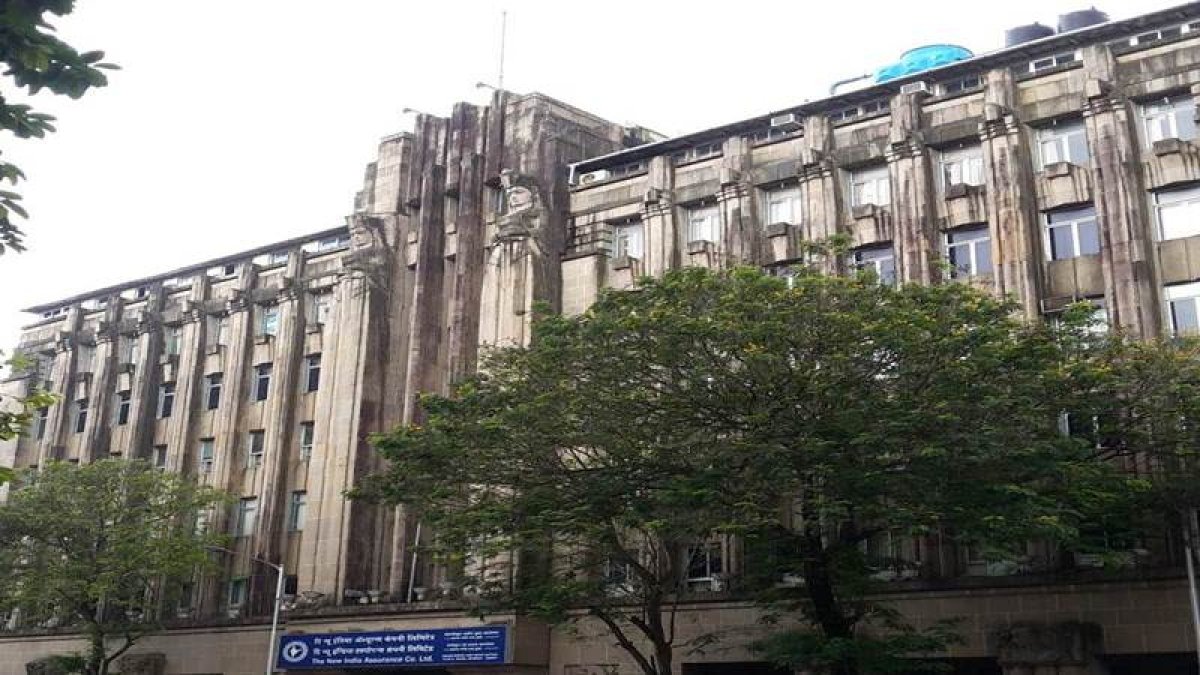
    Apart from the geometric patterns and the need for symmetry, one also observes nautical elements being part of the Art Deco buildings in Mumbai. One can see the new age design elements on buildings such as the Eros Cinema right across Churchgate station that was completed in 1937, or the decorative motifs on the façade of the iconic Regal Cinema in Colaba that was opened to public in 1933. Another notable Art Deco building is on the Mahatma Gandhi Road in Fort — The New India Assurance Building. It has bas reliefs depicting rural life in India, but what catches your attention first are the two huge statues on the façade that appears of Egyptian origin. It is indeed a long list of beautiful Art Deco buildings that exist in the city.

    So, next time when walking on the streets of Mumbai do pay attention to the buildings that you pass by, you might stumble upon an Art Deco hidden somewhere in the urban cluster of high rises that stands as a testimony of the era that was popularly known as the roaring 20s or the Jazz Age.

  • Haunting Notes from Mumbai

    KALYANI MAJUMDAR explores Sarnath Banerjee’s ongoing exhibition, which brings a trove of stories from the supernatural realm that engages with the city of Mumbai. 

    (Published in Free Press Journal; Date: 26.05.2019)

    freepressjournal_import_2019_05_W_end_May26_pg4_anchor-left-1

    Every city has its fair share of ghost stories. I remember when I first arrived in Mumbai, I was told stories by people coming from various walks of life about certain buildings and roads in the city that are associated with apparitions. The Spectral Times is an exhibition of works by the Berlin-based renowned artist and graphic novelist, Sarnath Banerjee at Dr Bhau Daji Lad Museum (BDL). The exhibition brings forth stories that take the visitors through a wonderful journey into the temporality of haunting, wherein, the past and the present seems to overlap. The exhibition is curated by Tasneem Zakaria Mehta, Managing Trustee of BDL, and co-curated by Himanshu Kadam. This is part of the museum’s decade-long series, Engaging Traditions, which invites contemporary artists to engage with its archives and history.

    The exhibition space

    From the entrance of the BDL Museum, and through the hallway on the ground floor you make your way up a flight of stairs onto a hall that leads you to a room with an interesting choice of lighting that creates a strong contrast of dark and light, very different from the rest of the museum space, lending it a feel of an old painting or a photograph with chiaroscuro lighting. It has a cabinet filled with a collection of objects such as a man’s head, a book on Arabic surgeries and so on. There are few chairs arranged in a circle for the visitors to sit. The exhibition area is divided into three sections. The next section of the room showcases Banerjee’s artworks. The illustrations combined with sound installations narrating fictional tales that mostly have an eerie ending, creates an engaging environment. The exhibition commands full engagement of all your senses as it is recommended that once you listen to the narratives, you must revisit the artworks, and see the characters come alive and you as an onlooker become a part of the process of storytelling. The third section of the room is separated with a black curtain, you step in the section and sit on one of the chairs arranged facing an old radio. While you sit and listen to another story with an anticlimactic ending with the storyteller being a woman with the severed head, you can’t help but take in the surrounding of the room with a derelict spiral staircase at the corner that has lost its functionality with time and you wonder how the theme of the exhibition fits the museum space as the past keeps reasserting itself through the stories. Narrated in the form of a magazine interview, Birjis Bari, a fictional reporter continues to provide us scintillating tales through the news periodical, The Spectral Times.

    Magic of storytelling

    The exhibition uses the radio component and takes us back in time when the only source of news, entertainment and information was radio. Now, we have videos for everything, however listening to a story in a radio provides us the freedom to imagine the characters of the story, the atmosphere and everything else. It has its own magic.

    Illustrations and narratives

    Although almost all the stories have eerie endings each story also depicts city life and its people. For instance, there is a couple that meets at Dom’s Guesthouse. Even though they belong to the city and yet they ritualistically make it a point to spend few days at the guesthouse and experience the city as two strangers. Of course, there is a spectral angle to this narrative as well. Then there is Shehri Adamkhor that recounts the story of a man, who has shifted cities and is trying to quit smoking and talks about his cannibalistic behaviours. The narration is laced with dark humour. Then there is an artwork titled, Milk Colony, that has a narration revolving around the Aarey forest wherein several auto-rickshaw wallas share their experience of spotting a ghostly figure that appears out of nowhere and sings a very famous Hindi movie song. However, there are some stories that are more unsettling than the others, like the Fidaly Mansion.

    After spending a good amount of time soaking in the dramatic atmosphere accompanied with the narratives, when you step out of the room into the hall with its bright light and merge into the sea of visitors to the museum, there is a sort of longing for that atmosphere that you just left behind in the room with its spectres and their tales. You are forced to wonder about this inherent fascination that we have for apparitions and the unexplained phenomenon. Is it the ghost narratives that are merely reasserting itself in our stable present that makes it unsettling for our logical understanding of concepts that are linear? Or, are we just fascinated by the idea of temporality of haunting, through which events and people return from the limits of time and mortality? Perhaps, both!

    Event details:

    On till May 26, 2019

    Timings: 10 am– 6 pm (Wednesday closed)

    Venue: Dr Bhau Daji Lad Museum, Ranibaug, Byculla East, Mumbai