Tag: tagore

  • Six must-do activities in Kolkata

    Six must-do activities in Kolkata

    By Kalyani Majumdar | Published in Free Press Journal |10.06.2017

    Whether you are a foodie, an architecture enthusiast, a book worm, a history buff, or a poet at heart, Kolkata has something for everyone, says Kalyani Majumdar who lists six must-do activities to do in the city

    Through the meandering streets and by lanes flanked with a mix of colonial, vernacular and modern built structures you land on a busy street where along with cars, bikes and buses you see a tram moving at its own pace. That is Kolkata for you! With all the hustle and bustle of a city it still manages to have a whiff of leisurely pace to it.

    The Trams from yore
    Did you know that the trams in Kolkata are the oldest electrically operated trams in Asia?At first when it was introduced by the British in 1873 it was horse drawn. In 1902 they became electric. This is the only tram network in India which is still operating. The slow pace of a tram ride gives you an opportunity to enjoy the sight and sound of the city properly and has the added feel good factor that your mode of transport is environment friendly. The old trams still have wooden interiors. If you want to feel nostalgic of the good old days then choose a tram ride that take you northwards of the city as that is the old part of Kolkata.

    Trams still run on Kolkata streets | Image credit: Kalyani Majumdar

    College Street and Coffee House
    The name College Street goes back to 1817 when Sir David Hare started the Hindu College. Now of course, it also has Kolkata’s most prestigious and renowned academic institutions such as the University Of Calcutta, Calcutta Medical College, Presidency College, Sanskrit College and Hare School. This stretch is a paradise for book lovers. It is a one stop place for all your book search.

    Once you are done with your book browsing, stop at the legendary Coffee House. Even if the coffee they serve is too sweet for your palate, and the fact that the place does not have fancy amenities, it can beat any modern coffee shop for its old world charm.  A spiral staircase takes you to the coffee house. Waiters wearing headdress greets you, as a young Rabindranath Tagore looks on over everyone from his life size portrait. The place has been graced by notable personalities such as Rabindranath Tagore, Subhas Chandra Bose, Satyajit Ray, Manna Dey, Amartya Sen, Shashi Kapoor and Aparna Sen to name a few.

    Exploring the streets, museums and ghats

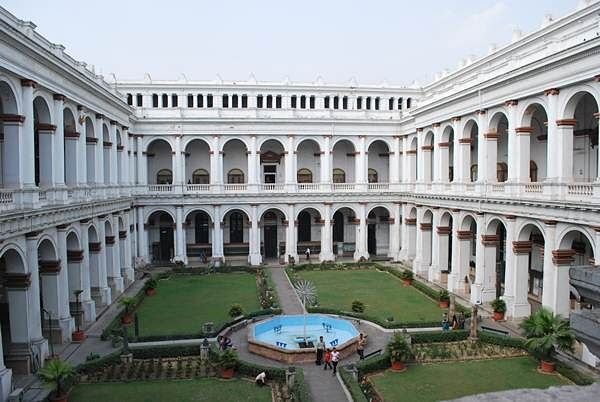
    The oldest museum in India The Indian Museum, Kolkata | Image credit: Kalyani Majumdar
    Jorasankho is the house where Rabindranath Tagore lived, now it is a museum | Image credit: Kalyani Majumdar

    Walking is the best way to not miss the vibrant energy of the city. Amix of architectural styles can be observed such as the Victorian, Neo classical, Indo-Saracenic and also few art-deco buildings.Do not miss the majestic Esplanade mansion, built in 1910. Also, visit the Indian Museum. It is the oldest in India founded in 1814. In 1878 it was transferred to the present building. It houses an Egyptian mummy.

    Make a trip to the Marble Palace in North Kolkata. Walking around this property takes you back to the 19th century. It is a popular location for movie shoots. Also, nearby is the JorasankhoThakurbari. It was built in 1785and was the ancestral home of Rabindranath Tagore. It houses a lovely museum which is worth visiting.

    The Ganga ghat and the boat rides beacon | Image credit: Kalyani Majumdar

    After a good measure of history and culture take a leisurely walk either at the Princep Ghat or the Outram Ghat in the evening. It is highly recommended that you take a boat ride under the starlit sky and appreciate the Vidyasagar Setu, a cable-stayed bridge from the river.

    A dose of spirituality
    Plan an early morning visit to the beautiful Dakkhineshwar temple. It was built in 1855 by Rani Rashmoniand has a traditional Bengali nine-spired architectural style. The spacious temple complexis dedicated to Goddess Kali and is associated with the spiritual leader Shri Ramakrishna Paramhansa.From here take a boat ride across Hooghly River to visit Belur Math. It was founded in 1938 by Swami Vivekananda. The serene and quiet atmosphere at Belur is a perfect place to unwind while providing a splendid view of the river.

    The potters of Kumartuli (to read more about Kumartuli visit my article here)
    A trip to Kolkata is incomplete without visiting Kumartuli. The name Kumartuli or Kumortuli comes from the Bengali word kumor meaning potter and tuli meaning locality. As you negotiate through the labyrinthine lanes of this area it is like visiting an art and crafts workshop. Rows of idols of Durga and the entire pantheon can be seen standing on either sides of the narrow lanes as you see sculptors in action. The idols for Durga Puja are prepared here and also exported to different parts of the world. It is an amazing place for budding photographers and is a delightful experience to interact with the potters.

    Although the name of the city changed from Calcutta to Kolkata in 2001, the city has managed to keep the unique mix of both worlds alive in a graceful manner, and that is perhaps what adds to the extraordinary charm that Kolkata imbues.

  • Remembering the great Indian bard

    On the 157th birth anniversary of Rabindranath Tagore we take a moment to remember the polymath as he continues to ignite our creative consciousness and inspires us to see the world from a fresh perspective. KALYANI MAJUMDAR pays homage to the Nobel Laureate.

    Published in Free Press Journal; Date: 06.05.2018

    On the 157th birth anniversary of Rabindranath Tagore we take a moment to remember the polymath as he continues to ignite our creative consciousness and inspires us to see the world from a fresh perspective. Kalyani Majumdar pays homage to the Nobel Laureate

    “Where the mind is without fear and the head is held high

    Where knowledge is free,

    Where the world has not broken into fragments…”

    These profound words were written by Rabindranath Tagore in 1910, and even today these words remain relevant. Tagore is the only known personality who has penned the national anthem for two countries. The Jana Gana Mana was chosen for India and Aamar Shonar Bangla was selected for Bangladesh.

    Tagore believed that humanity was the highest spiritual practice and he believed in the idea of ‘One World’. Thus, it is no wonder that his works have an immense capacity to transcend nationality, religion, geographical regions and has the natural ability to touch every soul. Tagore was one of the prominent faces of the Indian Renaissance. Not only did he changed the landscape of Bengali literature, but also redefined modern Indian art, and presented Indian literature, philosophy and culture to an international audience.

    Movie clip from Charulata. The movie is based on Tagore’s novel Noshto neer (broken nest).

    The early years

    Rabindranath Tagore was born in a highly educated and influential Bengali-Hindu family to Debendranath Tagore and Sarada Devi in Jorasanko Thakur Bari in Calcutta (now Kolkata) in British India in 1861 on the 25th day of Baisakh, which according to the Gregorian calendar usually falls either on the 7th or on the 9th of May. His family owned lands and estates mostly in East Bengal, which later became Bangladesh.

    He was never interested in the formal education system that was prevalent at that time and dropped out from school. His interest in art and literature developed from a very young age as his family was progressive and was leading the way in culture, art and literature in Bengal. But it was Rabindranath Tagore, who was destined to shine through as the brightest star among all the Tagores.  His father was an extensive traveler and young Tagore travelled with him for months at stretch to different parts of India. These travels left a lasting impression in the young mind of Tagore that found expression later on through his writings.

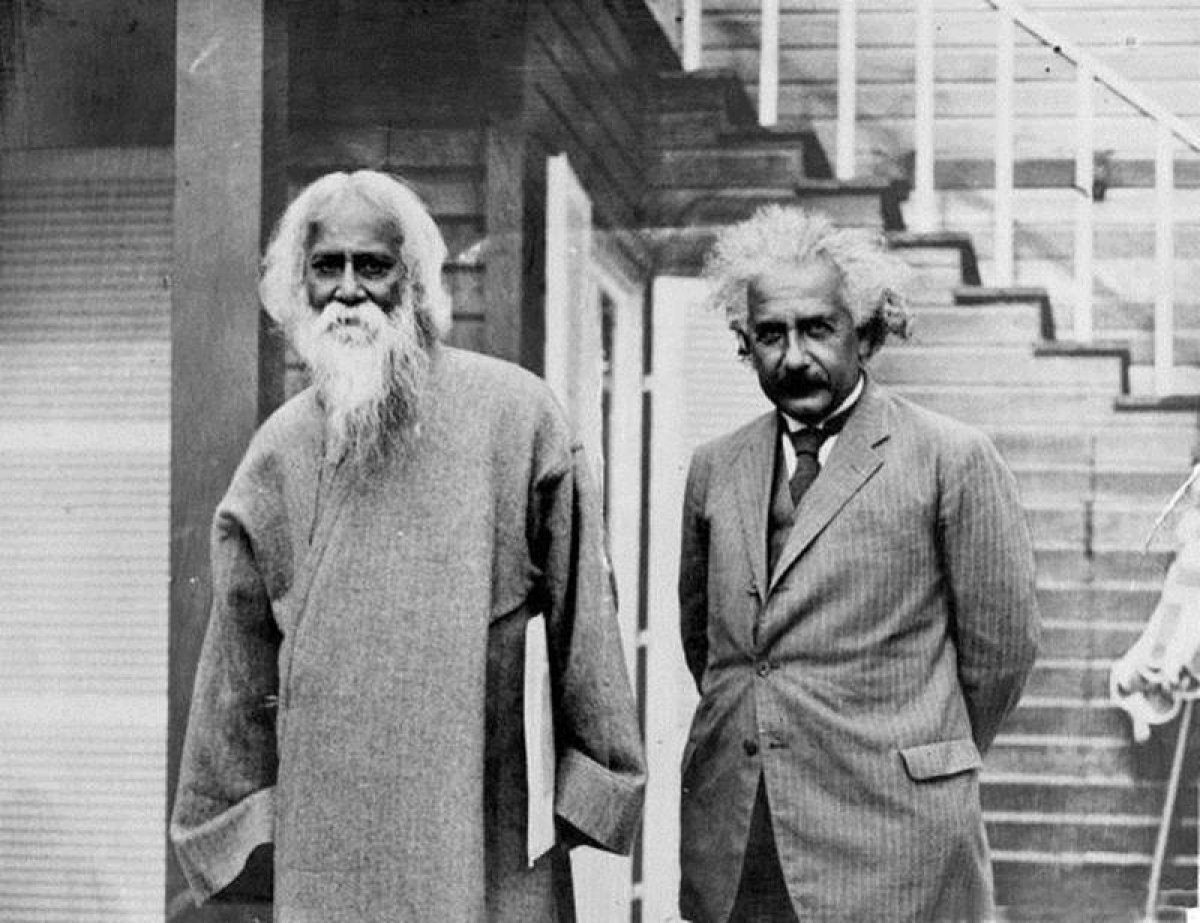
    Tagore with Einstein

    A polymath

    Rabindranath Tagore did not limit himself to one form of creative expression. Apart from writing poetry, short stories and novels, he was a great essayist, dramatist, song writer, composer and painter. When gramophone was introduced in India, he recorded his songs. He was an exceptionally curious man who wanted to learn as much as was humanly possible in one life. Some of his very popular short stories include Kabuliwalla, Khudita pashan, and Bhikarini.

    Apart from his short stories, his novels Ghare Baire (At Home and Outside) and Nastanirh (Broken Nest) were made into fantastic films by none other than Satyajit Ray, the latter was called Charulata. Both had strong female protagonists. It is said that no one understood women as beautifully as Tagore did. In 1913, he became the first non-European to win a Nobel Prize for Geetanjali—a collection of poems that was originally written in Bengali and were translated to English by Tagore. He never stopped exploring new avenues of self-expression. Tagore was in his sixties when he started painting. He was not formally trained in fine art, but that did not stop him from pursuing painting and he used his sensibilities and visual vocabulary to develop a distinct style of his own.

    A global phenomenon

    Tagore was inspired by both Eastern and Western philosophies. As an avid traveler, he had a keen understanding of different cultures and till his last days even with his failing health, he continued with his travels. He had visited around thirty countries in his lifetime, including Japan, Mexico, United States, and England to name a few. He wanted to spread his idea of ‘One World’ and gave lectures in universities in different countries. He was on a constant quest to facilitate a dialogue between the East and the West based on concepts of humanity, freedom and creative expression. He met some of the world’s greatest minds including Albert Einstein and shared ideas with them.

    An educationist

    Tagore’s pursuit to impart knowledge without the barriers of nation, geography, race or religion continued as he went on to set up a school at Santiniketan with the aim to focus on humanity and its creative expressions based on a Guru-Shishya method of schooling system. His father had bought a large stretch of land around 136 km from Kolkata and had established an ashram with a temple. Tagore shifted there in 1901 and set up an educational institution that was experimental. The classes were held under trees, close to nature. Later on, he turned it into the Visva Bharati University.

    The personal tragedies

    In Tagore’s life he had to confront several deaths of his near and loved ones. He lost his mother when he was very young and he found comfort when he identified his mother’s love in nature. But then the untimely death of his sister-in-law, Kadambari Devi, left him devastated. She was his muse and an anchor for the budding writer that he was, then. The loss was reflected in many of his stories, songs and poetry.  Between 1902 and 1918 he lost his wife, father, son and two daughters. Despite facing these personal tragedies in his life, Tagore never lost the optimism that life had to offer. Instead of drowning into the sea of sorrows he channeled his energy towards creative pursuits.

    It was on 7th August 1941, that Tagore breathed his last. He died in Jorasanko Thakur Bari, the place where he was born and had his first tryst with writing. Tagore wrote a poem Aaji hote shoto borsho pore (100 years from now), wherein, he was curious to know who would be his readers after 100 years. Perhaps, when he wrote that poem, he didn’t know that even after 76 years since Tagore’s demise, he continues to live through his writing, music and ideas in the collective consciousness of people from around the world.