Tag: tasveer arts

  • An anthology on women in Indian photography

    An anthology on women in Indian photography

    By Kalyani Majumdar; Published in Domus India magazine; News section; 2014

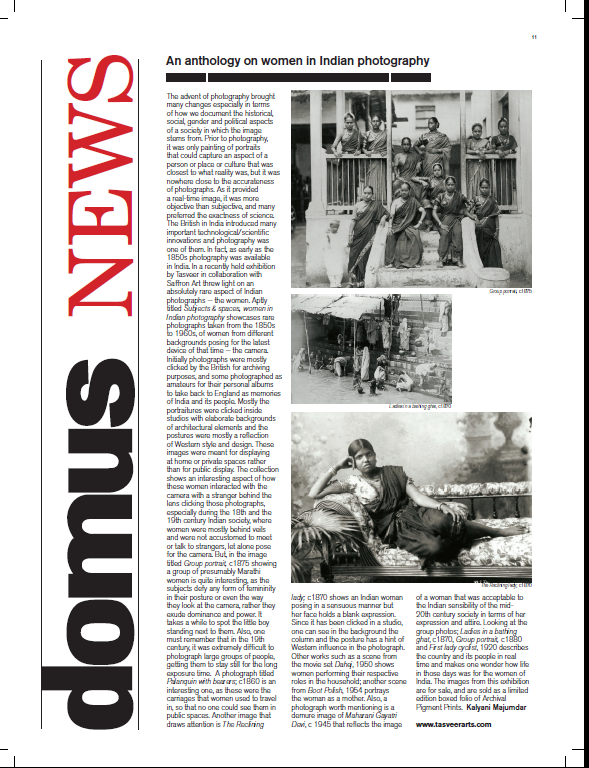
    Group Portrait, circa 1875

    The advent of photography brought many changes especially in terms of how we document the historical, social, gender and political aspects of a society in which the image stems from. Prior to photography, it was only painting of portraits that could capture an aspect of a person or place or culture that was closest to what reality was, but it was nowhere close to the accurateness of photographs. As it provided a real-time image, it was more objective than subjective, and many preferred the exactness of science.

    The British in India introduced many important technological/scientific innovations and photography was one of them. In fact, as early as the 1850s photography was available in India. In a recently held exhibition by Tasveer in collaboration with Saffron Art threw light on an absolutely rare aspect of Indian photographs — the women. Aptly titled Subjects & spaces, women in Indian photography showcases rare photographs taken from the 1850s to 1960s, of women from different backgrounds posing for the latest device of that time — the camera.

    The reclining lady, c 1870

    Initially photographs were mostly clicked by the British for archiving purposes, and some photographed as amateurs for their personal albums to take back to England as memories of India and its people. Mostly the portraitures were clicked inside studios with elaborate backgrounds of architectural elements and the postures were mostly a reflection of Western style and design. These images were meant for displaying at home or private spaces rather than for public display. The collection shows an interesting aspect of how these women interacted with the camera with a stranger behind the lens clicking those photographs, especially during the 18th and the 19th century Indian society, where women were mostly behind veils and were not accustomed to meet or talk to strangers, let alone pose for the camera. But, in the image titled Group portrait, c1875 showing a group of presumably Marathi women is quite interesting, as the subjects defy any form of femininity in their posture or even the way they look at the camera, rather they exude dominance and power. It takes a while to spot the little boy standing next to them. Also, one must remember that in the 19th century, it was extremely difficult to photograph large groups of people, getting them to stay still for the long exposure time. A photograph titled Palanquin with bearers; c1860 is an interesting one, as these were the carriages that women used to travel in, so that no one could see them in public spaces. Another image that draws attention is The Reclining lady; c1870 shows an Indian woman posing in a sensuous manner but her face holds a blank expression. Since it has been clicked in a studio, one can see in the background the column and the posture has a hint of Western influence in the photograph.

    Ladies in a bathing ghat, c 1870

    Other works such as a scene from the movie set Dahej, 1950 shows women performing their respective roles in the household; another scene from Boot Polish, 1954 portrays the woman as a mother. Also, a photograph worth mentioning is a demure image of Maharani Gayatri Devi, c 1945 that reflects the image of a woman that was acceptable to the Indian sensibility of the mid-20th century society in terms of her expression and attire. Looking at the group photos; Ladies in a bathing ghat, c1870, Group portrait, c1880 and First lady cyclist, 1920 describes the country and its people in real time and makes one wonder how life in those days was for the women of India. The images from this exhibition are for sale, and are sold as a limited edition boxed folio of Archival Pigment Prints. (www.tasveerarts.com)