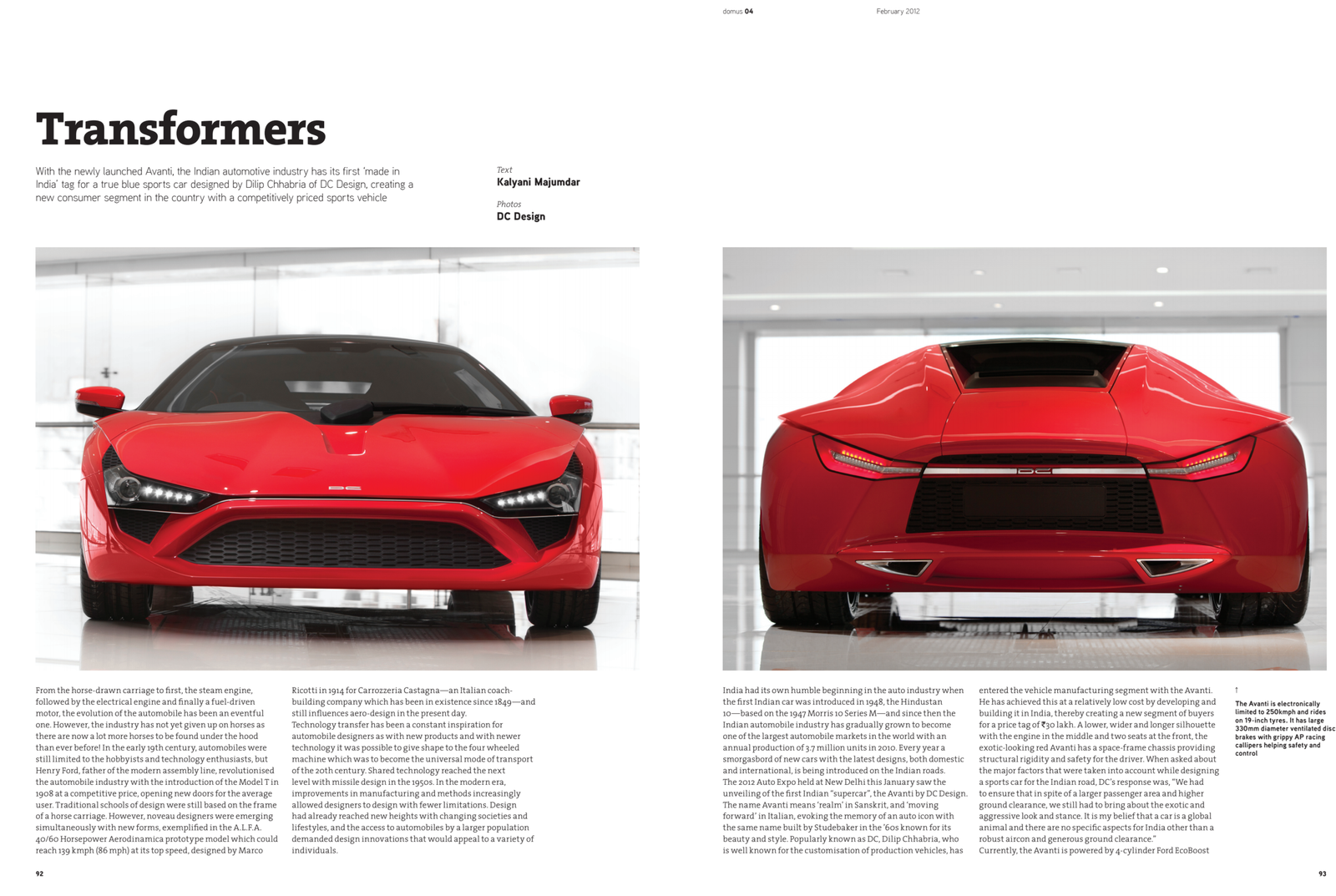
With the newly launched Avanti, the Indian automotive industry has its first ‘made in India’ tag for a true blue sports car designed by Dilip Chhabria of DC Design, creating a new consumer segment in the country with a competitively priced sports vehicle
Text: Kalyani Majumdar
Photos: DC Design
From the horse-drawn carriage to first, the steam engine, followed by the electrical engine and finally a fuel-driven motor, the evolution of the automobile has been an eventful one. However, the industry has not yet given up on horses as there are now a lot more horses to be found under the hood than ever before! In the early 19th century, automobiles were still limited to the hobbyists and technology enthusiasts, but Henry Ford, father of the modern assembly line, revolutionised the automobile industry with the introduction of the Model T in 1908 at a competitive price, opening new doors for the average user. Traditional schools of design were still based on the frame of a horse carriage. However, nouveau designers were emerging simultaneously with new forms, exemplified in the A.L.F.A. 40/60 Horsepower Aerodinamica prototype model which could reach 139 kmph (86 mph) at its top speed, designed by Marco Ricotti in 1914 for Carrozzeria Castagna—an Italian coachbuilding company which has been in existence since 1849—and still influences aero-design in the present day.
Technology transfer has been a constant inspiration for automobile designers as with new products and with newer technology it was possible to give shape to the four wheeled machine which was to become the universal mode of transport of the 20th century. Shared technology reached the next level with missile design in the 1950s. In the modern era, improvements in manufacturing and methods increasingly allowed designers to design with fewer limitations. Design had already reached new heights with changing societies and lifestyles, and the access to automobiles by a larger population demanded design innovations that would appeal to a variety of individuals.
India had its own humble beginning in the auto industry when the first Indian car was introduced in 1948, the Hindustan 10—based on the 1947 Morris 10 Series M—and since then the Indian automobile industry has gradually grown to become one of the largest automobile markets in the world with an annual production of 3.7 million units in 2010. Every year a smorgasbord of new cars with the latest designs, both domestic and international, is being introduced on the Indian roads.
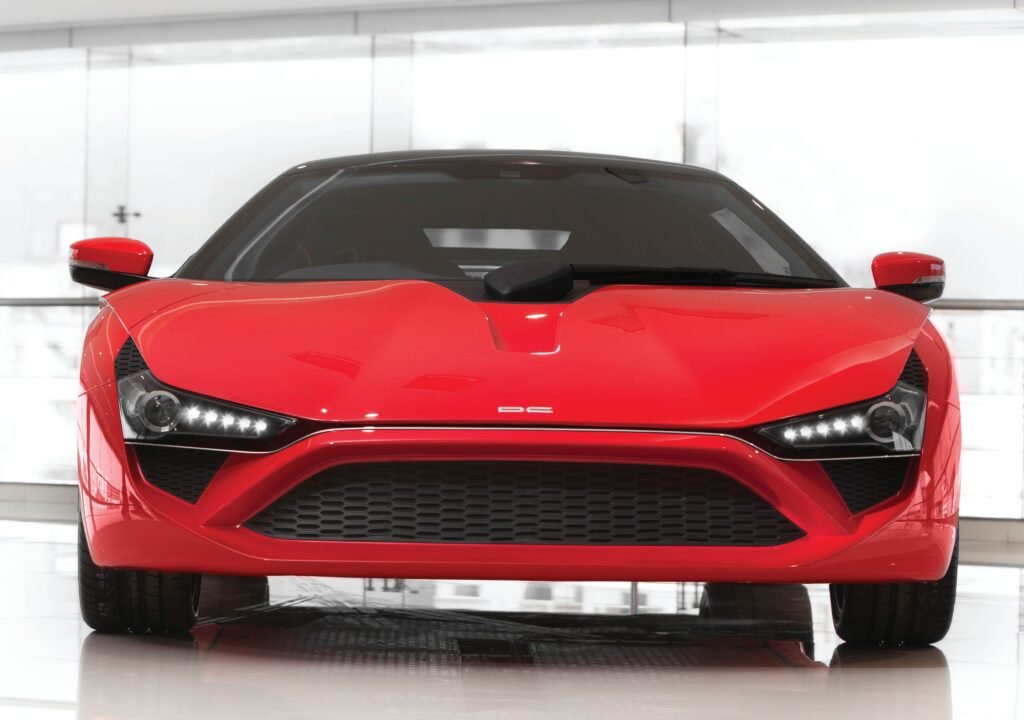
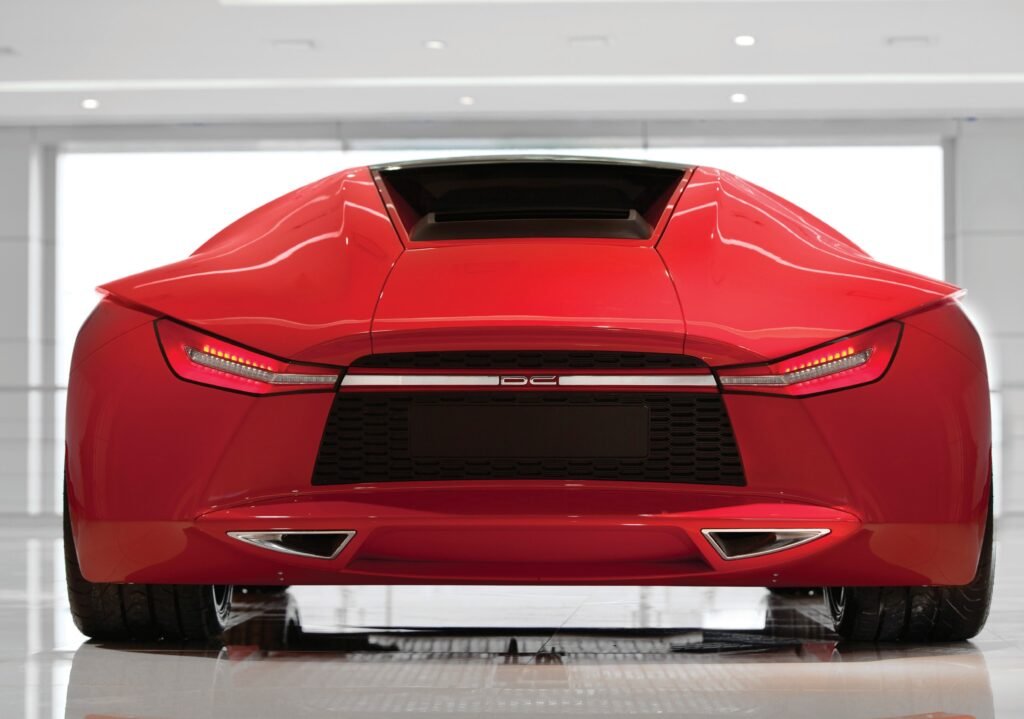
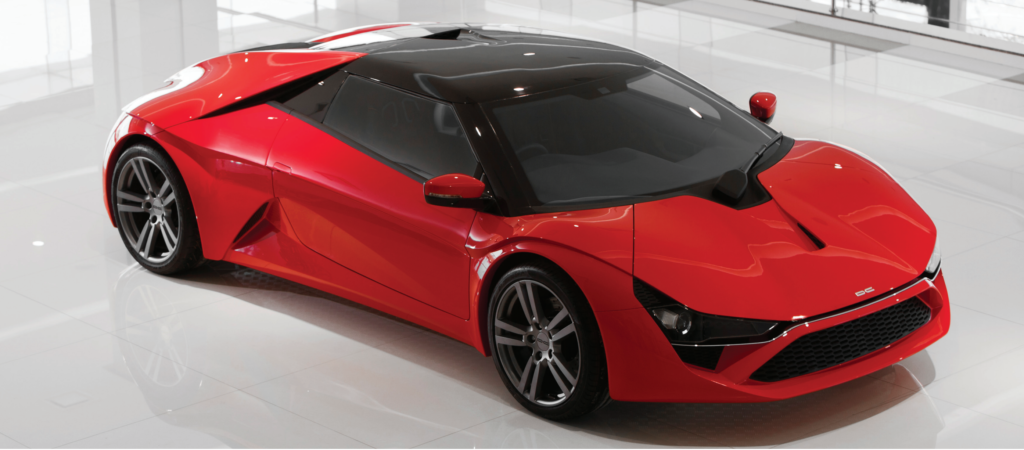
The 2012 Auto Expo held at New Delhi this January saw the unveiling of the first Indian “supercar”, the Avanti by DC Design. The name Avanti means ‘realm’ in Sanskrit, and ‘moving forward’ in Italian, evoking the memory of an auto icon with the same name built by Studebaker in the ’60s known for its beauty and style. Popularly known as DC, Dilip Chhabria, who is well known for the customisation of production vehicles, has entered the vehicle manufacturing segment with the Avanti. He has achieved this at a relatively low cost by developing and building it in India, thereby creating a new segment of buyers for a price tag of ₹30 lakh. A lower, wider and longer silhouette with the engine in the middle and two seats at the front, the exotic-looking red Avanti has a space-frame chassis providing structural rigidity and safety for the driver. When asked about the major factors that were taken into account while designing a sports car for the Indian road, DC’s response was, “We had to ensure that in spite of a larger passenger area and higher ground clearance, we still had to bring about the exotic and aggressive look and stance. It is my belief that a car is a global animal and there are no specific aspects for India other than a robust aircon and generous ground clearance.”
Currently, the Avanti is powered by 4-cylinder Ford EcoBoost 2.0 litre, DOHC, 16 valve engines—for their easy availability and cost effectiveness—generating 240 horsepower and 366 Nm of torque. Its other version, the V6 with 400 horsepower is in the works. It will be made available to the public and more variants will evolve from the Avanti. The power will run through a 6-speed manual or 6-speed PowerShift dual clutch transmission. It has four massive 330mm disc brakes at all corners grabbed by AP racing callipers, and automotive safety experts like Bosch lent a hand in developing ABS brake systems as well as the SRS airbag technology. The engine is already compliant with Euro 4 and 5 emission norms and with a slight change in engine-mapping characteristics, it can meet the upcoming Euro 6 legislation as well. The road test drives for the Avanti will start from 2013 and every car will be hand-assembled at the DC Design workshop at Pune, restricting production to around 300 units in the next two years (2013-2014). When asked which factors influenced him most when designing Avanti, DC’s response was that the distribution was 60 percent towards the development of form and 40 percent for function and the market. And, why not? With the Indian automobile market maturing at a fast pace, aesthetics, shape and form have become important to the consumer.
Avanti specifications
| Dimension | |
| Overall length | 4623 mm |
| Overall width | 1967 mm |
| Height | 1213 mm |
| Wheelbase | 2700 mm |
| Front track | 1680 mm |
| Rear track | 1660 mm |
| Ground clearance | 155mm |
| Kerb weight | 1562 kgs |
| Transmission | |
| MMT6 | 6 speed manual |
| Optional | Power shift 6 speed dual clutch |
| Tyres | |
| Front | 255/35 19”x8.5” J |
| Rear | 295/30 19”x11” J |
| Brakes | |
| Front | 330 mm ventilated discs |
| Rear | 330 mm ventilated discs |
| Engine | |
| Type | Inline 4 -direct injection & VVT – turbo charged |
| Capacity | 2000 cc |
| Maximum power | 240 bhp @ 5500 RPM |
| Maximum torque | 270 lb/ft @3500 rpm |
In modern times, design has penetrated beyond the shell and frame and seeped into the interior space of the automobile. DC, known for his custom-designed vehicles since the inception of DC Design in 1993, has carried this forward as the basis of his own practice. The functional aspect of automobiles, no longer limited to mobility, has been extended into the atmospherics and gadgetry of the contemporary living space of the car, carrying auto design into the realm of customisation.
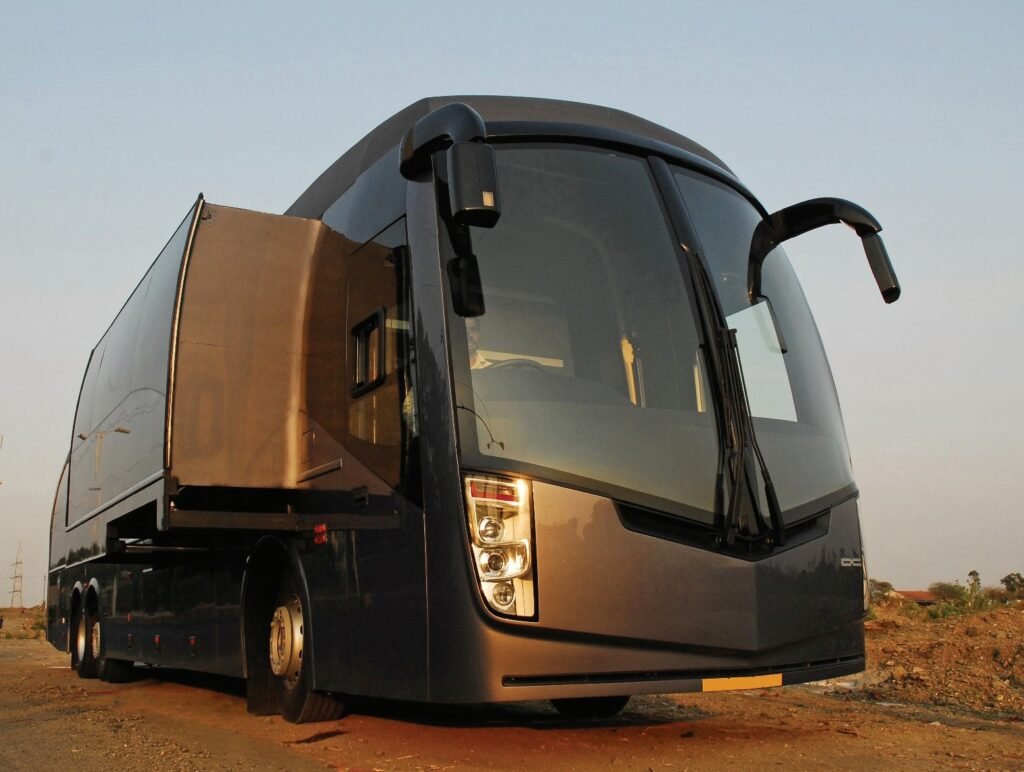
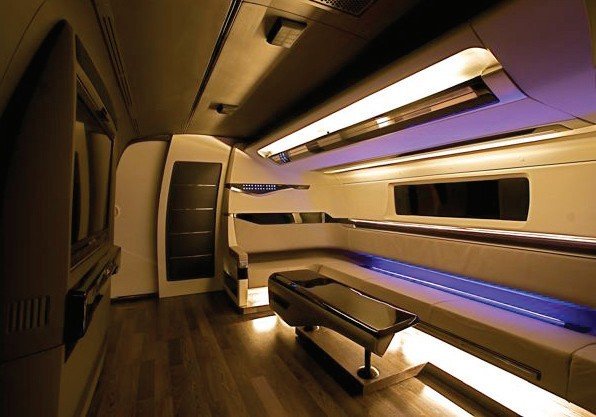
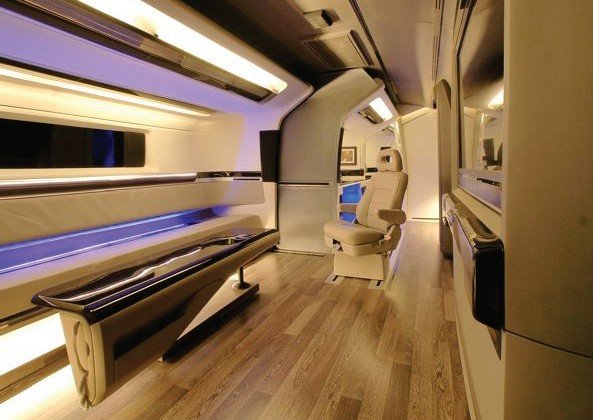
In 2009, DC designed a 14-metre long vanity van for actor Shah Rukh Khan and it took DC Design four months to build it, complete with a hydraulic system that enables the van to reduce in size while in motion, thus making it easier to navigate. It has five rooms inside, with a bar lounge, gym, office, bedroom and washroom with a shower. It is also fully automated with touch-screen switching. The latest offering by DC Design is the new modified version of the original Mahindra Thar. It poses as an off-road convertible with a removable targa roof and is a stylish six-seater with the dual functionality of a regular city car which can double up as a weekend getaway vehicle for mountains and safaris. Customisation of the interior and shell has been the foundation of DC Design’s methodology, in contrast to the conventional mode of practice in this field.
When a machine enters the human realm, emotional reactions often inspire design innovation. Designers not only take the functionality of the automobile into account but also the changing needs, tastes and desires of the consumer as an individual. Bio-design techniques are being used by automobile designers to mimic-engineer the shape and form of animals—not solely to engineer speed but rather to express individual personality. There was a time when inventors were equally concerned with function and form. With highly advanced engineering for automobiles, form has become the field that reflects the minutiae of the invisible engine even as it prefigures the future of custom-automobile design.
Leave a Reply